Chincoteague Ponies: DNA Analysis Lends Credence To Spanish Shipwreck Folklore

An abandoned Caribbean colony unearthed centuries after it had been forgotten and a case of mistaken identity in the archaeological record have conspired to rewrite the history of a barrier island off the Virginia and Maryland coasts.

These seemingly unrelated threads were woven together when Nicolas Delsol, a postdoctoral researcher at the Florida Museum of Natural History, set out to analyze ancient DNA recovered from cow bones found in archaeological sites. Delsol wanted to understand how cattle were domesticated in the Americas, and the genetic information preserved in centuries-old teeth held the answer. But they also held a surprise.

“It was a serendipitous finding,” he said. “I was sequencing mitochondrial DNA from fossil cow teeth for my Ph.D. and realized something was very different with one of the specimens when I analyzed the sequences.”

That's because the specimen in question, a fragment of an adult molar, wasn't a cow tooth at all but instead once belonged to a horse. According to a study published this Wednesday in the journal PLOS ONE, the DNA obtained from the tooth is also the oldest ever sequenced for a domesticated horse from the Americas.
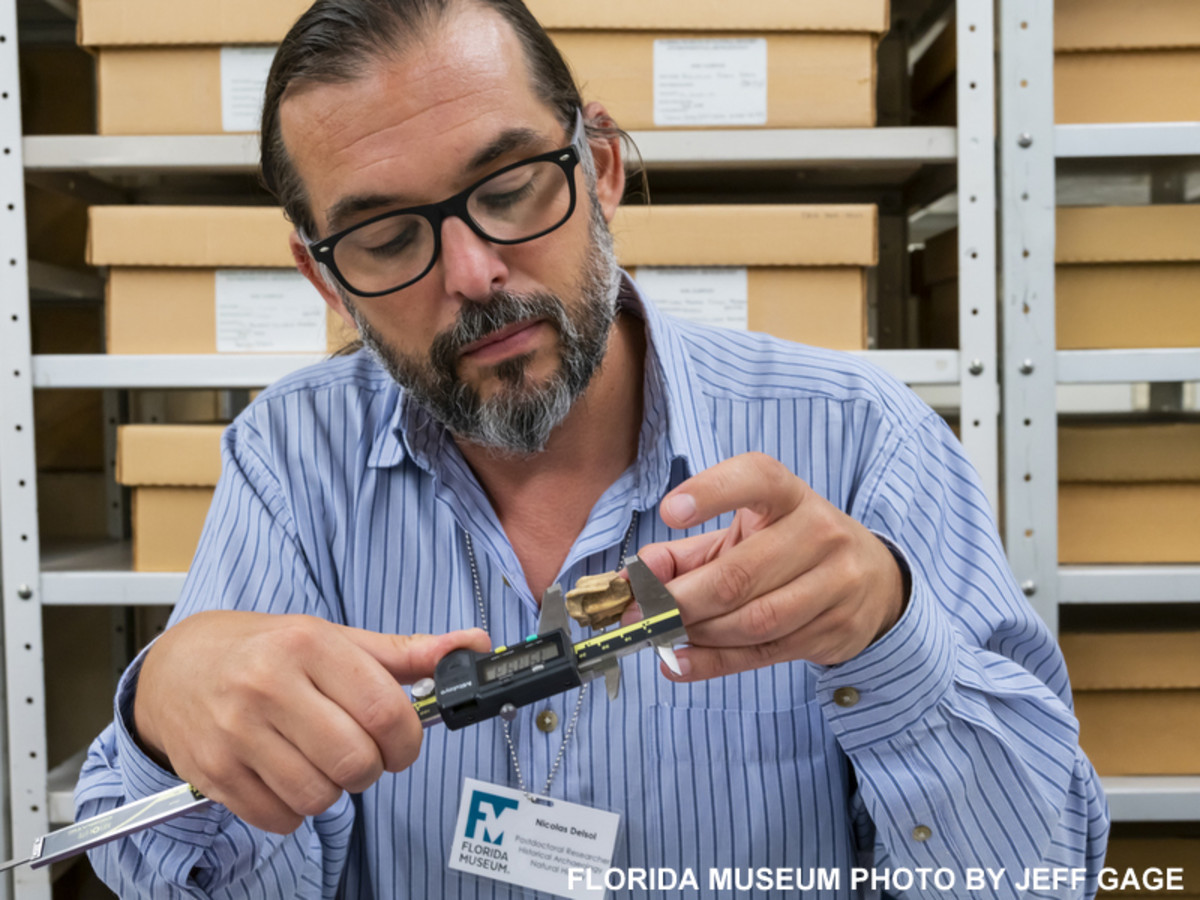
Nicolas Delsol was originally sequencing ancient DNA from cow teeth preserved in archaeological sites when he realized one of his specimens actually belonged to a horse.

The tooth was excavated from one of Spain's first colonized settlements. Located on the island of Hispaniola, the town of Puerto Real was established in 1507 and served for decades as the last port of call for ships sailing from the Caribbean. But rampant piracy and the rise of illegal trade in the 16th century forced the Spanish to consolidate their power elsewhere on the island, and in 1578, residents were ordered to evacuate Puerto Real. The abandoned town was destroyed the following year by Spanish officials.

The remnants of the once-bustling port were inadvertently rediscovered by a medical missionary named William Hodges in 1975. Archaeological excavations of the site led by Florida Museum distinguished research curator Kathleen Deagan were carried out between 1979 and 1990.

Horse fossils and associated artifacts are incredibly rare at Puerto Real and similar sites from the time period, but cow remains are a common find. According to Delsol, this skewed ratio is primarily due to the way Spanish colonialists valued their livestock.

“Horses were reserved for individuals of high status, and owning one was a sign of prestige,” he said. “There are full-page descriptions of horses in the documents that chronicle the arrival of [Hernán] Cortés in Mexico, demonstrating how important they were to the Spanish.”

In contrast, cows were used as a source of meat and leather, and their bones were regularly discarded in communal waste piles called middens. But one community's trash is an archaeologist's treasure, as the refuse from middens often confers the clearest glimpse into what people ate and how they lived.

The specimen's biggest surprise wasn't revealed until Delsol compared its DNA with that of modern horses from around the world. Given that the Spanish brought their horses from the Iberian Peninsula in southern Europe, he expected horses still living in that region would be the closest living relatives of the 500-year-old Puerto Real specimen.

Instead, Delsol found its next of kin over 1,000 miles north of Hispaniola, on the island of Assateague off the coast of Maryland and Virginia. Feral horses have roamed freely across the long stretch of barrier island for hundreds of years, but exactly how they got there has remained a mystery.

According to the National Park Service, which manages the northern half of Assateague, the likeliest explanation is that the horses were brought over in the 1600s by English colonists from the mainland in an attempt to evade livestock taxes and fencing laws. Others believe the feral herds descended from horses that survived the shipwreck of a Spanish galleon and swam to shore, a theory popularized in the 1947 children's novel “Misty of Chincoteague.” The book was later adapted to film, helping spread the shipwreck legend to an even wider audience.

Until now, there has been little evidence to support either theory. Proponents of the shipwreck theory claim it would be unlikely that English colonists would lose track of valuable livestock, while those in favor of an English origin of the herds point to the lack of sunken vessels nearby and the omission of feral horses in historical records of the region.

The results of the DNA analysis, however, unequivocally point to Spanish explorers as being the likeliest source of the horses on Assateague, Delsol explained: “It's not widely reported in the historical literature, but the Spanish were exploring this area of the mid-Atlantic pretty early on in the 16th century. The early colonial literature is often patchy and not completely thorough. Just because they don't mention the horses doesn't mean they weren't there.”

The feral herds on Assateague weren't the only horses to revert back to their wild heritage after arriving in the Americas. Colonists from all over Europe brought with them horses of various breeds and pedigrees, some of which bucked their bonds and escaped into the surrounding countryside.

Today, the U.S. Bureau of Land Management estimates there are roughly 86,000 wild horses across the country, most of which are located in western states, such as Nevada and Utah. Delsol hopes that future ancient DNA studies will help decode the complex history of equine introductions and migrations that occurred over the last several centuries and offer a clearer understanding of today's diversity of wild and domesticated horses.

The study was published in the journal PLOS ONE.

Jessica Oswald of the University of Nevada, Reno; Elizabeth Reitz of the Georgia Museum of Natural History; and Brian Stucky, Kitty Emery and Robert Guralnick of the Florida Museum of Natural History are also authors on the study.

Funding for the study was provided in part by the National Science Foundation (DDIG 1930628) and the Fulbright Program.

The post Chincoteague Ponies: DNA Analysis Lends Credence To Spanish Shipwreck Folklore appeared first on Horse Racing News | Paulick Report.

Source of original post

Champagne Next For Undefeated Isaac Shelby

The Sept. 10 G2 Champagne S. is next for the unbeaten Isaac Shelby (GB) (Night Of Thunder {Ire}), according to trainer Brian Meehan. Owned by the Manton Thoroughbreds VII partnership led by Sam Sangster, the chestnut won at Newbury on debut, and followed up in the July 9 G2 Superlative S. If the colt continues to progress, a crack at the G1 2000 Guineas is on the horizon next spring.

“We put him in the Champagne S. at Doncaster and that is probably likely to be his next spot,” said Meehan. “He has taken the race well. He has had a little break and we couldn't be happier with him.

“He was impressive in the way he battled like that. He wasn't going to stop. There is lots to look forward to and we are looking forward to the autumn.

“The plan is to definitely train him as a Guineas horse going forward. He is a colt with huge potential. Physically, you'd think there would be massive improvement to come, but he has plenty of time before Doncaster.”

The post Champagne Next For Undefeated Isaac Shelby appeared first on TDN | Thoroughbred Daily News | Horse Racing News, Results and Video | Thoroughbred Breeding and Auctions.

Source of original post

Texas Summer Yearling Sale Catalogue Released

Over 200 yearlings made the catalog for the 2022 Texas Summer Yearling Sale, presented by the Texas Thoroughbred Association and Lone Star Park. The sale will be held on Aug. 29 at the sales pavilion at Lone Star.

The catalog lists yearlings by Kentucky stallions such as Justify, Good Magic, Sharp Azteca, Mendelssohn, Bernardini, Practical Joke, Goldencents, Kantharos, Mitole, Vino Rosso and more. Texas stallions such as Too Much Bling, Bradester, My Golden Song and Competitive Edge are also represented.

The interactive catalog is available now at www.ttasales.com or on the Equineline IPad App.

The post Texas Summer Yearling Sale Catalogue Released appeared first on TDN | Thoroughbred Daily News | Horse Racing News, Results and Video | Thoroughbred Breeding and Auctions.

Source of original post

‘I Have Never Known A Horse Like Him’: World Number One Baaeed Makes It Look All Too Easy In Sussex

Baaeed cemented his position as the world's highest-rated racehorse with a dominant 1 3/4-length success in Wednesday's Group 1 Qatar Sussex Stakes, handing trainer William Haggas a first win in the mile highlight at Goodwood. The Sussex is a “Win and You're In” race for the Breeders' Cup Mile this fall at Keeneland.

Sent off the 1/6 favorite, Baaeed was shaken up by Jim Crowley to lead inside the final furlong and pulled away from Classic winner Modern Games (12/1) and last year's winner Alcohol Free (11/1) in authoritative fashion.

This success takes Baaeed's career record to a remarkable nine wins from nine starts and prize money earnings through the £2 million barrier. The 4-year-old is now set to step beyond a mile for the first time in next month's G1 Juddmonte International at York.

Haggas said: “I am relieved it's over. Baaeed is such a nice horse. It is a great occasion and I said to Sheikha Hissa beforehand that the only time I've been photographed as much was when I walked into the paddock at Meydan and shook hands with her father [Sheikh Hamdan Al Maktoum] and about 50 people took my photo. I can't tell you how sad it is for all of us that Sheikh Hamdan is not here to witness it. He did everything for days like this and he would have loved it.

“We had a little delay coming up here. It's quite complicated as the boxes are quite a way away at Goodwood so you can't walk up here. He was up here five minutes too late, but that's the way it is. He was a little bouncy. He is a 4-year-old colt and he knows it. Little things like being drawn next to Alcohol Free, the only filly in the race, does make you think, but actually once he gets going and once all the saddling is out of the way, he is a very professional horse.

“I am really looking forward to stepping up to 10 furlongs as I think he will enjoy it. When the entry [Prix de l'Arc de Triomphe] came up I said to Angus Gold [Shadwell Stud Racing Manager] that if he is a mile and a half horse, we are in trouble as he would have lost his speed. I don't think we need to go for the Arc. I think we'll go for the Champion Stakes or the QEII, depending on how he gets on at York.

“I said this to Jim in the paddock, we've got him for two more races after this so let's just enjoy him and make the most of him – because he will most likely go to stud at the end of the year and I'll spend the rest of my training career trying to find the next one.”

Sheikha Hissa Hamdan Al Maktoum, daughter of the late Hamdan Al Maktoum, said: “For me and my family, Baaeed means the world. He is a homebred and from the same family of Nashwan and the whole lineage. It's good to see one of our best horses coming from the family that my father worked so hard on.

“He is a pleasure to have. He loves to work in the morning and it's nice to see horses from a horse person's perspective that they enjoy their job. Whenever I'm here, I love to come and see the horses. I was very happy to be here. When I came yesterday, I thought Baaeed was going to like it and he did well in the Group Three here last year [Bonhams Thoroughbred Stakes].

“I am very excited to see him at York. After Royal Ascot we thought he was ready for a mile and a quarter. I am wearing a badge with my father on. He comes everywhere with me.”

Crowley said: “Baaeed just does what he has to. He is like his sire [Sea The Stars]. Just before the winning line, he pricked his ears and shut down with me. Baaeed is never going to be exuberant and win by 10 lengths, but the feeling I got off him between the three and the two-furlong pole, no horse can give you that feel.

“I have never known a horse like him before. In the winner's enclosure here, it's like he was out having a pick of grass in the morning. He's so relaxed. He has taken great strides and can do more than win the way he is doing it. I thought the most remarkable fact was that at Royal Ascot he ran the last two furlongs quicker than Nature Strip.

“He's got everything; a turn of foot, you can put him anywhere in a race; you can make the running, or you can drop him out. Good horses like that, they just tick all the boxes. It will be interesting up to a mile and a quarter next time – I am looking forward to it. I don't have any worries about him going 10 furlongs. I wouldn't have any worries if he went a mile-and-a-half, he's that type of horse. It's just a real pleasure to be part of him.

“I have ridden some lovely horses, I've been very lucky, but this is just on another level. The excitement and build-up before the race is great. It's funny, I'm not a great sleeper, but I always sleep well the night before riding him. I don't have any worries and he gives me confidence, and hopefully I give him some confidence as well.”

Charlie Appleby said of Modern Games: “He is like his father [Dubawi] – he goes down on his sword. Everyone said to me you've got your substitute, but he is no substitute – he has won a Breeders' Cup Juvenile and a French Guineas. I would like to have a few more substitutes like that!

“William has given him a great ride. We were in the box seat. The winner is a very good horse, and full plaudits to him. From our point of view, we are delighted.

“We have always worked back from the Breeders' Cup Mile, and that is going to be the plan. I don't think you will see him now – he will either go to Canada or Keeneland and then you will see him in Kentucky for the Breeders' Cup Mile.

“I hope he will stay in training. I feel that where we with the horses that we have to potentially retire to the farm, he deserves to stay on for another year and have another crack at it.”

William Buick said: “It was a race for second and Modern Games came second, so we are delighted. It is nice for him to come back to this form after his run over seven furlongs in the Jean Prat. He has plenty of talent. The winner did what we suspected. I did not see him until quite late. He is an exceptional horse, a fantastic horse, take nothing away from him.”

Alcohol Free's trainer Andrew Balding said: “Alcohol Free has run a marvelous race. I thought Rob Hornby did a beautiful job of getting her to settle.

“She was checked at a crucial stage, but she would not have got anywhere near the winner. However, despite losing some momentum, she has put her head down and stayed on right the way to the line. She has run a fantastic race and we are delighted with her.

“William Haggas couldn't believe how much she had developed as you sort of miss it when you see her every day. She has really developed into a fantastic looking racemare and we are thrilled with her.

“I am leaving future plans up to Jeff [Smith, owner]. We have entered her in everything over six furlongs up to a mile at Group One level. The filly will tell us to a certain extent, but anything is possible. It could be France, the Matron Stakes or the Haydock Sprint Cup. She owes us nothing, but she is thriving at the minute, but as soon as we think she has had enough, that will be that.”

Rob Hornby added: “We had to take our time and make sure Alcohol Free settled, which she did nicely. At the two and a half, I would have loved a nice clear run at things, but I had to check slightly, gather her up and go again. I was confident that I was grabbing third, but I might have given the second a race.”

The Qatar Sussex Stakes is part of the QIPCO British Champions Series.

3.35pm Qatar Sussex Stakes (Group 1) (British Champions Series)
1 Baaeed (Shadwell Estate Company Ltd) William Haggas 4-9-10 Jim Crowley 1/6F
2 Modern Games (Godolphin) Charlie Appleby 3-9-02 William Buick 12/1
3 Alcohol Free (Jeff Smith) Andrew Balding 4-9-07 Rob Hornby
7 ran

The post ‘I Have Never Known A Horse Like Him’: World Number One Baaeed Makes It Look All Too Easy In Sussex appeared first on Horse Racing News | Paulick Report.

Source of original post

Verified by MonsterInsights