Safe Poker Chip Cleaning: Tips For Keeping Your Poker Chips Clean

It’s traded hand to hand, shuffled from one side of the table to the next, and tossed back into the pot time and time again. It sees a lot of action, and represents everything that you bring to the table. Of course you’ve guessed it; I’m referring to the darling of the table, the poker chip.

Poker chips get handled, tossed and raked by everyone at the table. It’s at this time when poker chips tend to pick up not only body oils from the players hands and fingers, but also tiny bits of food and beverages always present at a poker game. After repeated exposure to these conditions, poker chips can begin to change in appearance. The buildup of oils and food particles which get deposited during play will turn any shiny poker chip turn into a grimy token no one wants to pick up.

If your poker chips are beginning to offend your senses, then it’s most definitely time to clean them. Just how you clean them comes down to personal preference, but there are a few general guidelines you can follow to keep your poker chips in pristine fashion, without damaging the chips. Please note that the following suggestions do not cover the cleaning of vintage poker chips. You are advised to seek out a qualified professional to clean vintage poker chips.

Although the choice in cleaning supplies seems limitless, when it comes to cleaning poker chips your choices are considerably narrowed down for you. In fact, there are three very import properties that your chosen poker chip cleanser must possess before it can be considered for use. To prevent damage to your poker chips, make your choice wisely.

When choosing the cleanser you intend to use, it’s important to remember the cleanser must pass the following three very crucial criteria:

Removes Grime Buildup. The cleanser should be able to remove the aforementioned body oils and food particles adequately.

Leaves Ink Intact. The last thing you want is to remove the ink from your poker chips while cleaning. Be sure the cleanser isn’t harsh enough to dissolve ink.

Leaves Poker Chips Hydrated. It may sound a little strange, but poker chips do need a certain level of moisture left in them, or they will become brittle. Avoid using agents such as rubbing alcohol, as it can remove ink and dry out your poker chips.

Some of the cleansers that veteran poker players use to clean their poker chips are mild hand dishwashing detergent, Sterling Magic and Armor All Multi-Purpose Cleaner. When using the Armor All, be sure you get the multi purpose cleaner and not the Armor All tire cleaner or other Armor All products as they will damage your poker chips. Another popular cleanser to use is called Quick’n’Brite. When used properly, all the above mentioned cleansers will clean your poker chips without any harmful side effects.

When cleaning poker chips, it’s best to use a very soft-bristled baby toothbrush, or a very soft cotton towel. Pay special attention to protecting the center design. Try keeping your thumb over the center of the poker chip while using the toothbrush around the outer edge.

Rinse the poker chips in a bowl of water and wipe them dry with a soft towel or terry cloth. After a good gentle cleaning, you can add extra shine by giving them a dip in baby oil to restore luster. As always, due diligence is required by testing your cleaning method on one poker chip to see if you get the desired results.

View From The Eighth Pole: The Price Of A Grade 1 Winner

So you want to go to a major yearling sale and buy a horse that your trainer can turn into a Grade 1 winner and boost its value (and your bank account) as a future stallion or broodmare prospect. How much cash should you stuff into your pockets on the way to the sale?

The question came up recently in a discussion with a veteran horse owner who has played both sides of the commercial market as buyer and seller. He watched Ireland's Coolmore associates try to dominate the top of the yearling market going back more than 20 years and has seen that same strategy carried out more recently by partnerships formed among individual entities who pool their significant resources.

The idea is to buy enough well-pedigreed yearlings to give yourself a chance to have one or two colts win Grade 1 races and pay for the whole lot through a stallion syndication deal or stand them at your own farm and reap the benefits of stud fees. Fillies that win Grade 1 races boost their broodmare prospect value significantly. For those playing the long game, adding a Grade 1-winning filly to a broodmare band can strengthen your racing stable or commercial breeding operation.

One group that was formed with this “critical mass” theory in mind is the 10-member partnership of SF Racing LLC, Starlight Racing, Madaket Stables LLC, Robert E. Masterson, Stonestreet Stables LLC, Jay A. Schoenfarber, Waves Edge Capital LLC, Catherine W. Donovan, Golconda Stable and Siena Farm LLC.

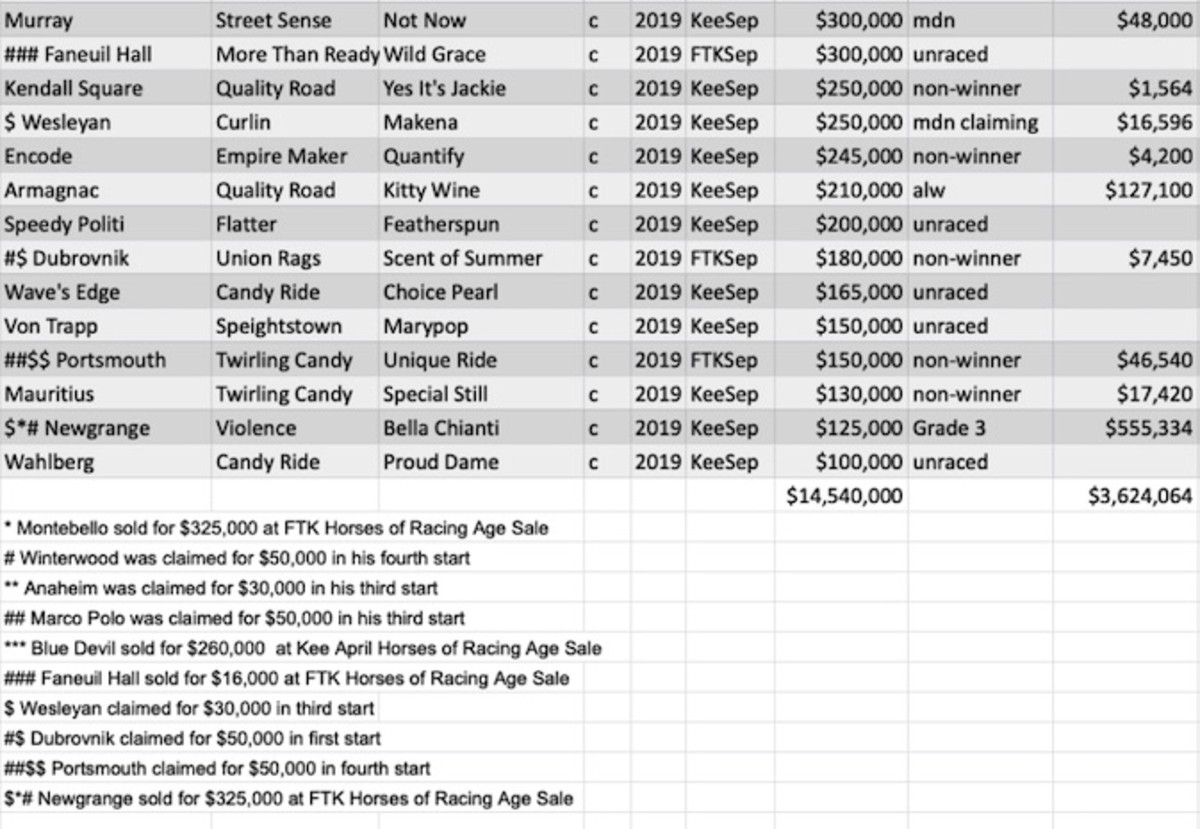
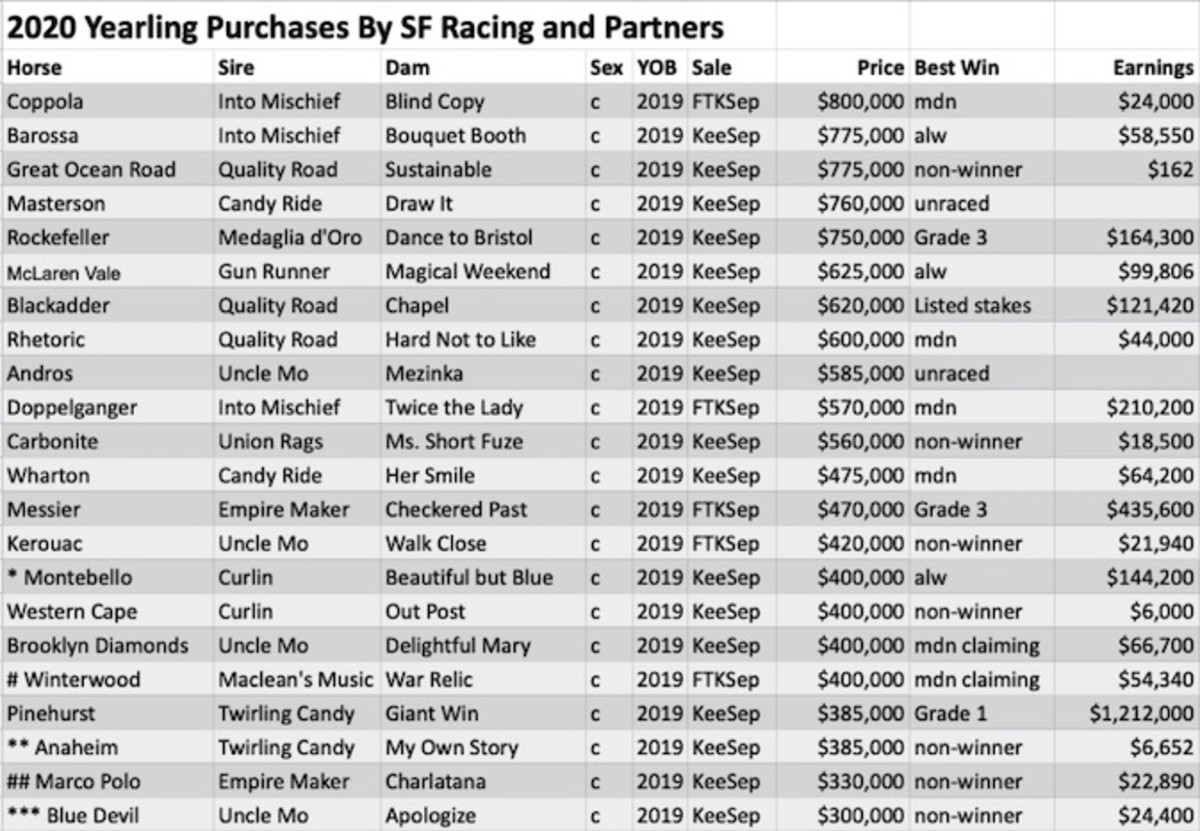
In 2020, according to records in Bloodhorse.com's auction database, SF Racing et al purchased 36 yearlings (all colts) for $14,540,000, an average price of $403,889 and a median of $400,000. Top price in the group was the $800,000 paid for an Into Mischief–Blind Copy colt named Coppola, who won his debut in a six-furlong maiden special weight race for 3-year-olds at Delaware Park July 13 for trainer Jonathan Thomas. Lowest price was the $100,000 paid for the Candy Ride–Proud Dame colt, Wahlberg, who currently is unraced.

Of the 36 yearlings, there are some successes, led by Grade 1 Del Mar Futurity winner Pinehurst, a $385,000 Keeneland September purchase who also won this year's Grade 3, $1.5 million Saudi Derby. Messier, Rockefeller and Newgrange are Grade 3 winners.

Newgrange was sold recently for $325,000 at the Fasig-Tipton Kentucky Horses of Racing Age Sale, one of four of the original 36 to be sold at public auction by the SF group. Another six were claimed from their stable in maiden claiming races.

Nineteen of the 36 yearling purchases have yet to win midway through their 3-year-old seasons, with seven of those 19 yet to start. The Triple Crown and most stallion-making races for 3-year-olds are in the rear-view mirror, but there are still some opportunities for one or more of these 2020 yearlings to become the proverbial home-run horse.

From a racetrack earnings standpoint, the group has won $3,624,064 to date from the original $14,540,000 investment. Keep in mind, however, it's stallion deals that will make or break this business model, not racetrack earnings.

Let's go back to the original question of this nerdy pursuit: What does it take to buy a Grade 1 winner?

Here is what I learned looking at 11 years of graded stakes results in the United States and Canada.

  • There were 260 individual Grade 1 winners from 2011-2021 who either were sold or bought back by consignors at major summer yearling sales in Kentucky and New York. This number does not include yearlings purchased for pinhooking purposes and reoffered for sale as 2-year-olds.
  • The average sale price of those 260 yearlings who subsequently became Grade 1 winners in the U.S. or Canada was $272,555. The median yearling price of the future Grade 1 winners was $200,000.
  • Five yearlings that sold for $1 million or more as yearlings won Grade 1 stakes from 2011-2021, led by Mendelssohn, who brought $3 million at the 2016 Keeneland September Yearling Sale. The others were Cambier Parc ($1,250,000), Tapwrit ($1,200,000), Malathaat ($1,050,000), Flightline ($1,000,000), and Good Magic ($1,000,000).
    For some perspective, at the Keeneland September Yearling Sale alone from 2008-2019, there were 151 million-dollar yearlings sold.
    Thirty-one of the 260 future Grade 1 winners sold for $500,000-$999,999.
  • At the other end of spectrum, there were 68 future Grade 1 winners that sold for less than $100,000. Of course the pool of horses selling for less than $100,000 is much larger than those selling for a half-million dollars or more.

The bargain of the decade was the Congaree filly Don't Tell Sophia, winner of the Grade 1 Spinster Stakes at Keeneland in 2014 and second to Untapable in that year's Breeders' Cup Distaff. Bred by Stonerside Stable and offered by Taylor Made Sales Agency at the 2009 Keeneland September Yearling Sale, Don't Tell Sophia was purchased by trainer Philip A. Sims for $1,000. She earned $1,382,479 on the racetrack, then was sold by consignor Spring Trace Farm to leading Japanese breeder Katsumi Yoshida for $1,200,000 in foal to Medaglia d'Oro at the 2015 Keeneland November Breeding Stock Sale.

Only someone with the wildest of imaginations could write up a business plan with a result like that.

That's my view from the eighth pole.


Note: Below is a listing of the SF Racing et al yearling purchases in 2020. Auction data from Bloodhorse.com and Equibase.com. Racing information from Equibase.com.


The post View From The Eighth Pole: The Price Of A Grade 1 Winner appeared first on Horse Racing News | Paulick Report.

Source of original post

Chub Wagon, Beren Among MATCH Series Competitors Solidifying Standings At Laurel Park

Several horses whose connections committed to the 2022 Mid-Atlantic Thoroughbred Championships (MATCH Series) early on solidified their positions with strong performances as Laurel Park hosted stakes in all four series divisions July 16.

Laurel Park launched the five-leg MATCH Series in April and hosted the third leg, which produced total pari-mutuel handle of just over $4 million for an 11-race Saturday card. Pennsylvania-bred runners accounted for two wins and one second in two of the stakes. The Pennsylvania Horse Breeders Association again is offering $5,000 bonuses to the top male and female state-bred runners by overall points.

The MATCH Series now moves to Colonial Downs Tuesday, Aug. 16, with the final leg scheduled for Monday, Oct. 3, at Parx Racing.

$100,000 Alma North Stakes

Daniel Lopez and George Chestnut's Pennsylvania homebred Chub Wagon continued her domination in non-graded Mid-Atlantic stakes with a powerful victory in the 6 1/2-furlong Alma North, run on a sloppy track after a mid-afternoon thunderstorm. It was the 12th victory in 13 starts for the 5-year-old mare by Hey Chub who has never finished worse than second.

With Silvestre Gonzalez aboard for trained Guadalupe Preciado, Chub Wagon rated in second behind Cheetara before taking over at the half-mile mark and pulling away to a three-length score as the heavy favorite. Kaylasaurus, who has started in the first three legs in her division, rallied from last to second, while Cheetara held for third. The time for the distance was 1:16.03, a little more than one second off the track record.

Chub Wagon made her 2022 debut June 27 in her prior start, an off-the-turf state-bred stakes at Parx Racing, where she is stabled.

“You're never overconfident going into a race especially when the track gets wet like today,” Preciado said. “All these horses today looked like speed. When you run with all these speed horses you see who has the speed. She's coming around very nicely. Hopefully she gets a little stronger.”

Chub Wagon picked up 10 points for the win in her first MATCH Series start of the year. Lopez indicated the mare will be pointed to the Satin and Lace Stakes at Presque Isle Downs & Casino Aug. 15. She never has raced on the Tapeta surface, but her performance could be a determining factor in whether she shoots for the Grade II $400,000 Presque Isle Downs Masters Stakes Sept. 19.

Kaylasaurus, owned by Bush Racing Stable, Liberty House Racing, Blackridge Stables and George Saufley, picked up 7 points for her second-place finish and remains the overall series leader with 22 points. The 6-year-old Pennsylvania-bred Munnings mare trained by Tim Kreiser is now poised to have an impact on the division and overall standings.

“I think she raced really well,” said David Bushey, who manages Bush Racing Stable. “We were concerned about the sloppy track, but she did well against Chub Wagon. As of now we're still thinking about going to Colonial and then finishing the series at Parx. It all depends on how she comes out of the race.”

$150,000 De Francis Memorial Dash

Beren, owned by St. Omer's Farm and co-breeder Christopher Feifarek, proved best after a three-way speed duel in the six-furlong De Francis Dash and took the division lead after two MATCH Series starts.

Beren, who has won eight of 18 starts with earnings in excess of $600,000, broke well under Frankie Pennington and was in front through a half-mile in :44.78 while in between Special Reserve and Wondrwherecraigis, both of which were coming into the race off layoffs. Despite the difficult position, the 4-year-old Pennsylvania-bred colt by Weigelia drew clear in the stretch to win by 2 3/4 lengths in 1:09.66. Wondrwherecraigis, a seven-time winner, was second, while Pickin' Time rallied for third.

“This was a very tough race today,” trainer Robert “Butch” Reid Jr. said. “He had a position between two speed horses but Frankie did a sensational job. I was watching it unfold and Frankie looked very confident.”

“He's a quick horse who breaks sharply, but the inside horse went for the lead,” Pennington said. “They were dueling down the stretch and I knew it would be a fight, but he ended up opening up the lead on them.”

Beren, who is based at Parx, now has 17 MATCH Series points after two starts and leads his division, which Reid noted appears to be wide open. The trainer said Beren will skip the Colonial leg to compete in a state-bred stakes on “Pennsylvania's Day at the Races” in late August, and then race in the final MATCH Series leg at Parx.

Pocket 3's Racing's Threes Over Deuces, trained by Gary Capuano, finished fifth but made his third series start and qualified for bonus money. He now has 10 points, which ties him for second with two horses that have made only one series start.

$100,000 Big Dreyfus Stakes

Merriebelle Stable's Bellagama, trained by Ignacio Correas IV, rallied from ninth and last to win the 1 1/8-mile Big Dreyfus on a turf course rated good after the heavy rain. Ridden by Vincent Cheminaud, who has been based in Kentucky, the 5-year-old mare bred in Argentina previously posted a second and two thirds in stakes company since her arrival in the United States.

“She ran the last time very good (at Hawthorne Race Course),” Cheminaud said. “The grass was a little soft for her, so I preferred to wait a little bit for a good finish.”

Bellagama covered the distance in 1:51.15. She won by 1 1/2 lengths over Deciding Vote, who was neck in front of In a Hurry in third.

Deciding Vote, bred and owned by William Pape, made her third MATCH Series start in the Big Dreyfus and rallied from well back under Angel Suarez, who has ridden the mare in her last three starts. Deciding Vote, trained by Edward Graham, picked up 7 points to give her a total of 20. She qualified for bonus money and remains the division leader with two legs remaining.

$100,000 Prince George's County Stakes

English Tavern hit the finish first after a stretch duel in the 1 1/8-mile Prince George's County, but after an inquiry and claim of foul was placed second by the stewards behind Eons, who was just to his outside a nose behind. The elevation to first gave Eons, who won the Bensalem Stakes at Parx in his first MATCH Series start this year, 20 points and the lead in the division.

English Tavern was placed second, while Pixelate was third. Eons, ridden by Jorge Ruiz for owner Mark Grier and trainer Arnaud Delacour, cleared the $500,000 mark in earning with the victory.

“He ran a great race, regardless of the outcome of the inquiry,” Delacour said. “I thought it wasn't an easy spot for anyone because we didn't know how to ride the race. There was not a lot of speed, and he's a pretty difficult horse to ride. I thought considering everything he ran great, and he's in good form, for sure.”

Eons last year won the 1 1/8-mile Buckland Stakes at Colonial, which this year is the fourth race in his MATCH Series division. The 6-year-old Giant's Causeway horse is the only horse this year with two victories in a division.

The MATCH Series originally debuted in 1997 and ran for five years. It returned with great success in 2018 and was held in 2019 and 2021. The innovative regional racing series—the only one of its kind in horse racing—combines rich stakes and bonuses for participating owners and trainers who compete over a five- to seven-month span. Horses competing in MATCH earn points based on participation and order of finish in each series race, and the leading point-earners in each of the series divisions, as well as the owner and trainer of the overall points leader, win lucrative bonuses.

The post Chub Wagon, Beren Among MATCH Series Competitors Solidifying Standings At Laurel Park appeared first on Horse Racing News | Paulick Report.

Source of original post
Verified by MonsterInsights