Ramey: Rationale For Treating Navicular Disease With Isoxsuprine Is Questionable

If you want to elicit fear in someone who owns a horse, tell that person that you think that his or her horse has “navicular.” The story of the horse's navicular bone is a curious and instructional tale that speaks to how diagnoses and therapies come into vogue, and how hard they can be to get rid of once they are in vogue. It's also about why you should ask a lot of questions if your horse gets diagnosed as one with “navicular disease.”

NOTE: This story is also a good illustration of why you should be careful before you jump into the latest new treatment boat. Today's treatment that nobody uses anymore is often yesterday's “cutting edge” therapy. The list is long, and every year – sometimes every few weeks – there's another one for horse owners to buy.

But this story starts with the horse's navicular bone. People have recognized that the horse's navicular bone can give some horses all sorts of problems for centuries.* And it was, and has pretty much always been, a very bad disease, because once the horse's navicular bone is shot, you can't fix it. (I wrote a book on navicular disease – you can see it if you CLICK HERE. It's needs to be updated just a little – another project – but it's still pretty good, even if I do say so myself).

It's a truism that when horse's have problems, veterinarians (and many other folks) want to make horses better. So, in the 20th century, people started to really look closely at navicular bones, to try to figure out what caused the problem, and to see if it could be prevented, or treated. They dissected navicular bones, they X-rayed navicular bones, and they advanced theories about what caused navicular bones to go bad.

They kept very busy.

One of the first things that they noticed was that, when you took X-rays of the navicular bone, the bones of some horses looked like they had holes in them. Some of the horses had more holes than others. And so it was determined that holes (also given descriptive names like “lollipops” or “channels”) were bad, and that a lack of holes was good. And, importantly, it was easy.

VOICEOVER: … and, yea, verily, so it was that holes in the navicular bone became diagnostic for “problems,” (not only now, but in the future, too).

It was also determined that if you shot a bit of anesthetic over the nerves that run down the back of the horse's pastern (the palmar digital nerves), you could make many horses that were limping go sound. Horses limp because something hurts – make the spot that hurts numb and, voilà, the horse goes sound. Branches of the nerves on the back of the pastern run right on down to the navicular bone. So, in the 1980's, if you had a limping horse, and he stopped limping once you shot some anesthetic over his nerves, and he had some holes in his X-rays, he was probably diagnosed as being “navicular.”

VOICEOVER: … and yea, verily, so it was that a simple nerve block became “diagnostic” for navicular disease.

It was very clean and easy. But alas, it was not to last.

Somewhere towards the end of the 1970s, a British veterinarian by the name of Dr. Chris Colles came up with a theory. He asserted that disease of the navicular bone was caused by a lack of blood to the navicular bone – he said that little clots in the arteries that go to the bone caused the bone to die, and deteriorate (the process is called ischemic necrosis). Thus, in his view, the possible cure for disease of the navicular bone was to get the blood flowing.

Thus armed with a plausible theory – and even a study or two – Dr. Colles (who, as far as I remember, was a great guy) got people going on treating “navicular” horses with rat poison. Not rat poison like you'd buy at the home improvement store, but warfarin, a drug that gets in the way of the blood's clotting process (the same drug has been used for decades used to treat humans who have had a stroke, although newer drugs are taking its place). Amazingly, many horses that became sound with an anesthetic block, and had some holes in their X-rays, got better after getting warfarin.

And all was good. I mean, how easy could it be? Block a couple of nerves, shoot a couple of X-rays, give a medicine, the horse gets better… AMAZING!

VOICEOVER: … and, yea, verily, navicular disease became a problem with blood circulation that was treated with blood thinners.

Well, sort of good. The problem with giving a poison to a horse is that, well, it poisons them. Warfarin kills rats because it makes them bleed to death internally. So horses that got warfarin had to be closely monitored to make sure that their blood still clotted, which was important, but something of a pain. And that became a bit of a problem.

THREE TRUISMS ABOUT MEDICAL TREATMENTS:

1) Treatments that are a pain are less likely to be administered than treatments that aren't a pain.

2) Otherwise stated, when it comes to treatments, the easier it is to do something, the better.

3) Nobody likes treatments that have really nasty side effects.

So, in the early 1980's, thinking that the blood supply was the key to navicular disease, and being acutely aware that administering warfarin was a pain in the backside, other British investigators proposed the use of isoxsuprine for the treatment of navicular disease. And they concluded that the drug was very effective, and that it made horses that they had diagnosed with navicular disease (whether they had it or not) go sound, and stay sound. Isoxsuprine was pretty cheap, and very safe, and could be given in pill format. It wasn't a pain. And, even better, there was one small study that supported it's use!

And all was good (again).

VOICEOVER: … and yea, verily, isoxsuprine became the treatment of choice for navicular disease.

And then things got messy.

In the mid-1980's, a study was done where a pile of X-rays was thrown on a table (almost literally). Some of the horses had been diagnosed with navicular disease, and others were normal. Veterinarians were asked to look at the X-rays, and decide which ones belonged to the lame horses, and which ones belonged to the sound horses. And they couldn't. Then additional studies came along, showing that there was tremendous variation in the appearance of navicular bones of normal horses. Normal horses had all sorts of holes, channels, whatever.

Then, even more studies came along – including one I did in 1994 – that showed that you couldn't predict if a horse would become lame based on the appearance of his navicular bone X-rays. And later studies involving CT scanning showed that navicular bone X-rays don't provide a particularly good picture of the navicular bone anyway. All of a sudden, we, as a veterinary profession, went from being very confident in saying that a horse had – or was going to get – navicular disease, based on his X-rays, to realizing that we probably didn't know very much after all (or, at least some of us went to that spot).

But then it got worse.

People started looking at what we were doing when we put anesthetic over the nerves that ran down the back of the pastern. Turns out, veterinarians weren't just making the navicular bone numb, they were blocking most of the foot. And there a whole bunch of things inside the horse's foot that can get injured. Turns out that many of those horses that had holes in the navicular bone on X-rays, that also went sound after a nerve block, did not also have navicular disease.

And, believe it or not, it got even worse. Folks that were looking for the cause of navicular disease kept looking, they did dissections of navicular bones, and they found out that there was no evidence that navicular disease was caused by a lack of blood supply to the navicular bone. Diseased navicular bones didn't look like bones that lose their blood supply. In fact, diseased navicular bone look at lot like joints that have osteoarthritis. So, the underlying rationale for prescribing things like warfarin, or isoxsuprine, turned out to be wrong all along.

And, believe it or not, it still got worse.

People then started looking at isoxsuprine. It turns out that when you give a horse isoxsuprine pills, only 2.2 percent of it is actually available to the horse, and most of that gets taken out of the system right away by the horse's liver. Studies in horses showed that there weren't any effects on the horse's cardiovascular system following oral administration. Another study showed that it didn't have any pain-relieving effects, either. All of which indicated – to people that were paying attention anyway – that the rationale for the use of isoxsuprine for the treatment of navicular syndrome (or laminitis, another popular condition for which isoxsuprine has been advocated) – is, to be very, very kind, questionable.

So, whereas previously, navicular disease was something that was pretty easy to diagnose and treat, all of a sudden, pretty much everything that veterinarian's thought they knew turned out to be wrong. After about fifty years, we've at least figured THAT out.

Unfortunately, people tend to have long memories. So, even today, horses get quickly diagnosed with navicular disease, based on a simple series of steps, and they get treated with a drug that's almost certain not to work. There are new drugs, too – and there's good reason to believe that they don't do much, either. But the kicker is: the horses still get better. Of course – and you know this, having read this far – the reason that some of these horses get better is they didn't have the problem in the first place. They got better in spite of their treatment, not because of it. The problem still persists in the prepurchase arena, too, where good sound horses can get condemned for having “pre-navicular” or “navicular changes” when, in fact, there's no evidence that these horses have – or will have – any problem at all.

So, look, if your horse gets diagnosed with navicular disease, or if your horse gets rejected on a prepurchase exam, don't necessarily despair. Make sure that it's a diagnosis that's arrived at carefully. Make sure that your horse gets plenty of time off to allow other things in his foot to heal; a good number of problems related to the foot will heal with time (and may be assisted by good shoeing). And forget about the isoxsuprine, because it almost certainly can't work.

And try to forget all that other stuff, too. Except….

Now there are new treatments for navicular disease (CLICK HERE to read about them). They're being doled out like candy. They're the latest. We'll see how that goes, I guess. If history is any example, memories will likely persist, at least until the next new opportunity to make one comes along.

Dr. David Ramey is a vocal advocate for the application of science to medicine, and—as such—for the welfare of the horse. Thus, he has been a frequent critic of practices that lack good science, such as the diverse therapies collectively known as “alternative” medicine, needless nutritional supplementation, or conventional therapies that lack scientific support.

This article original appeared on Dr. Ramey's website, doctorramey.com and is reprinted here with permission.

The post Ramey: Rationale For Treating Navicular Disease With Isoxsuprine Is Questionable appeared first on Horse Racing News | Paulick Report.
Source of original post

Seven Days: A Coronation in Chantilly

Just when you thought a fully-charged Royal Ascot couldn't be topped, along came Hollie Doyle. 

The royal meeting was sadly missing The Queen for all five days this year but, France's republican tendencies aside, there are few in the racing world who would deny that Doyle is now the queen of Chantilly after reaching yet another milestone to become the first woman to ride a Group 1 Classic winner in Europe.

Her great triumph came aboard Nashwa (GB) (Frankel {GB}) for Imad Al Sagar, who was achieving an important landmark victory of his own with his first homebred Classic winner for his Blue Diamond Stud. It is now not even remarkable to see Doyle booked for top rides. She's so good at what she does, proving it day in and day out, from Group 1 showcase races to Class 6 handicaps, but there are not many of those top-class horses to go around.

For this observer, it was a punch-the-air moment when Doyle was announced as first jockey for Al Sagar three seasons ago. It felt important that a woman should be given a prominent retainership in the first place, and more symbolic that this offer was made by an Arab owner. It was an inspired and refreshing move on Al Sagar's part, and a thoroughly deserving position for Doyle. If she hadn't already, she has certainly repaid his faith in her now.

Doyle is five wins clear at the head of the jockeys' table for this calendar year. The nonsensical shortening of the jockeys' championship from the Guineas meeting to Champions Day means that a number of those 85 wins don't count, so she lies in fourth place in the 'championship', if we can call it that. Given the unwelcome publicity surrounding Oisin Murphy's behaviour and the conclusion to last year's jockeys' title, we could do with some better news in that regard, and one story that would guarantee more front-page, good-news headlines for racing would be the first female champion jockey. Doyle will get there one day, no doubt.

Al Sagar, as a breeder who has recently undertaken a significant restructuring of his two farms near Newmarket that comprise his Blue Diamond Stud operation, now finds himself in the happy position that his paddocks contain the dams of both female French Classic winners this season. As already noted in these pages, he bought Zotilla (Ire) (Zamindar), the dam of G1 Poule d'Essai des Pouliches winner Mangoustine (Fr) (Dark Angel {Ire}), later in the year that her future Classic heroine was foaled. Nashwa's dam Princess Loulou (Ire) (Pivotal {GB}) was bought as a yearling. 

Frankel's Classic Touch

Nashwa was of course only the second Group 1 winner of the week for her sire Frankel and trainers John and Thady Gosden, who also had last year's leading 2-year-old filly Inspiral (GB) primed to perfection for her return in the G1 Coronation S., which was arguably the race at Ascot with the greatest depth.

Her victory was vengeance for her dam Starscope (GB) (Selkirk), who had been second in both the Coronation and the 1,000 Guineas of 2012, and Inspiral, who was the fourth generation of her family to have been bred by Cheveley Park Stud, became their fourth Coronation S. winner after Exclusive (GB), Russian Rhythm and Nannina (GB). The Thompson family's operation also enjoyed some reflected glory at Ascot as the breeder of surprise Chesham S. winner Holloway Boy (GB) and Buckingham Palace S winner Inver Park (GB), whose victories would have been all the sweeter for the fact that they are by one of the stud's resident sires, Ulysses (Ire), and the late former star of the stallion yard, Pivotal (GB).

Frankel still has some way to go to peg back Dubawi (Ire) if he is to retain his champion sire title this year, but the season is not even halfway through yet. One of the notable absentees on the quick ground at Ascot was his daughter Homeless Songs (Ire), the sensational winner of the Irish 1,000 Guineas. An eventual clash with Inspiral would be a mouth-watering prospect but, even without the filly, Moyglare Stud's 60th anniversary year continued in fine style with victory in the Gold Cup for another homebred, Kyprios (Ire) (Galileo {Ire}), the rising star of the staying ranks. Never was a mare better named than his dam Polished Gem (Ire) (Danehill Dancer {Ire}), who has produced three Group 1 winners among her eight stakes winners. 

Frankel also featured as the damsire of the G3 Jersey S. winner Noble Truth (Fr), who is a son of his stud mate Kingman (GB).  It was a second major international winner for the family in less than a month as Noble Truth was bred by Jean-Pierre-Joseph Dubois from Speralita (Fr), an unraced sister of the six-time Group/Grade 1 winner Stacelita (Fr) (Monsun {Ger}), who took the Prix de Diane 13 years ago. As a broodmare Stacelita has plied her trade in Japan for Teruya Yoshida with great success, providing Frankel with his first Classic winner anywhere in the world when their daughter Soul Stirring (Jpn) won the GI Yushun Himba (Japanese Oaks).

There has been further notable success for the Japanese wing of the family this season with Stars On Earth (Jpn) (Duramente {Jpn}), who is a grand-daughter of Stacelita and won the GI Oka Sho (1,000 Guineas) on April 22 followed by the Yushun Himba on May 22. Her dam Southern Stars (Smart Strike) has a colt foal catalogued for the foal section of the JHRA Select Sale, which takes place on July 11 and 12.

Dubawi Wears the Crown

With five winners, including a one-two in the G1 Platinum Jubilee S. with Naval Crown (GB) and Creative Force (Ire), Dubawi owns all the bragging rights among the sires represented at Royal Ascot. In fact, he is presently lording it over all-comers in Europe by just about every metric with 24 stakes winners led by four individual Group 1 winners this year.

One of the latter, Coroebus (Ire), followed up his 2,000 Guineas victory with a G1 St James's Palace S. success, to cement a memorable opening day for the Maktoum family following the procession of the unbeaten Baaeed (GB) (Sea The Stars {Ire}) in the G1 Queen Anne S.

Dubawi's son New Bay (GB) also deserves plenty of plaudits with two group winners at the meeting. His daughter Saffron Beach (Ire) returned to the winner's enclosure in imperious fashion in the G2 Duke of Cambridge S., while her stable-mate Claymore (Ire) landed his first group-race strike in the G3 Hampton Court S. We'll be hearing more about their trainer Jane Chapple-Hyam's love of New Bay in Wednesday's TDN.

And let's not forget Dubawi's French-based son Zarak (Fr), who continues to make giant strides in the second-season sires' table. It has to be said that he looks the stand-out of this intake at this stage, with La Parisienne (Fr) going close to giving him a first-crop Classic winner in the Prix de Diane when running Nashwa to a neck. 

Admittedly Churchill was first off the mark in that regard with the very impressive Prix du Jockey Club winner Vadeni (Fr), and it was exciting to hear that this Aga Khan-bred colt is under consideration to be supplemented for the G1 Coral-Eclipse next month. But Zarak leads the way with five black-type winners, which equates to 11 per cent of his runners, and he also had Times Square (Fr) placed in the G1 Poule d'Essai des Pouliches.

On With The Show

The sole appearance of Showcasing (GB) at Royal Ascot ended in ignominious defeat when he trailed in last of the 24 runners for the G1 Golden Jubilee S. But he has fared much better as a sire, notably with two G1 Commonwealth Cup winners in Quiet Reflection (GB) and Advertise (GB), while Soldier's Call (GB) won the Windsor Castle S. of 2018, and Tasleet (GB) and Cappella Sansevero (GB) finished runner-up in the G1 Diamond Jubilee S. and G2 Coventry S. respectively.

Showcasing was represented again this year by the smart G2 Queen Mary S. winner Dramatised (Ire), who provided a first major homebred success for Steve Parkin's Branton Court Stud. By that stage, the aforementioned Shadwell stallion Tasleet, whose first crop are now juveniles, was given a major boost by the G2 Coventry S. win of his son Bradsell (GB), who was sold as a breezer by Mark Grant to Tom Biggs and Archie Watson for £47,000, and presumably for many multiples of that after scorching to his nine-length maiden win on York's Knavesmire exactly a month after his appearance at Goffs UK.

Bradsell, bred by Deborah O'Brien, was one of two runners at Royal Ascot for the Bahrain-based Victorious Racing, the other being the Windsor Castle S. runner-up Rocket Rodney (GB) (Dandy Man {Ire}). He too had been purchased after an impressive novice win, this time at Goodwood for George Scott.

Whitsbury Manor Stud, which has stood Showcasing for his entire 12-season stud career to date, will have taken plenty of encouragement from the results of the royal meeting. Not only did they breed Tasleet before selling him to Sheikh Hamdan, but another of their own young sires featured prominently among the juvenile races. 

Havana Grey (GB) is currently romping away with 18 winners from his first crop and is seven clear of his nearest pursuer in that category, Sioux Nation. Though he is yet to join Tasleet and James Garfield (Ire) with a stakes winner, Havana Grey does have four black-type horses to his name, with Maylandsea (GB) having finished second in Queen Mary and Eddie's Boy (GB) third in the Windsor Castle.

There was further success for Showcasing at Chantilly on Sunday where Nurlan Bizakov's Sumbe homebred Belbek (Fr) landed the G3 Prix du Bois.

An Ascot for Everyone

As much as Royal Ascot represents some of the elite of European racing, the addition of handicaps in the first year of Covid has increased the potential for participation for owners and trainers, and the results reflected a broad spectrum of yards of all sizes.

George Boughey has been the up-and-coming name for the last couple of seasons and, with a Classic winner under his belt, he can now be considered to have truly arrived. His string is far from small on Newmarket Heath these days and he once again illustrated how adept he is in getting a great tune out of horses bought in training, usually in tandem with his great friend and ally Sam Haggas of Hurworth Bloodstock. Together they bought the Golden Gates H. winner Missed The Cut (Quality Road) for 40,000gns in February and, now with three wins from four runs under his belt, the 3-year-old looks a promising individual who had been an expensive foal purchase for Shadwell in America. 

Similar comments apply to Inver Park (GB) (Pivotal {GB}), who was already a decent dual winner for Mick Quinn when sold last October at Goffs UK for £35,000. He too has found a winning groove this spring, with his Buckingham Palace S. win being his third on the bounce. 

While Hollie Doyle is usually riding against her husband Tom Marquand, Hayley Turner is in the more agreeable position of riding for her partner Harry Eustace, the second-season trainer who bagged a Royal Ascot winner with his first ever runner at the meeting. Hopefully the much celebrated success of Latin Lover (Ire) (Starspangledbanner {Aus}) in the Palace of Holyroodhouse H. will put Eustace's name on the radar of more owners as he is currently enjoying a fantastic season on a strike-rate of 24 per cent winners to runners. 

It's true then. The louder you shout the faster they run. Latin Lover wins the last at Ascot on Day 4. #scenes pic.twitter.com/6bCiDsj3wj

— Harry Eustace (@H_Eustace) June 18, 2022

Huge credit must also go to Dave Evans for brining Rohaan (GB) (Mayson {GB}) back to Ascot in great shape to claim his second successive Wokingham S.

It was pleasing to hear the 4-year-old's co-owner Chris Kiely get his priorities right when saying after the race, “I've had two kids and got married, but this is the best moment of my life.” Let's just hope his wife and children weren't listening in.

Jane Chapple-Hyam put all her fellow trainers in the shade, however, when bringing three horses to the royal meeting and waltzing home with two group wins and a runner-up in the Royal Hunt Cup. As already mentioned, we will be reflecting more on the success of her Abington Place stable tomorrow.

A Royal Nod For Tattersalls

There's always plenty to take in during Ascot week so you may have missed the announcement of a small adjustment to the Tattersalls December Mare Sale. The four-day auction which follows hard on the heels of a day of yearlings and four days of foal sales at Park Paddocks will now feature a specifically labelled 'Sceptre Session' which takes its name from the star filly of the early 1900s and a former Tattersalls sale record-breaker.

To a degree, the Tuesday evening of the mare sale, when this select session of high-class broodmares and breeding prospects is set to take place, is already one of the high points in the sales calendar when it comes to drama. Quite frankly, if you're a bloodstock aficionado and you weren't playing your part in the mass game of Sardines in the Tatts ring when the likes of Dancing Rain (Ire) and Marsha (Ire) sold for millions, then where were you? 

Having up to 75 of the highest-profile offerings clearly labelled in one select session within a session makes a lot of sense, though it will make for an even more fraught couple of hours than usual for the weary bloodstock journalists on the hunt for quotes. A timely reminder to start getting into training for the sales season.

The post Seven Days: A Coronation in Chantilly appeared first on TDN | Thoroughbred Daily News | Horse Racing News, Results and Video | Thoroughbred Breeding and Auctions.

Source of original post

First-Crop Yearling Previews: Catalina Cruiser

The 2022 class of first-crop yearling sires features a diverse batch of Kentucky-based young stallions, including a pair of Breeders' Cup champions, two sons of reigning top sire Into Mischief, five graded stakes winners at two and five Grade I winners on turf. Throughout the course of the yearling sales season, we will feature a series of freshman sires as their first crop points toward the sales ring.

David Ingordo has followed Catalina Cruiser (Union Rags–Sea Gull, by Mineshaft) throughout his career, but the Lane's End bloodstock agent said that this year, the multiple graded stakes-winning stallion has never looked better.

Catalina Cruiser has always been a big, well-grown horse,” Ingordo said. “I've seen him from when he was a yearling at Lane's End through his time at Mayberry Farm and with John Sadler and to coming back here to our stallion barn. When he retired, he just filled out even more. He's one of the most magnificent individuals you're going to find that's big and strong and has the body to go with his race record and substance.”

With a debut stud fee of $20,000, Catalina Cruiser bred 148 mares in his first year at Lane's End. After the stallion's first foals arrived, Ingordo said it has never been a challenge to guess their sire. The group includes plenty of good-sized, flashy chestnuts.

Catalina Cruiser is stamping his offspring to look like himself,” he said. “They're flashy, they're big and they're strong. They have this precocious look to them. I'm a balance fanatic and the Catalina Cruisers that I have observed have great balance. He has a tremendous hindquarter, hip and great width behind and all his offspring do as well.”

In his second and third year at stud, Catalina Cruiser stood for a fee of $15,000. One of the greatest compliments a young sire can receive, according to Ingordo, is to have a mare return to him after their first mating. Such has been the case with this stallion, he said.

Bred by W.S. Farish, Catalina Cruiser was a $370,000 Keeneland September yearling. His debut win at three for Hronis Racing was followed by three straight wins as a 4-year-old, including the GII San Diego H. and GII Pat O'Brien S. Returning at five, the Sadler pupil shipped to Belmont to take the GII True North S. at six and a half furlongs in stakes-record time before going back home to California to claim repeat titles in the San Diego H. and Pat O'Brien.

Ingordo said he is often asked why Catalina Cruiser did not debut until October of his sophomore year.

“When he left Mayberry Farm, we knew he had a ton of talent, but that his mind was way ahead of his body,” he recalled. “He was this big, gangly horse and he wanted to do it, but his body wasn't ready for it yet. We gave him all the time to be the best horse he could be. When he came together as a 3-year-old, he never really looked back.”

Despite the five-time graded stakes winner's late start, Ingordo said he does not believe the same will be said of Catalina Cruiser's offspring.

“I look for them to be precocious,” he explained. “I see these 'Cruiser' babies as a little bit better versions of their sire because I think they're maybe a little bit less growthy than he was. I can see them running at two and I can see him having a 2-year-old champion.”

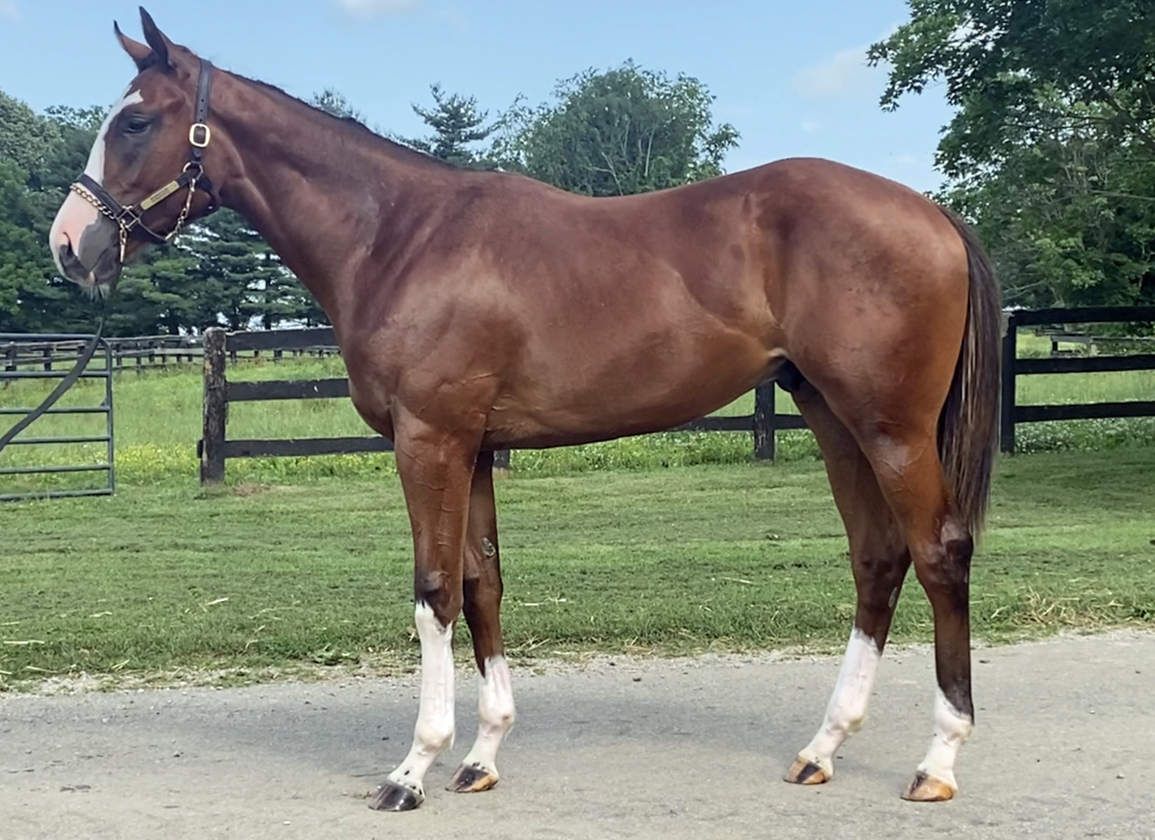
Catalina Cruiser colt out of She's Trouble sells as Hip 39 at the Fasig-Tipton July Sale

“I don't think they'll be limited to sprinting,” he added. “I think they'll be able to go two turns and ultimately be a Classic horse, like Catalina Cruiser's sire Union Rags and his broodmare sire Mineshaft.”

Catalina Cruiser sent 47 first-crop weanlings and short yearlings through the auction ring. Headlined by a $200,000 colt at the Keeneland November Sale, 37 sold to average $66,027 and rank their sire among the top five first-year sires in North American by weanling average.

The son of Union Rags has six yearlings entered in the upcoming Fasig-Tipton July Sale on July 12, including Hip 39, a colt out the stakes-placed Into Mischief mare She's Trouble from Scott Mallory's consignment.

“This has always been a mature colt,” Mallory said of the yearling. “He's really nice for the first foal out of the mare and he's got a lot of attributes that I like from Union Rags and Catalina Cruiser. We're hoping for the best and believe that the Catalina Cruisers are really nice foals. They have a lot of leg to them, a lot of scope and of course a lot of flash. They all seem to have a really good mind.”

Ingordo did not hesitate to say that he would be looking to get his hands on a Catalina Cruiser yearling or two for his own clients this summer.

“I don't have any pride of ownership in this stuff,” he said. “If I don't like a horse, I don't like them. I look at every horse and ask, 'Would I buy it?' and I want to buy some Catalina Cruisers because they're the kind of horses that we buy to win races and win the big races.”

The post First-Crop Yearling Previews: Catalina Cruiser appeared first on TDN | Thoroughbred Daily News | Horse Racing News, Results and Video | Thoroughbred Breeding and Auctions.

Source of original post

Zayas Returns To Saddle Friday At Gulfstream; Prado Has Winning Homecoming In Peru

Jockey Edgard Zayas will make his long-awaited return to action on Friday's program at Gulfstream Park, where South Florida's most dominant rider for the past several years will have three mounts on the 10-race Happy Hour card (2:55 p.m. ET).

Zayas has been sidelined since undergoing shoulder surgery in December 2021.

The 28-year-old journeyman is named to ride Ralph Nicks-trained first-time starter Flag Woman in Race 3, hard-knocking Antonio Sano-trained Don't Get Khozy in Race 7, and Saffie Joseph Jr-trained Li Li Bear in Race 8.

Zayas, who has been galloping and breezing horses at Gulfstream for the last few weeks in preparation for his return to action, was aboard for Princess Rooney Invitational (G2) contender Allworthy Sunday morning.

Hall of Fame jockey Edgar Prado enjoyed a triumphant visit to his native Peru Saturday, capturing the Clasico Lady Shatzi, a 1 ¼-mile stakes at Monterrico aboard Argentine-bred La Fascinada.

Prado added a second victory guiding Rabiata to win on the undercard.

The post Zayas Returns To Saddle Friday At Gulfstream; Prado Has Winning Homecoming In Peru appeared first on Horse Racing News | Paulick Report.

Source of original post

Verified by MonsterInsights
