Never mind the champion stallion who emulated his own rags-to-riches rise: every yard of paddock rail, every coat of paint, every blade of grass at Spendthrift Farm commemorates the man whose arrival here transformed the commercial breeding landscape. But it's not just the fact that it will formally preserve his name that makes an especially apt memorial of a new visitor center, opening later this year. For its very existence attests to the unique, restlessly challenging style of the late B. Wayne Hughes, and the determination of those charged with his legacy to honor his example and influence.
“The thing about Wayne was that you couldn't keep up with him,” says his son-in-law Eric Gustavson with a chuckle. “Because he wouldn't even stick to his own ideas. Years ago we were talking about doing tours here, and he didn't want anything to do with it. I don't know, maybe because of potential liabilities, or it being a distraction on the farm. Then he got involved with MyRacehorse, and we couldn't get that thing built fast enough. He just flipped the script completely, wanted people on the farm non-stop, to the point we were going, 'Woah, that's too much.' But he wouldn't be beholden to his own ideas.”
“He had very little pride of ownership of an idea,” agrees Ned Toffey, hired as manager when Hughes bought the farm in 2004 and now maintaining continuity for Hughes's daughter Tammy and her husband. “He always felt an idea was a good way to start a discussion, and that often it would lead to something else and hopefully a better one.”

Eric Gustavson | Spendthrift Farm
Those who grieved Hughes last summer, at 87, could comfort themselves that a life spanning much of the American century had distilled the American dream itself. Gustavson remembers a vacation when Hughes sat down his children and grandchildren to watch The Grapes of Wrath, so that they could understand his boyhood migration from the Oklahoma Dust Bowl to California. In 1972 Hughes and a partner put $50,000 into launching Public Storage, which was eventually valued at $40 billion. Even in that famous gamble, Hughes had flouted orthodoxy.
“He loved to tell that story,” Toffey recalls. “He decided to do it unleveraged, no debt, and the head of one of the major investment houses said, 'Well, you can't do it that way.' And now that's how it's taught in business schools. So when I started here, I had no shot to say, 'You can't do it that way.' I think he took pride in proving that you could do something a different way, and we all wound up being better for being exposed to that perspective.”
Hughes used to tell his team that he would get 100 ideas every day and 99 of them were probably duds. Their job was to tell him which was which. But they had to explain why.
Toffey taps the boardroom table where we are seated. “We all sat round here and had some pretty spirited debates,” he says. “And maybe 'spirited' is a bit of an understatement. It could be really quite intense, but at the end he would say 'thank you.' He really appreciated people bringing their ideas and staying behind them. If you couldn't do that, then it was done: it was off the table.”
Having established a client relationship during seven years as broodmare manager at Three Chimneys, Toffey had deceived himself that he knew what to expect when Hughes brought him here. His eyes were soon opened. They walked every acre, scrambling over ditches and pulling back branches, his new boss challenging every single thing he saw.
“Pretty quickly I realized that, okay, he's going to ask me a question and I better not just have an answer but a really good explanation,” Toffey recalls. “I came up in traditional circles, and was very much subject to conventional thinking. It's never a very good answer to give anybody, that 'it's always been done that way.' But Wayne least of all. He'd get very upset if anybody said that! Later I figured out that sometimes he was just trying to see how you'd react, how you'd defend your ideas. But he brought a fresh perspective because he wasn't subject to the same conventional wisdom, and was by nature an innovator anyway.”
Or even, as Gustavson puts it, “a disruptor.” That was why Hughes took such pleasure in the making of Into Mischief, a stallion with so little commercial traction that he prompted the 'Share the Upside' scheme so resented by some rivals, and adapted by most. But if challenging norms extended to the whole industry, it always started on home ground. On one occasion, Hughes summoned a member of the Public Storage acquisitions team and demanded why he had bought a particular property.
“And the guy panicked, just folded,” Gustavson says. “Didn't understand why he was being challenged like that. But all Wayne wanted to do was hear him back it up. He always wanted you to defend your position and if you could, he'd be okay.”
That vignette irresistibly prompts one to wonder what Hughes must have been like when Gustavson first appeared on the scene, hoping to marry his daughter. The laughter that greets this question discloses a charming blend, in Gustavson, of self-deprecation and affection.
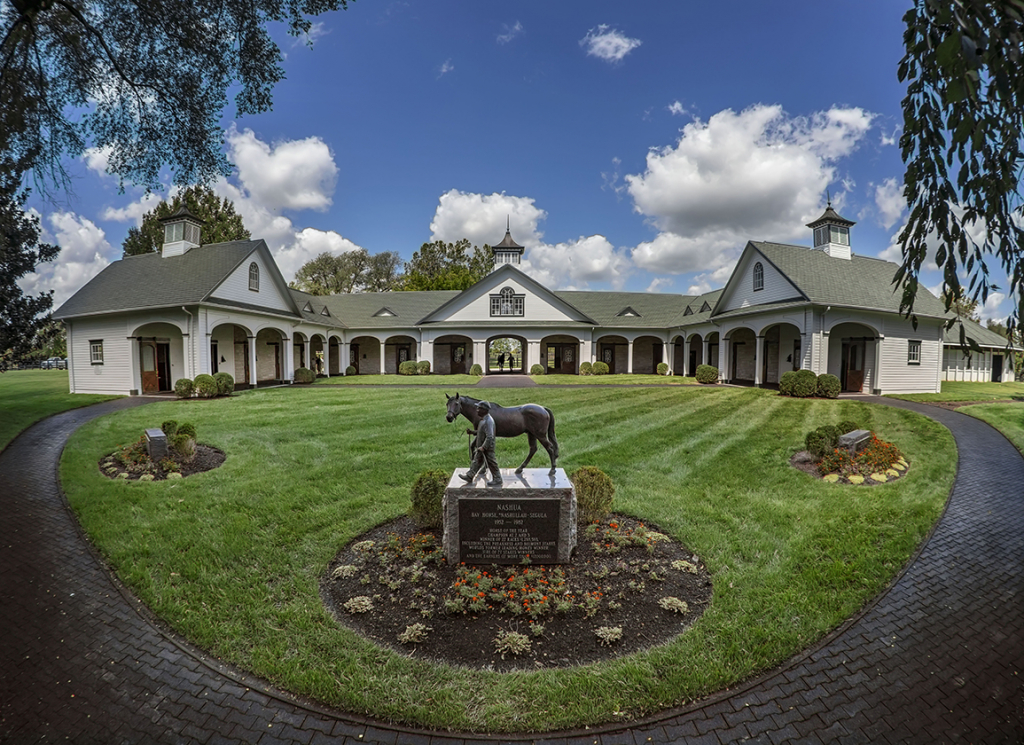
Spendthrift's Stallion Complex | David Coyle
“Well, he lived in this house behind this gate and he had these two enormous dogs,” he says. “Anatolian Shepherds. And they weren't friendly. They wouldn't knock you down and bite you on the jugular, but they would scare the daylights out of you. I told my wife I knew it was true love when I would get past those dogs to come and see her. And Wayne loved it! He wouldn't call them off but just sat there to see how you'd react.”
In time Gustavson, a former actor, would come to share his father-in-law's “outsider” journey into the arcane and insular Turf community.
“Not that I don't feel welcome, because I do,” he stresses. “But just being able to come in with him, and have him bringing me along, I felt like his sidekick, Robin to his Batman. I was learning on the fly, but we spent so much time with him that it just became natural for me.”
It was only when Gustavson and his wife transitioned to the helm a couple of years ago that they realized how masterfully Hughes had prepared them for that moment.
“I wasn't really ready before,” Gustavson says. “But by then he had built into the whole team, myself included, the ability to take it over and run with it. I'm so thankful for all the time I got to spend with him. He changed me for the better in many ways. I was more of a reclusive guy, and have been able to step out of that a little bit. I think he just caused the succession to happen naturally.”
Hughes helped to create space for the process by a typically enthusiastic engagement with new projects, notably MyRacehorse.
“A lot of us, if we start something, our tendency would be to say this is my baby and to hold on to the very end,” Gustavson reflects. “But he was never afraid to let that baby go off to college and make it on its own. He'd done it before, with enormous businesses, walked away from his leadership position to move onto the next thing. I think that's an amazing trait.”
“I think he felt comfortable that he could pass the torch,” Toffey concurs. “That he'd put a really good team in place, taught us a lot, and the farm was in really good hands. That freed him up to shift his attention to MyRacehorse.”
It is almost as though Hughes most enjoyed the challenge of hefting the boulder until reaching a favorable slope, and then felt able to stand back and watch with satisfaction as it gained its own momentum.
The challenge, for the next generation, is when to stick to a system that has worked so well; and when to match changes in the environment in their own strategy. “He's given us such a strong foundation, but we're not beholden to that,” Gustavson says. “We have our own minds and own ideas. For instance, we may start breeding fewer mares to our stallions—not because The Jockey Club says so, but because we feel it's best for our stallions, and our operation in general. We honor the past but we go forward into the future.”
One ongoing aspiration had already taken shape under Hughes: the upgrading of the roster, while retaining options for those smaller breeders he was always determined to serve.
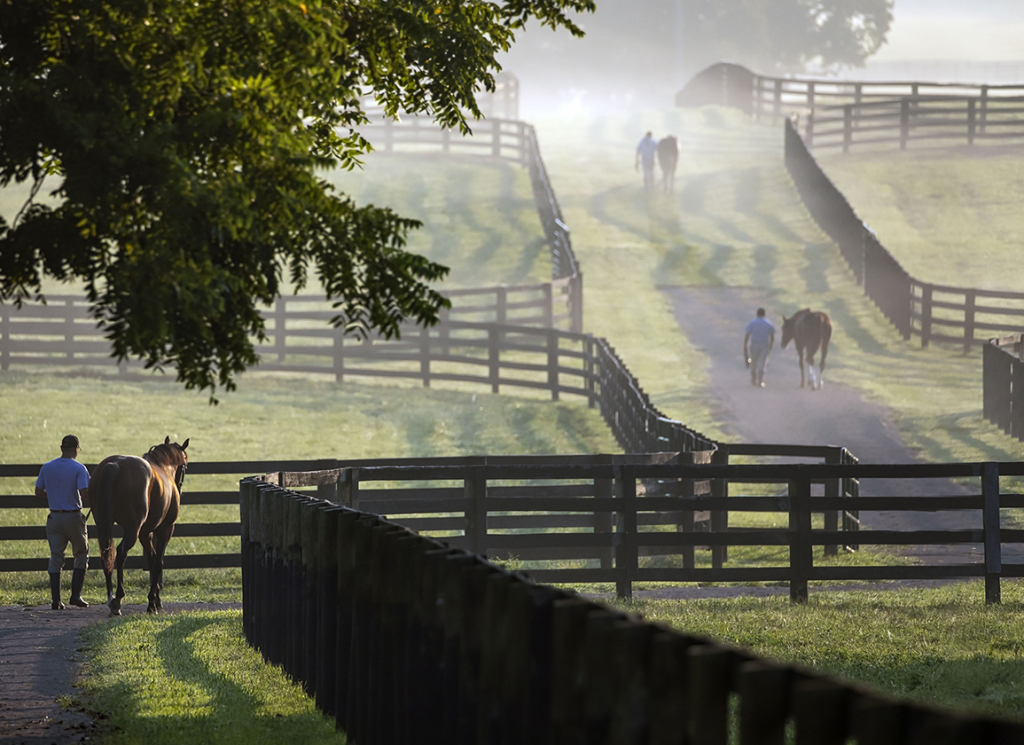
The stallions heading out at Spendthrift | David Coyle
“Very early on, Wayne loved the idea of bringing in an inexpensive horse and proving to everybody that he could make that horse work,” Toffey reflects. “And he did that; we hit the jackpot with Into Mischief. But we did need to focus on bringing in stronger stallion prospects. Whether we have any better success, we'll find out, but we tried to get that started under Wayne and every indication is that we'll continue trying to bring in more high-end horses.”
Assisting that agenda, of course, is Into Mischief's son Authentic, a ray of sunshine through the clouds of pandemic when bringing a partnership including Hughes and MyRacehorse into the Derby winner's circle. And that shift of gear is complemented by an attempt, quite conspicuous at recent breeding stock sales, to elevate the broodmare band as well—something of a shift of emphasis, Toffey acknowledges, Hughes having tended to focus primarily on the stallion shed.
While many of the things that made Hughes an exceptional businessman were precisely what set him apart from the run of humanity, he did know how to separate business and pleasure. And it was striking how radically he changed his approach, once acquiring Spendthrift.
“Racing had been a distraction for him,” Gustavson says. “He loved going to the track, watching them train and going for breakfast afterwards, and didn't really pay much attention to the finances of it. But when he bought the farm, it became business. Now we were going to run it right, and make it profitable—to the point that he talked about getting out of racing altogether. I remember my wife saying, 'Dad, why are you doing this? This is the twilight of your life. You should be buying more horses, not less. You love it.' But he couldn't help himself: once it became a business, he had to make it work.”
Hughes went down the horses in training, one at a time. “This going to be a stakes winner?” “Probably not.” And his pen struck out the name. Henceforth he would only swing for the home run, a colt that might make the stallion barn.
That disclosed a paradox. On the one hand, he would cheerfully roll the dice at the top of the market and write off the flops. Yet he would resent incremental waste of nickels and dimes, and sometimes got “down in the wheat” to monitor that. As Gustavson wryly observes: “He was someone who'd do multimillion-dollar deals and then get mad if the valet stole quarters out of his car.”
That, Toffey suspects, went back to those formative experiences in the Dust Bowl migration.
“I think that flashes back to the early days,” he suggests. “He was wired to be frugal. It was an interesting contrast in him. Dealing in huge sums and thinking really on a grand scale, there was nobody like him. It was all very natural. But at same time he could say of a very small sum of money, `this is a waste, let's stop it.'”
If there are ambitions in terms of quality, Spendthrift remains committed to quantity and participated in the derailment of the proposed stallion cap. For one thing, many breeders had assured Toffey they would cut right down or get out altogether if denied their commercial preferences. But still more pertinent to the Spendthrift model, perhaps, is a second consideration.
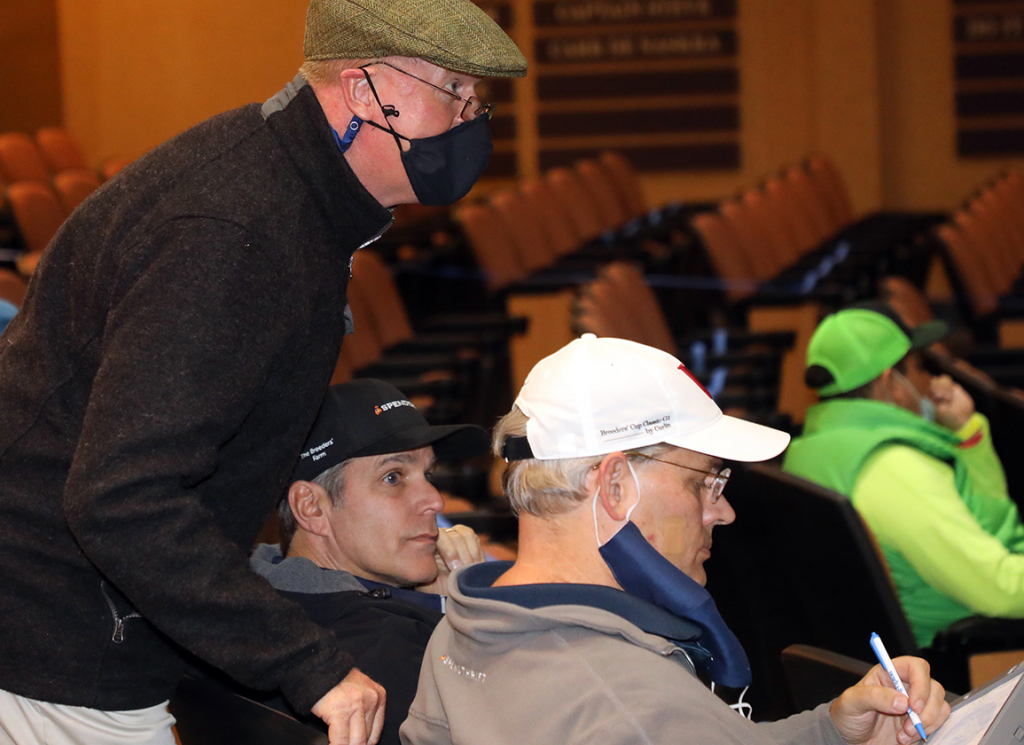
Gustavson and Toffey at Fasig-Tipton October in 2020 | Fasig-Tipton photo
“There are lot of very good breeders that are not necessarily the wealthiest people in the game,” Toffey notes. “And they realize and appreciate that the larger book does allow us to price at a point where they can afford to use a horse. It goes without saying that you want a good crop of mares, but it's equally important that you have a good crop of breeders supporting your stallion. And the best breeders are not always the guys who can afford the most.”
That, one feels, was the pivot of Hughes's brilliantly adventurous incursion into the industry. And that determination to embrace those lower down the pyramid also nourished his hope that microshares could dismantle some of the social barriers confining our sport.
When the Spendthrift team contemplate the future, then, they are profoundly aware of collective responsibilities. “Going forward, how does Spendthrift fit into the overall landscape?” asks Gustavson. “We want to be a positive influence, a positive player, partaking in different things that lend themselves to the health and viability of the industry and help us to move forward. There are a lot of challenges to be navigated. It'll be fun, it'll be difficult, but we'll work it out as a team.”
Like so many, Gustavson says he's baffled by resistance to what seem blatantly wholesome aspirations for uniform regulation and centralized strategy. “That's really frustrating because I think that's what is required for us to become what we could be,” he says. “As for HISA, I know it's in its infancy, it all has to be honed and we can't be legislated to the point where we can't even get horses onto the track. But it's curious that everyone wants uniformity, but then so many object when they get it.”
Everything is connected, after all: the hope of broadening our reach, and the obligation to clean up our act. “You need to have your house in order before guests come in,” Toffey urges. “Because if they come in, look around and don't like what they see, then all your marketing efforts were in vain.”
Toffey recently took some novices to Keeneland. “We watched a horse work out and then went back to the barn to see it cool out, have a bath, and these people were just enthralled,” he reports. “That's the frustrating thing: we do have such a good product. We just have to manage it better. But while it's easy to get a little down, I'm not sure I've ever heard of more new investment at the sales. So there are glimmers. We've just got to keep working at it.”
One thing is for sure, the industry could have no better model of engagement with Main Street than his late employer. A resolute aversion to vanity may have extended rather notoriously to his attire—a friend messaged Toffey in the winner's circle at the Breeders' Cup, suggesting that now perhaps his boss could afford a decent coat—but this was only ever the exterior rendition of a profound humility.
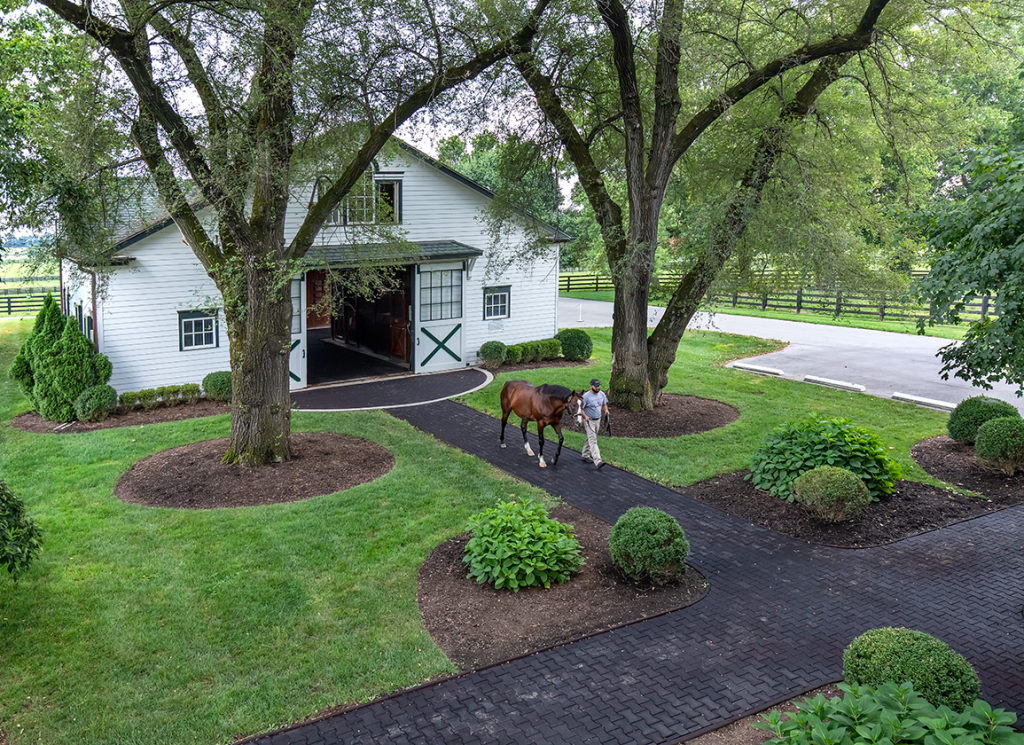
Into Mischief at the Spendthrift stallion complex | David Coyle
“He was very unassuming,” Gustavson says. “His friends used to tell him that he could walk the streets of the worst parts of any city and nobody would bother him, he looked so poor. Especially as he got older, he just didn't care.”
Toffey remembers Hughes being asked by a friend's son for the secret of his success. The young man leaned forward avidly as the guru began his answer.
“He thought he was about to get the golden key,” says Toffey with a laugh. “And then all Wayne said was, 'Work as hard as your father does!' His face literally dropped.”
“Though besides working hard, it helps to be a genius in a certain area,” Gustavson adds.
What a privilege, then, to have absorbed something, day after day, of such vitality and creativity and stubborn curiosity about alternatives; and what a prism Hughes remains, even now, for the decisions and aspirations of the next generation.
“All the time, at the sales or wherever, we find ourselves saying that we know just what Wayne would say in this situation,” says Gustavson. “And that will spark the conversation, the back and forth we need to have. So it's like he still has a voice, that he's there with us.”
And if Hughes remained ever humble, then who could resist a vicarious pride on his behalf? “He had the means,” Gustavson says. “But it was all about the desire. You should have seen this place when he bought it. Now I drive round and try not to have pride about it myself. But I'm proud of him, what he did here, and proud to be a part of it.”
The post The Hughes Legacy: Keep Moving Forward appeared first on TDN | Thoroughbred Daily News | Horse Racing News, Results and Video | Thoroughbred Breeding and Auctions.
