LongRun Thoroughbred Retirement Society will host an Open House Saturday, July 9, from 10 a.m. to 2 p.m. at their farm in Hillsburgh, Ontario.
The public will have access to the 100-acre property and will be able to meet many of the farm's 40 residents, including Canadian Horse of the Year Pink Lloyd, champions Fifty Proof, Riker, Rahy's Attorney, Rare Friends and millionaire Something Extra among others.
Demonstrations and merchandise sales and a prize draw are also part of the day's festivities. A donation of $10 per person is suggested.
Interested parties may contact LongRun at (416) 675-3993, extension, 1-3440, or by email at info@longrunretirement.com.
No trainer has a better record in the G2 Hardwicke S. than Sir Michael Stoue, who will be bidding to win the race for a 12th time at Royal Ascot on Saturday after supplementing Solid Stone (Ire) (Shamardal), who will be sporting the Derby-winning colours of Saeed Suhail.
Stoute won his sixth Derby when Desert Crown (GB) (Nathaniel {Ire}) powered home at Epsom just over a week ago for Suhail, who was also successful in 2003 with Kris Kin (Kris S), and the in-form trainer-owner combination will be bidding to maintain their good run of form at the royal meeting.
Solid Stone was last seen winning the G2 Huxley S. at Chester and will bid to emulate previous Stoute-trained winners of the Hardwicke like Harbinger (GB), Sea Moon (GB), Telescope (Ire) and more recently Crystal Ocean (GB).
All bar one of the past 14 winners were 4-year-olds and the Charlie Appleby-trained Hurricane Lane (Ire) (Frankel {GB}), winner of the Irish Derby last season, will be bidding to strengthen that record.
Not seen since finishing third in the Prix de l'Arc de Triomphe, Hurricane Lane is likely to give the 6-year-old Solid Stone most to think about, and Appleby provided an upbeat bulletin on the colt's wellbeing.
He said, “I'm delighted with the way he has physically done from three to four and this has very much been our target, we're very much working back from the Arc.
“Compared to some of the older horses he had an extended break as we knew we weren't going to do anything early in the season with him.”
Appleby added, “He took in a racecourse gallop at Newmarket the other day, William (Buick) sat on him and he was very pleased. He needed it in the sense that everything is very relaxed at Moulton Paddocks and he was in a relaxed mode, so William just had to give him the signal to remind him to switch on his racing brain and you could see the penny dropped at the right time.”
Due to forecasted extreme temperatures and heat indices expected to reach triple digits, Tuesday's live program at Horseshoe Indianapolis has been canceled.
“The safety of our equine athletes and those who are involved in the racing program is always at the forefront of our concerns,” said Eric Halstrom, Vice President and General Manager of Racing. “We are taking the proper steps to ensure everyone involved in conducting our racing program is safe from the anticipated temperatures on Tuesday.”
With the entire area under a heat advisory, officials will monitor the weather over the next few days. Racing is scheduled to resume Wednesday, June 15, at 2:25 p.m. EDT.
I am unquestionably not an expert on radiographs. I've seen far fewer than your average veterinarian or professional equestrian, though probably a few more than the average person off the street.
Still, when top equine surgeon Dr. Patty Hogan tweeted the image above of a horse's pastern, I knew enough to recognize that this seemed really, really bad.
(If you don't already follow @HoganEquine on Twitter, you should do so – you'll learn so much.)
Trainer David Donk said his trainee D'vinicris was out for a gallop at Belmont Park in April when his exercise rider sensed a problem. Neither of them guessed, when he pulled up the 5-year-old, that the x-rays would be so dramatic-looking.
“The horse had been racing and was quite sound,” Donk recalled. “He'd just started off on a routine gallop and he was pulled up by his rider, who obviously did a great job.
“It's one of those situations where you get them back to the barn, evaluate them and then you're quite surprised by what you see.”
D'vinicris is a homebred for part owner Miracle Man Racing, and had spent two seasons with Donk, picking up one win, one second, and one third.
“He's like a love sponge,” chuckled Jeffrey Pearl, owner of Miracle Man Partners. “He is such a sweet, happy-go-lucky horse. I'd go and see him twice a week when he's been at Belmont and bring him carrots and mints. The grooms, everybody just loves him. He's such a sweet horse.”
Dr. Keith Bogatch, who works with Donk's stable on the racetrack, took radiographs of the injured leg. D'vinicris had two fractures bisecting his right front P1 — the bone that runs between the ankle and the top of the hoof. The reason you see such wide, dark fracture lines on the x-ray, Hogan said, is a reflection of the bones shifting apart slightly after breaking, called displacement.
“This type of fracture we actually see much more commonly in Standardbred horses,” Hogan said. “Pastern fractures are not as common in Thoroughbreds, but when they do occur, they're critical. They're usually not just a small hairline.”
“This is about as displaced as we would see. And that can make it challenging to get it to fit back together perfectly.”
Bogatch sent images of the radiographs to Hogan, who said that the chestnut gelding could likely undergo surgery and have a very favorable prognosis.
A look at D'vinicris' leg post-surgery.
“I tell my clients I'm really just a simple carpenter because they're basic carpentry techniques,” she said. “It's called lag screw fixation, where you put two pieces of wood together in the same way using threads on one slab of wood and a glide hole on the other slab of wood so it fits together perfectly.”
Hogan inserted six screws into D'vinicris' pastern, angling each to hold the fracture lines closed and keep the screwheads as flat as possible against the bone surface. Hogan angled the screws slightly to close the fracture line while giving the ends enough solid bone material to hang onto on the other side of the marrow cavity.
In some types of fracture repair, screws stay in place permanently, while in others they may be removed after a short period of time. In the case of screws going into a pastern, Hogan says those will stay in place for the rest of the horse's life. Screws placed into a cannon bone for fracture repair are more likely to eventually be removed. Because of their length, cannon bones bend slightly at high speed in the course of a horse's normal movement and screws can inhibit this movement if they're placed too far above the ankle, creating discomfort when the horse returns to work.
It's a common misconception that “hardware” in a horse's leg is setting them up for future problems like arthritis. Hogan said this is really an issue only in situations where there was a complicated injury necessitating hardware and that particular injury either concurrently resulted in significant joint damage, or there was a preexisting joint injury, which wasn't the case here.
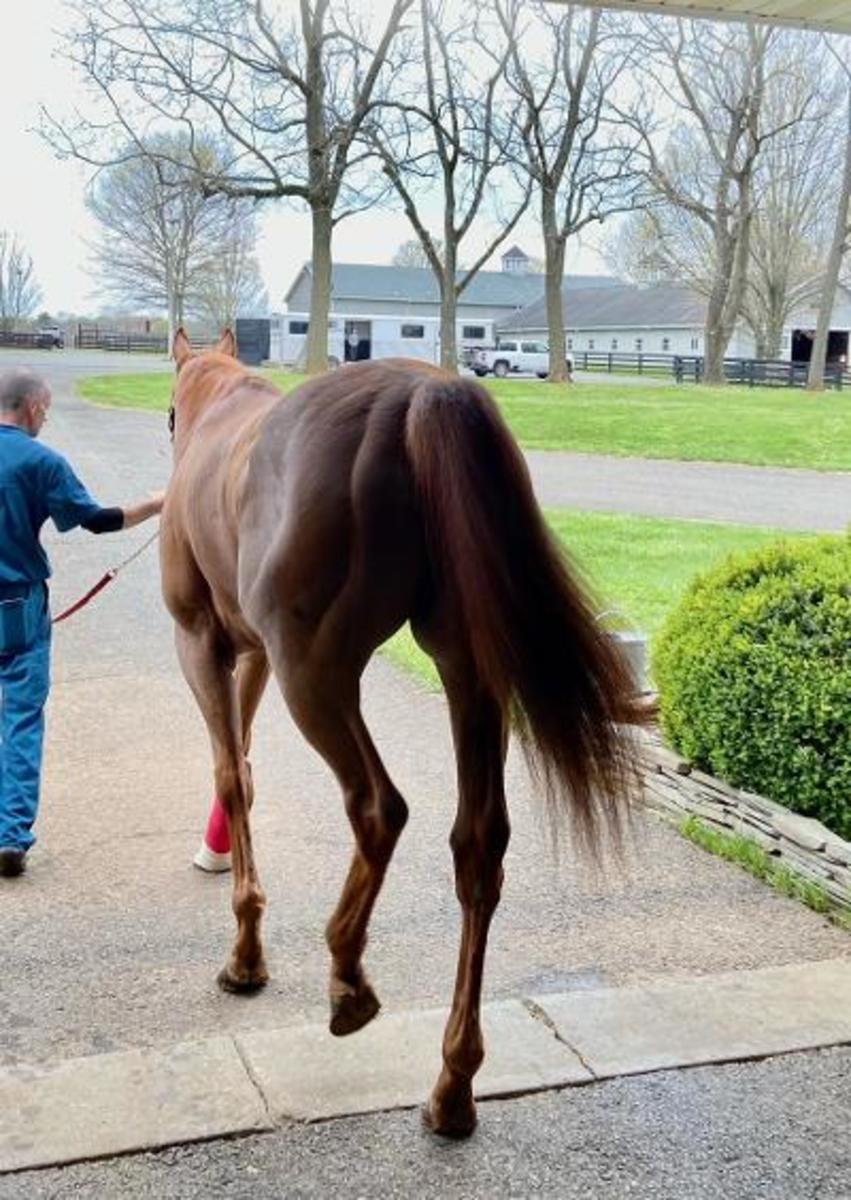
D'Vinicris heads home post-surgery with a light bandage on his right front
“A lot of off-track horses will sometimes hit a roadblock with people because they have this perception that if they have a screw somewhere, it's a negative connotation to the horse's ability to do anything and in most cases that's really not true,” said Hogan.
Instead, D'vinicris has moved on from the injury and is not expected to have any performance limitations. Like many horses undergoing surgery to repair a fracture, he walked out of Hogan's clinic sound and wearing a light bandage.
Hogan said there are a few reasons that fractures like this are repairable in 2022 when they wouldn't have been years ago. One of them is that equine surgeons have a better sense now for how to handle anesthesia.
“One more thing that I think is very important to our increasingly favorable outcomes in repairing fractures in racehorses is that we have learned some very valuable lessons about anesthetic protocols since the days of Ruffian,” Hogan said. “We know now that horses need a brief 'adjustment period' for them to recognize that they have an injury and that one leg does not work properly. It is a very important mental aspect for them to be aware of.
“Also, we never anesthetize a horse the same day as the when the injury occurs for that reason as well as because they are typically very stressed, are full of adrenaline, are fatigued, etc., and are just not ideal anesthetic candidates. Almost every fracture can be stabilized with a splint or bandage for a day or two and the fracture repaired successfully with a short delay. I have never regretted waiting but I surely have regretted anesthetizing a horse that was not quite ready physically and mentally for the process.”
Hogan said she also gives a lot of credit for positive outcomes like this one to the team around the horse prior to surgery. In this case, the rider was experienced enough to recognize quickly there was a problem and the on-site veterinarians got the leg stabilized and booted, minimizing the ability of the fractured bones to shift farther. Even the transport team shipping the horse to Hogan's clinic played a crucial role, keeping the horse calm and comfortable.
D'Vinicris prior in his stall at Belmont prior to his injury. Photo courtesy Jeffrey Pearl
Pearl said the big gelding's rehabilitation is going well so far and he's expected to resume turnout soon. Assuming the remainder of his recovery is uncomplicated, D'vinicris should have no lasting weakness or elevated risk of injury at the fracture site, Hogan said, and could even return to race training. Pearl said this week he hadn't decided whether D'vinicris will return to the races or embark on a new career, but either way his owners will facilitate whatever he needs.
“No matter what, we would have taken care of him,” said Pearl. “I tell my partners, this is what we've got to do. For the most part, they're all 100 percent in agreement.”