Timm, Grovendale Debut New Partnership at Keeneland

Last month, James Keogh announced that Chance Timm would be joining him at his Grovendale Sales in a new partnership designed to expand their footprint in the sales consignment arena. Most industry people have dealt professionally with Timm at one time or another over his 15 years in the business, but while he has had some high-profile jobs, by and large, he has kept his head down and flown pretty much under the radar. He has preferred, as he says, to deflect the attention to the people he worked for and the success they had built.

As a principle at Grovendale, he now `is' the people he works for, and he sat down for a long-overdue talk to discuss the four horses they will offer at the Keeneland April Sale on Friday and provide some background about his life and history in the sport.

The Grovendale consignment features Hip 10, Suppressor (Munnings) a racing prospect; and three racing or broodmare prospects: Hip 82, First Sip (Ghostzapper), Hip 86, Lady Love Me (Star Guitar), and Hip 91, Winedown (Kantharos).

It's fairly certain that Timm himself will be the only Utah native consigning horses at the sale. He hails from the town of Murray, a suburb of Salt Lake City, and Utah's fourteenth-largest town. Timm's grandfather bred and raised Quarter Horses and trained racehorses, and his father and uncle rode races for their father. “My first experience in the horse world was those guys riding on the weekends in bush tracks,” he said. “There was no parimutuel wagering out there, so it was fairly limited. It was more a hobby than a real profession.”
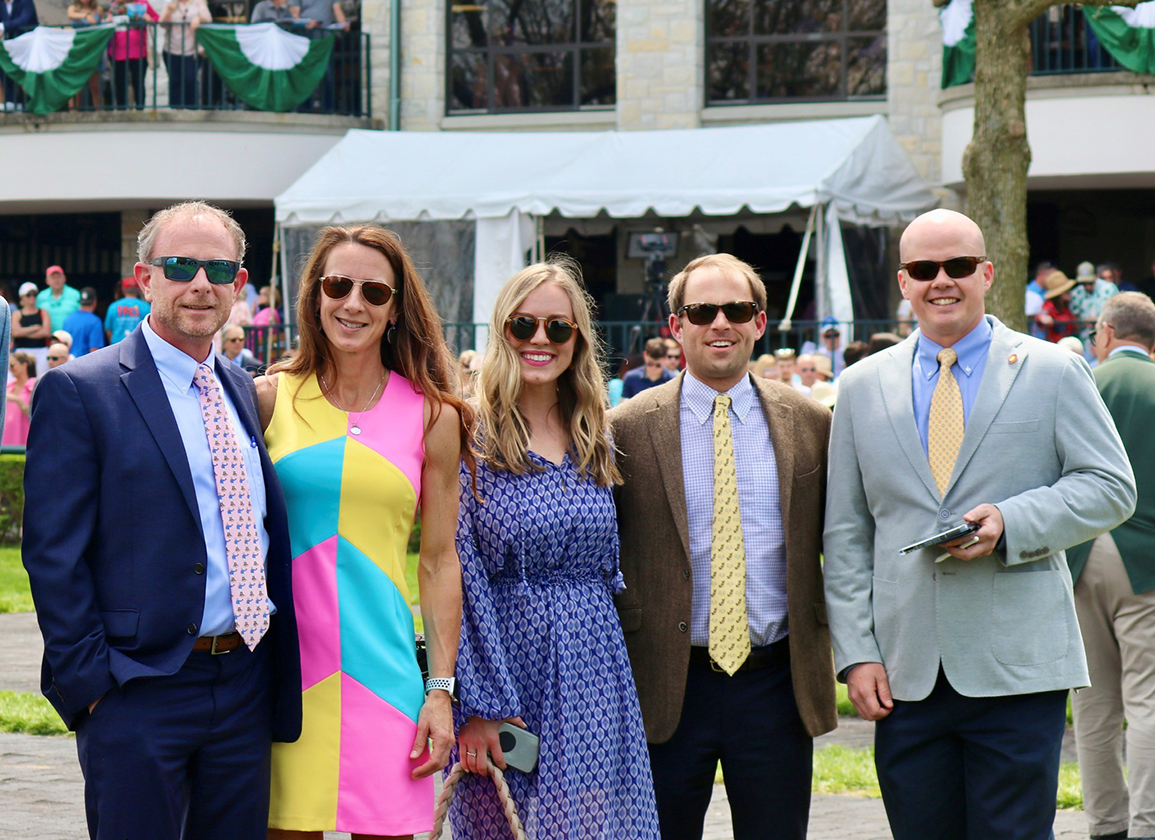
Timm with clients Here We Go Stable | Alyssa Cumming photo

When his father died when Timm was just 11, he said he drifted away from the sport, before finding his way back a half-dozen years later.
“A big thing in the inter-mountain West in Utah, Idaho, Wyoming, is chariot racing,” he said. “They hook Quarter Horse racehorses to a chariot, kind of Ben-Hur style, and they race them for 440 yards in the wintertime. It's a big family event down there, and while it's dying now, it was really popular when I was in high school. And so my family always had chariot horses, too.”

Timm started helping out an uncle with his horses, driving them, getting them fit, and accompanying him to the races on weekends. “It was a great time for me, because I needed a really positive male influence in my life at that time, after my father had passed away, and he was it and the horses became a pathway to that.”

He started his college career at the University of Utah where he was offered a Reserve Officers' Training Corps (ROTC) scholarship, but decided to pursue horse racing at the University of Arizona on a Race for Education scholarship instead. But upon his graduation, he found that horse racing opportunities out West were few and far between. He worked as an assistant starter, galloped horses, and took a the job as the assistant racing secretary and clerk of scales at Arapahoe Park, which he described as “a miserable time.”

“I remember one day, late in the summer of the meet, they were racing Arabians and I was in the paddock watching them give a leg up on these Arabians, and I thought to myself, `I've got to get the heck out of here.'”

Two former U of A classmates had a suggestion that proved to be the answer when Jordyn Egan and Ian Tapp suggested he apply for the Darley (now Godolphin) Flying Start program. The experience was life-changing.

“It was huge for me,” he recalled. “I had never been out of the country when I applied to Flying Start. I didn't even have a passport.”
Timm is a soft-spoken, reflective person with a quick laugh who loves nothing more than a good intellectual debate. He is also someone who has put a lot of thought into what sort of job would make for a fulfilling life for him, his wife and two children.

Timm lives in Lexington, and is married to the former AbiGail Spalding, the daughter of Summer Wind farm manager Bobby Spalding, whom Timm credits with an important role in shaping his life and career. They have two young daughters.

“When I was on the course, I always thought I wanted to get involved in bloodstock,” said Timm. “When I was getting going, it wasn't uncommon at all for yearlings to bring $6, $7, $8 million. And funny enough, what I knew I didn't want to do was get into stallions, and I ended up loving it. When I was at WinStar doing seasons with Gerry Duffy and syndicating all those horses, that's when I really understood how it all worked, the syndication process and scouting the horses and trying to figure out what they're worth and what you can buy them for. And then I got to do even more of it at Lane's End. It's a great part of the industry, where you put a big bet on the line and then you go on and sell it. There's a lot of excitement behind it. It's great calling people up and saying, `Hey, we got the breeding rights to this horse and this is what we're going to stand him for, and we'd like you to partner with us.'”

In the end, what he learned was that he wanted to be in the relationships business.

“Luckily, during my time at Lane's End, I was pretty involved with the sales consignment. And apart from my responsibility to the stallion roster and all that came with that, they were gracious enough to let me be actively involved in recruiting and placement of horses in the sales consignment, and I really enjoyed that. One of the things I enjoy the most in this industry is meeting new people and talking to these people, finding out their story and where they're from, and then helping them along and watching their program succeed.”

At Grovendale, he'll get to build on that resume.

“I've come to realize that the sales process is something that I really, really enjoy, for all those same reasons. I like working closely with people and playing the long game and advising them on making sound decisions that pay off long-term, instead of taking shortcuts, or maybe just trying to get a nice horse for them, sell and move on. That's not really what I'm about or what James Keogh is about. We want to develop long-lasting relationships with people that trust us, and we have strong ties with them and watch their programs do well. I've come to realize how much I enjoy that part of it, placing horses in the sale, figuring out what's the best spot to sell them. Who's on the horse? How much is it going to bring? And going through that whole process.”
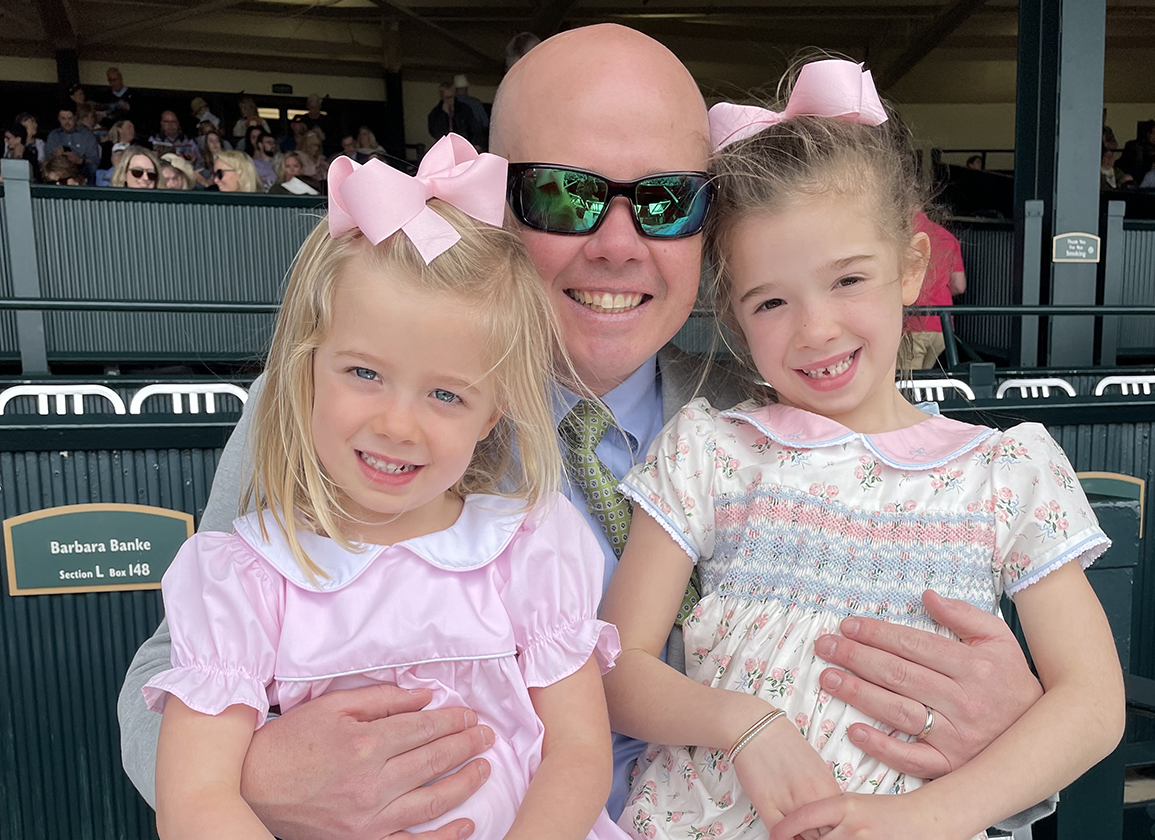
Timm at Keeneland with daughters Hallie and Vivian | courtesy Chance Timm

Grovendale will continue to feature its traditional services, including sales consignments, matings, investments and consultation. They will also continue to trade their own horses. Timm said having that kind of personal stake in the game is something that is critical to understanding your clients' business.

“James told me early on when I first got to know him that tuition in this game is not cheap, and the only way to learn it is to put your money up. And he's right. You learn all the time what works and what doesn't work. And I think if you've never lost money on a horse, it's hard to tell people-to look them in the face-and say that they are going to have to take a loss.”

Their expansion plans will focus on yearlings and horses of racing age.

“We'll be at all the major Kentucky sales,” he said. “We'll go to Saratoga with the right horse, but we'll stick mainly to Central Kentucky. The plan is to build the yearling and horses-of-racing-age areas of the consignment year-round. The breeding stock segment is always something that James has had a strong presence in, and obviously we'll continue to be involved there. But the primary focus is to further emphasize the quality of the breeding stock sales and build our presence in the yearling sales.”

The growing presence of digital and pop-up sales should further fuel business.

“Like most of the people in Central Kentucky, we trade horses. The market has become so concentrated at this point that there are very few of us that don't actively invest and trade horses. So for all of us that are advisors or industry professionals, digital sales provide a great opportunity to trade. But even beyond industry professionals, for participants that are looking to capitalize on something at the right time, it's an opportunity. And the reality is that this kind of stuff happens all the time. Horses trade privately at peak opportunities all the time. But the public marketplace gives buyers a lot of confidence, obviously. It gives people confidence and transparency. Boyd Browning has always said that the best place for sellers to maximize the value of a horse is at public auction, and he's right. There's no better way to value a horse than the open market.”

In the end, says Timm, he's just happy to work with someone for whom he has so much respect.

“There are very few people that have done more for me in the horse business than James Keogh,” he said. “I'm obviously biased and I've built this relationship with him over a long time, but James is one of the most generous people I've ever been around. He's a very kind, trustworthy person that gives his time and opportunities and just a hand to anybody and everybody that needs it–whether they're facing some kind of health ailment or they need help with fixing a fence or whatever it is.”

The important thing, he said, is that he and Keogh are on the same page when it comes to their goals for their clients.

“I think this is all based on relationships and building a relationship with somebody that you can trust and you have confidence in. That's really what I want to stand behind. I want the people that I work with and on whose behalf I work to have the trust and confidence that I'm looking out for their best interest. And that's always going to be the preemptive motivation for what we're trying to do.”

The post Timm, Grovendale Debut New Partnership at Keeneland appeared first on TDN | Thoroughbred Daily News | Horse Racing News, Results and Video | Thoroughbred Breeding and Auctions.

Source of original post

Mylady A Group First For The Grey Gatsby at Krefeld

Gestut Karlshof's spayed 3-year-old filly Mylady (Ger) (The Grey Gatsby {Ire}), who backed up an Aug. 22 debut win at Mulheim with a narrow score in Dusseldorf's Sept. 12 Listed Junioren-Preis, maintained her perfect record and went three-for-three in Sunday's G3 Dr Busch Memorial at Krefeld. The homebred grey, sent postward as the 11-5 favourite, was bustled along from the gates to remain in touch with the pack through the initial strides of this 8 1/2-furlong test. Angled wide for a clear passage in the straight, she quickened in impressive fashion to poach a decisive advantage approaching the final furlong and kept on strongly, despite rolling around in front, to hold the late surge of Schwarzer Peter (Ger) (Neatico {Ger}) by a neck, the pair four lengths clear of the remainder.

Mylady, who becomes the first pattern-race winner for her second-crop sire (by Mastercraftsman {Ire}), is the first of two foals produced by Minoris (Fr) (Dabirsim {Fr}), herself an unraced daughter of Monspa (GB) (Monsun {Ger}). Monspa, in turn, is kin to Listed Hampton Court S. victor and G2 Hardwicke S. third Persian Majesty (Ire) (Grand Lodge). Mylady's third dam Spa (GB) (Sadler's Wells) also produced Spasha (GB) (Shamardal), whose trio of stakes winners is headed by G1 Diamond Jubilee S. and G1 Sprint Cup hero Hello Youmzain (Fr) (Kodiac {GB}) and G2 Gran Criterium victor Royal Youmzain (Fr) (Youmzain {Ire}). Mylady's fourth dam is G3 Lancashire Oaks victrix Sandy Island (GB) (Mill Reef), herself kin to runaway G1 Epsom Derby-winning sire Slip Anchor (GB) (Shirley Heights {GB}). Sandy Island's descendants also include G1 Sisterna S. victor Summer Passage (Aus) (Snitzel {Aus}), with this being the dam line of legendary racemare and producer Schwarzgold (Ger) (Alchimist {Ger}). The winner's dam has 2-year-old colt by Counterattack (Aus) to come.

Sunday, Krefeld, Germany
GROSSER JUBILAUMSPREIS “125 JAHRE WOHNSTATTE KREFELD” – DR BUSCH MEMORIAL-G3, €55,000, Krefeld, 4-24, 3yo, 8 1/2fT, 1:44.25, g/s.
1–MYLADY (GER), 125, f, 3, by The Grey Gatsby (Ire)
1st Dam: Minoris (Fr), by Dabirsim (Fr)
2nd Dam: Monspa (GB), by Monsun (Ger)
3rd Dam: Spa (GB), by Sadler's Wells
1ST GROUP WIN. (€20,000 RNA Ylg '20 BBAGO). O/B-Gestut Karlshof (GER); T-Markus Klug; J-Andrasch Starke. €32,000. Lifetime Record: 3-3-0-0, €49,000. Werk Nick Rating: D+. Click for the eNicks report & 5-cross pedigree.
2–Schwarzer Peter (Ger), 128, c, 3, Neatico (Ger)–Sovalla (GB), by Pomellato (Ger). (€10,000 Ylg '20 BBAGS). O-Uwe Aisch; B-Gestut Hof Ittlingen (GER); T-Markus Klug. €12,000.
3–Georgios (Ger), 128, c, 3, Poet's Voice (GB)–Gotia (GB), by Teofilo (Ire). 1ST BLACK TYPE. (€36,000 RNA Ylg '20 BBAGO). O/B-Gestut Ebbesloh (GER); T-Peter Schiergen. €6,000.
Margins: NK, 4, 1 1/4. Odds: 2.20, 11.00, 3.30.
Also Ran: Ariolo (Ger), Magical Beat (Ger), Rocchigiani (GB), Spirit (Ger), The Iconist (Ger), Becassio (Ger). Scratched: Antharis (GB). Click for the free Equineline.com catalogue-style pedigree.

The post Mylady A Group First For The Grey Gatsby at Krefeld appeared first on TDN | Thoroughbred Daily News | Horse Racing News, Results and Video | Thoroughbred Breeding and Auctions.

Source of original post

Group 1 Winner Inspiral To Miss The 1000 Guineas

Cheveley Park Stud's Inspiral (GB) (Frankel {GB}), one of the leading fancies for the G1 QIPCO 1000 Guineas at Newmarket on May 1, will miss the race, according to the owners' managing director Chris Richardson. The John and Thady Gosden trainee is a perfect four-for-four, with black-type victories in the Listed Star S. in June, the Sept. 9 G2 May Hill S. and the Oct. 8 G1 Fillies' Mile to end her season.

“John Gosden had an in-depth discussion with the boss, Mrs. Thompson, and following that, it was decided that, sadly, she would miss the 1000 Guineas,” Richardson said on Sunday.

“John Gosden feels she wasn't really ready for the race and when you receive that advice from a trainer such as John, you follow it and now we'll look to the [G1] Coronation S. at Royal Ascot [on June 17] as part of her programme.

“It is disappointing for all concerned, but we must heed their advice. Royal Ascot is a favoured meeting of the Thompsons and we've had success there previously, it's the start of the year and we've still got lots of opportunities going forward.”

Also out of the 1000 Guineas is Saeed Al Tayer's Group 2 heroine Zain Claudette (Ire) (No Nay Never). A winner at second asking, the chestnut ran out a narrow victress of the G3 Princess Margaret S. at Royal Ascot last June. Sent to York for her next outing in August, she stalked and pounced to win the G2 Lowther S. by a measured length, prior to an unplaced run in the wake of likely Guineas favourite Tenebrism (Caravaggio) in the G1 Cheveley Park S. at Newmarket.

“We've brought her back to training and she is very well, she had some very good races last year,” said trainer Ismail Mohammed. “She is not going to the Guineas, we've pulled her out. We will have so many options for her, so we will see where to go with her.

“It could be Royal Ascot, there are many races for her. I want to find at least one good race for her over seven furlongs before we go for a mile.”

The post Group 1 Winner Inspiral To Miss The 1000 Guineas appeared first on TDN | Thoroughbred Daily News | Horse Racing News, Results and Video | Thoroughbred Breeding and Auctions.

Source of original post

What Is It About Spring Grass That Makes My Horse’s Body Grumble?

When it comes to consumption of spring pasture, horses and ponies hardly hold back; horses can consume over 3 percent and ponies up to 5 percent of body weight daily. “Given that horses and ponies usually consume 1.5 to 2 percent of their body weight in forage and feed to maintain body weight, these numbers alone explain why horse owners run into problems with lush grass,” said Kathleen Crandell, Ph.D., a nutritionist with Kentucky Equine Research.

Despite its nutritional benefits, spring grass can be high in sugar and starch, depending on the type of grass. “Levels of nonstructural carbohydrates (NSC) as high as 40 percent dry matter have been recorded in certain grasses. Cool season perennials—like ryegrass, timothy, orchardgrass, bluegrass—are especially predisposed to accumulating sugars and fructans,” explained Crandell.

Let's review some of the common issues that can spring up along with green grass.

Colic. Access to pasture is generally associated with a decreased risk of colic. When it comes to spring grass, though, colic risk rises, primarily due to changes that occur in the gastrointestinal environment consequent to overconsumption.

Issues arise because the high carbohydrate content of lush grass may cause rapid fermentation of fiber in the hindgut, upsetting the microbial balance and causing excessive gas production. With any shift in the microbial population of the digestive tract, an increase in gas-producing microbes can occur. The microbes that ferment sugars and fructans produce copious amounts of gas. “If there is good flow to the digesta in the tract, which is often the case with high-moisture spring grass, the gas will be easily expelled, although it may cause mild discomfort,” Crandell said.

She added, “Horses that are on pasture 24/7 during the winter and into the spring as the grass begins to green up have fewer problems than those who are suddenly introduced to grass because the intestinal microbiome has time to adapt to the changes gradually.”

Further, certain horses may have a problem transitioning from a high-fiber diet of hay or mature grass to lush grass, which has a much lower fiber content. Lack of fiber may cause intestinal upset. This is one reason why many owners offer hay to horses at the same time they're consuming lush pasture grasses.

[Story Continues Below]

Laminitis. Several modes of action may cause laminitis depending on the individual horse and its susceptibility.

One chain of events involves the hindgut. When a horse consumes spring grass, some of the sugar in it bypasses digestion in the small intestine and ends up in the hindgut. This produces a bloom of lactate-producing gram-negative bacteria that rapidly ferments the sugar and fructans. The byproduct of this fermentation is increasing amounts of lactic acid, which drop the pH of the hindgut. As the pH decreases, other microbes die, releasing endotoxins, reactive amines, and exotoxins into the bloodstream. These are thought to adversely affect circulation, increase inflammation, and destroy lamellar basement membranes in the hooves, causing laminitis.

Another mode of action implicates insulin dysregulation. Consumption of high-sugar grasses causes a rise in blood glucose, which triggers a release of insulin in an attempt to reduce glucose levels by helping to usher it into cells. If a horse or pony is insulin resistant, this mechanism malfunctions, so the pancreas releases more insulin, gradually increasing levels of insulin in the bloodstream. This hyperinsulinemia triggers alterations in blood flow to the hoof, boosts expression of lamellar pro-inflammatory cytokines that activate inflammation, and alters glucose metabolism within the hoof lamellae.

Loose manure. A change in manure is common when horses consume lush spring grass, most likely because of the elevated water content of grasses, which can reach 85 percent. If the horse's manure has green-cowpie consistency when first allowed to graze in the springtime, then the cause is probably the new diet, not disease, Crandell said.

However, horses can develop pathological diarrhea, particularly if they are allowed full-on access to spring grass without acclimation. A dramatic shift in the makeup of the hindgut microbiome, as described previously, can make the horse more susceptible to blooms of pathogenic bacteria that naturally reside in the hindgut. Always consult with a veterinarian when drastic changes occur in a horse's manure, especially if it is watery and lasts more than a day or two.

Wood-chewing. Horses require fiber in their diets. Because springtime grass contains little fiber, some horses will look elsewhere to satisfy this need. Horses often chew fence boards or rip bark from trees as a way to consume more fiber. Horses may colic from eating indigestible wood, possibly as a result of impaction.

Safe springtime turnout requires planning. According to Crandell, management strategies include:

  • Gradually acclimating horses unaccustomed to spring pasture by allowing more and more turnout per day and feeding hay the remainder of the day. Start with 20-30 minutes of exposure on the first day of grazing and then increase by 30 minutes every one to two days. Again, this would not be necessary if the horse has access to the pasture throughout the entire transition from winter to spring.
  • Using a grazing muzzle to slow the consumption of the fresh grass.
  • Continuing to offer hay to horses on pasture to give them more fiber. A flake or two is usually enough to discourage wood-chewing.
  • Feeding a research-proven hindgut buffer like EquiShure two to three times a day throughout springtime. EquiShure keeps the pH of the hindgut steady, decreasing the likelihood of sweeping shifts in the microbial population.

Reprinted courtesy of Kentucky Equine Research. Visit ker.com for the latest in equine nutrition and management, and subscribe to Equinews to receive these articles directly.

The post What Is It About Spring Grass That Makes My Horse’s Body Grumble? appeared first on Horse Racing News | Paulick Report.

Source of original post

Verified by MonsterInsights