Lord Lariat wins Irish Grand National at Fairyhouse to give trainer McLoughlin second successive victory
Lord Lariat provides local trainer Dermot McLoughlin with a second successive victory in the Irish Grand National at Fairyhouse.
By the beginning of April, there had been two fatal musculoskeletal injuries during the current Santa Anita meet. Wind the clock back to an identical window in 2019, there had been 22.
During Aqueduct's benighted 2011-2012 Winter meet, 21 horses died, 18 of which were fractures sustained during racing. Over the next seven years, New York's four racetracks saw a 50% reduction in racing fatalities.
What is the common denominator? Huge advances in identifying those horses at higher risk of sustaining fatal injuries in racing and training, and much tighter safety nets to filter these horses out of the racing pipeline before a catastrophic event occurs.
Racing's North Star is to reduce the number of musculoskeletal injuries to a single duck egg. But there remains a stubborn impediment: The ability to easily and accurately identify those emerging and subtle injuries that can't be detected with the naked eye but have the potential to devolve into a sickening fracture.
How prevalent are these sorts of issues? Well, 21 one of the 22 horses that died during Santa Anita's 2018-2019 Winter meet showed pre-existing pathology at the site of their fatal injuries.
Enter stage left the 21st century, and a collision of new technologies that bring an objective, mathematical approach to pin-pointing these hitherto elusive and barely perceptible problems.
The New York Racing Association (NYRA) is deep into a project that began last summer to trial a sophisticated biometric sensor mechanism which fits snugly into the horse's saddle cloth and can detect minute changes in a horse's gait at high speed. Called StrideSAFE, the sensor has been proven to detect problems in a horse's stride sometimes weeks in advance of a catastrophic event occurring.
Over on the opposite side of the country, The Stronach Group, under its 1/ST banner, is gearing up to unveil its own system which uses high-definition cameras to create detailed skeletal movement maps of horses as they navigate the racetrack. Company officials believe the technology has the potential to similarly red-flag horses at the very earliest warning stages.
What's more, these new kids on the block converge with an emerging generation of imaging modalities-think PET, MRI and CT-more capable than their diagnostic ancestors of providing a clear yes or no answer to the presence of subtle pre-existing problems.
And now, some of the industry's most pragmatic, unflappable leaders are making the argument that, given further development and understanding, these biometric systems hold the key to reducing fatal musculoskeletal injuries from the sport even further-potentially altogether.
“This is probably one of the most important contributions to the Thoroughbred horse industry that has ever been made,” said Scott Palmer, equine medical director for the New York State Gaming Commission, about the StrideSAFE sensor. “I do have a big stake in saving horses' lives, and so, in some respects this has been a holy grail.”
When David Lambert studies horse racing through a technology lens, he compares it to a ladder propped against a house going into the third-floor bedroom window.
Currently, racing's hitherto timid embrace of cutting-edge technologies-even basic training monitors, for example, used liberally for decades in human sports-have kept the industry rooted to the lawn.
“Me trying to get this [StrideSAFE sensor] introduced is the first rung of the ladder,” Lambert explained. “Keep that up over time, slowly but surely, you'll get right up to the third floor and walk into the bedroom.”
Lambert is a loquacious and affable 73-year-old veterinarian hailing from the North of England, who has dabbled in the odd bit of race-riding and training. He's lived Stateside for more than 50 years, during which time, he's spent decades digging through the mathematical arcana of performance prediction, and the role that sensors play.
Mickael Holmstroem, a Swedish PhD with expertise in equine conformation and locomotion, and Kevin Donoghue, professor of electrical and computer engineering at the University of Kentucky, have been Lambert's business and academic partners for much of this journey.
In 2019, they all formally embarked upon a mission to design a system that StrideSAFE looks like today. In all, Lambert reckons he has poured $1 million of his own money into its development.
It's no surprise, then, that he talks about it with the enthusiasm of a teenager with the keys to his first car.
“The sensor is the ultimate jockey,” Lambert said. “It's the best rider that ever rode a horse, never forgets anything, and picks up data 800 times a second in each of three directions for a total of 2,400 data points a second from the horse.”
So, how does it work?
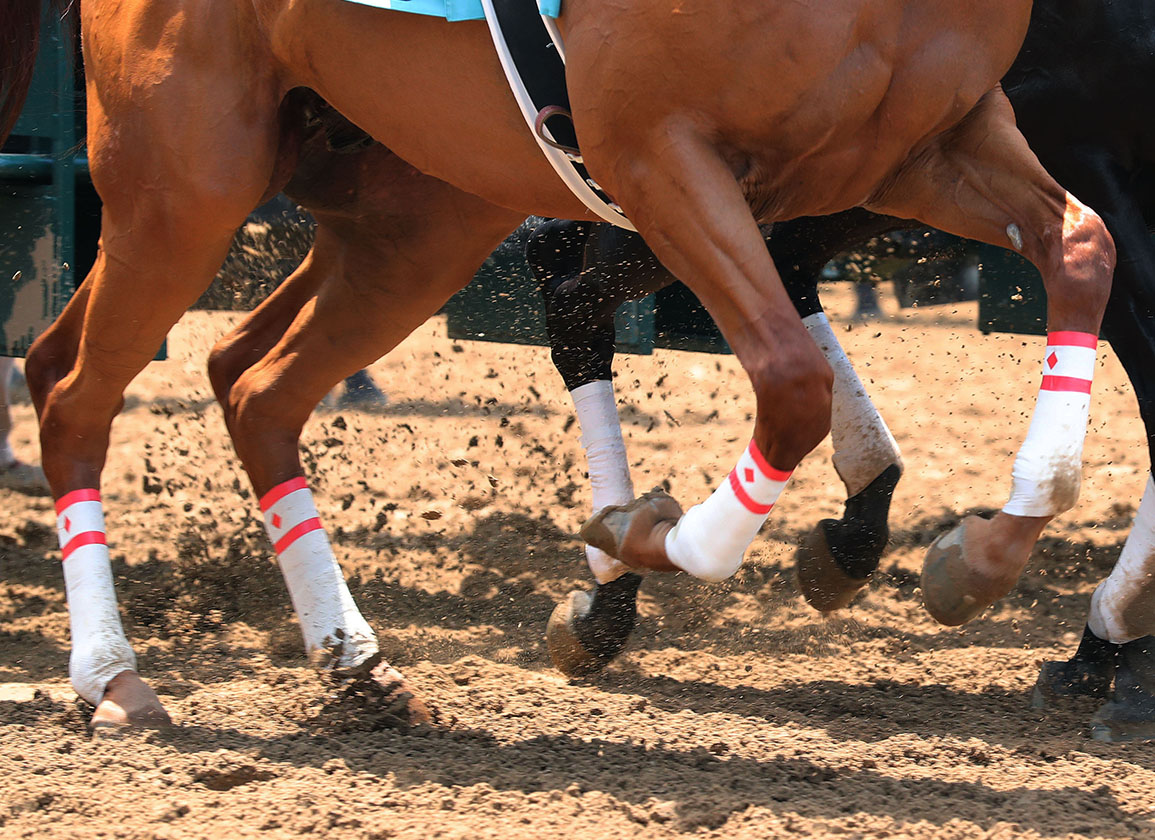
This wireless iPhone-shaped device fits snugly into the saddle towel, and eight-hundred times a second, it takes an assortment of measurements to capture in minute detail the movement of the horse at high speed.
These measurements include the horse's acceleration and deceleration, its up and down concussive movement, and its medial-lateral motion-in other words, the horse's movement from side to side.
Ultimately, the sensors capture the sorts of high-speed lameness invisible to the naked eye but significant enough to cause major musculoskeletal failures at some point down the line unless someone intervenes on the horse's behalf.
“A horse can basically stand to race. Their bones are strong enough, their ligaments are strong enough,” said Lambert. “But what they can't stand is imperfection over and over and over again. They're going to break something.”
When explaining the equine biomechanics underpinning the success of the StrideSAFE technology, Lambert first compares the horse to an antipodean cousin-the kangaroo.
“People don't get that,” he said, of the comparison. “Sixty or seventy percent of the energy it produces to go fast is from spring or elastic recoil.” He then breaks a single stride into three stages.
In the first phase of the gallop, the hindlimbs load and propel the horse forward, kangaroo-like. In the second, the horse shifts its weight to the front, its forelimbs acting like shock-absorbers. This is followed by a period of suspension, the horse entirely airborne, a time for it to catch its breath.
But if the horse suffers a physical problem, however, it cannot adjust its body to compensate when its feet are on the ground. It can only do this midair, rotating its spine and pelvis in preparation for landing.
“The horse does all kinds of things in the air, twisting and shaking and moving,” Lambert explained. Imagine a race-car hurtling along at high speed, one of its bolts working loose.
What's more, these midair adjustments are infinitesimal, occurring within a 1/100th of a second window imperceptible to even the jockey-but not a sensor.
“It tries its best to re-align itself and repeats it all over again,” Lambert added, of the horse. “Then six, eight, ten weeks in, that front leg is going to feel it. You're going to get a joint or a knee. You start to see the obvious lameness.”
Coady Photography
StrideSAFE works like a traffic light signal, providing a green for all-clear, a yellow for caution, and a red for possible danger. In mathematical terms, a red means that the horse's gait abnormalities are beyond two standard deviations of the norm.
It's important to note that a red-light doesn't necessarily indicate a brewing issue. It could simply mean the horse is slow or that it doesn't try.
Nevertheless, from trials at tracks in Tasmania, and at Emerald Downs and Kentucky Downs here in the U.S., the sensor has repeatedly proven effective at highlighting gait abnormalities sometimes weeks in advance of a fatal breakdown.
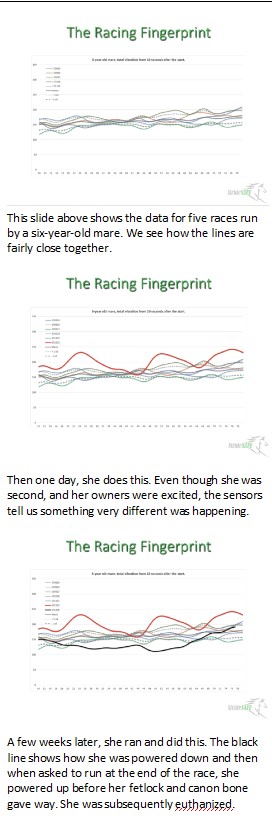
Lambert shared data slides showing the five-race progression of a 6-year-old mare. During her first three runs, the mare's way of going-what Lambert calls her “fingerprint”-showed no abnormalities.
Her fourth race garnered a red-flag, however, despite finishing an encouraging second that delighted connections. A few weeks later in her fifth race, the mare fatally broke-down.
“In a normal day of racing just one or two horses will get a red flag warning and this small group contains a significant proportion of the horses in danger of catastrophic injury,” Lambert said.
Early injury detection can help to not only avoid painful, expensive and time-consuming treatments but expedite convalescence time, too-a fillip for an industry grappling with the consequences of a dwindling horse inventory.
“Attrition of racehorses is an enormous problem,” said Scott Palmer. “This device gives the opportunity not just to identify horses with a gait abnormality before it becomes evident normally to a human being, it allows regulatory veterinarians and racing officials to work together with trainers early in the process to help keep horses in training.”
Last summer, NYRA used StrideSAFE on every horse in one race per day at Saratoga, allotting each the requisite red, yellow or green label. By the end of the meet, 3% of the horses measured had been red-flagged.
All participants were then tracked over the subsequent four months, to see if and when they returned to race-day competition.
Of the green horses, 78% were able to race back within four months. Of the yellow horses, 72% raced within four months. But only 40% of the red-flagged horses returned to race within four months.
“If you have horses that don't run back regularly, don't race on a regular basis, there can be a number of reasons for that, but the most common one is lameness,” said Palmer.
So impressed has Palmer been with the technology, NYRA has used it on every horse to race during the most recent Belmont Park and Aqueduct meets, for a number totaling roughly 6,000 recordings.
That data is now being evaluated. Plans are also afoot to trial the technology on horses during training. But Palmer already imagines a future where this technology is a more permanent part of the NYRA furniture.
“My vision about this is that when I get notified of a red-alert, I can just send an email to the trainer that says, 'trainer, your horse just got a red-alert today. What does it mean, what does it not mean, and what are your next steps,'” said Palmer. “That horse is going to get extra scrutiny, and that's the name of the game right now.”
And it reveals much when Palmer, chief veterinarian at one of global racing's highest profile jurisdictions, admits that StrideSAFE has evolved his understanding of the equine athlete.
He said, “I will never look at the horses in the same way.”
While StrideSAFE utilizes motion sensors that attach to the horse, 1/ST is readying for later this year the launch of a three-year, multi-million-dollar effort to design a biometric system with multiple uses, including the ability to create detailed skeletal movement maps of horses using high-definition cameras.
“We're at the beginning of the journey in terms of 'how far can we take it?'” said Paul Williams, who heads up technology at 1/ST. “But we're beyond the beginning of 'very excited about what it can do.'”
The basic building blocks of this system consisted of creating virtual 3D models of each 1/ST track which were then then mapped against the position, angle and zoom of the TV cameras already dotted around these facilities.
It took a year, said Williams, to be able to pin-point a horse on the track to within 13 centimeters of its actual location. Since then, he and his crew have whittled that down to a six or seven-centimeter range of accuracy.
“That gives us a level of accuracy where we can track the physical horses and people and vehicles and weather, weirdly, of the locations from the TV camera,” said Williams.
And with 85 million historical race clips already plugged into the system, “that's a nice place to be because you have such a large data lake to start to test and to infer theories,” he said.
Among the information the system collects includes acceleration and deceleration and horse stride length. What's more, the system, said Williams, can “effectively replace” and in some instances vastly improve upon a host of commonly used industry practices and technologies, like start-stop time, race order, race-speed, top-speed, and the number of times the jockey uses the whip.
“Even down to pseudo-jockey aero dynamics, based on where they're positioning their weight on the equine athlete,” Williams said, pointing out that some of the derivative data could be packaged and geared towards gamblers.
 And from this model, Williams and Dionne Benson, 1/ST's chief veterinary officer, are in the process of adapting it to identify patterns of horse lameness not visible to the naked eye.
The basic principle is fairly simple: High-definition TV cameras will pick up QR codes-think restaurant menu barcodes-attached to a horse's saddle towel during training, sending back in real-time a rich pool of highly detailed, high frame-rate data.
Over time, this system can accrue historical skeletal movement maps for each horse at all gaits, from walk to high-speed workouts.
Though this part of the system is still being beta-tested, the range of motion captured by the cameras is so sensitive, said Benson, they can pick up fractional changes to the fetlock, for example.
“At the trot, fetlock drop is very informative,” Benson explained. “If we know a fetlock is dropping more than it had been, that is a potential indicator of a problem going on-maybe because the ligament is weakening.”
A key to accurately pin-pointing horses with early brewing problems is a matter of proportion-in other words, having a comprehensive enough database of races, workouts and training days for the computer algorithm to identify outliers.
An outlier could be a horse that displays troubling gait changes over a period, for example. Or the system could red-flag certain horses using proven patterns of movement abnormality among horses in general. And so, there's another crucial component to this venture.
“Right now, you can't see a lot of the stuff that's picked up by the computer with the naked eye. So, there's going to be a period of time where we're going to be looking at issues that we may think is something but isn't,” said Benson.
The system's ultimate success, therefore, also rests upon what protocols are in place to siphon red-flagged horses towards diagnostic technologies-modalities like the PET and MRI units already housed at Santa Anita-capable of detecting those minor bone adaptations that can turn ugly.
Given the system's performance to date, both Williams and Benson appear noticeably sanguine about its promise to screen out early the horses who illustrate the sorts of subtle problems that could prove catastrophic.
“I'm pretty confident, because of the quality of data that keeps coming out of this thing, that we will get very close,” said Williams.
The system is expected to be launched and live at all 1/ST locations later this year, including training locations.
“If we get positive feedback there, I think we'll look to extending it beyond our tracks to our partners,” said Williams. “Horse populations move around the country, and to have this be a useful benefit for the industry, it's got to track a horse all the time.”
What stands out from discussions with proponents of these biometric technologies is the potential for adaptation, using them to compare the relative strengths and weaknesses of different jockeys, for example, a horse's performance on different tracks, and how hard it works.
Lambert tells the story of a horse fatally injured during a race. He said the post-race read-out showed noticeable gait abnormalities a full 70 seconds before the fatal event-from the minute the horse exited the gate, in fact.
And so, theoretically, such systems could also eventually be used in real-time, opening the door to preventing catastrophic injuries from occurring during a race or workout.
For the ambitious trainer looking for an edge other than through pharmaceutical intervention, therefore, technologies like StrideSAFE hold the key, said Lambert.
“You get to know your horse really, really well. You get to be the best horseman you can be by having the right kind of data to care for your horse,” he said. “It's the future.”
The post The Missing Link to End Fatal Musculoskeletal Injuries? appeared first on TDN | Thoroughbred Daily News | Horse Racing News, Results and Video | Thoroughbred Breeding and Auctions.
Though relaxation is a goal with an off-track Thoroughbred, riding without focus can contribute to distractions and “bad” behavior, Aubrey Graham, anthropologist and trainer at Kivu Sport Horses told Horse Nation.
Riding intentionally will keep a horse interested, which in turn will keep him engaged and progressing, Aubrey said. This is of particular importance to those who ride OTTBs, who tend to be smart and often become bored easily, causing them to seek distractions.
Additionally, OTTBs can get stuck in training “ruts” of being ridden the same way each day; they may express displeasure at being asked to change.
Horses can express their unhappiness in a few ways: anticipating an upcoming gait change or movement; exerting the minimal amount of effort and becoming dull; and being blatantly bad, like bucking, rearing, spooking, etc.
A rider who seeks to be more interesting – and therefore keep her horse's interest – must differentiate between “working on” and “working toward” Aubrey says. “Working on” involves core foundational pieces of riding that will serve a horse well no matter what discipline he takes on (like rhythm and straightness). “Working toward” means setting goals and working on building the skills to attain them, like progressing to jumping high jumps or competing at higher levels.
Read Aubrey's hints on how to keep OTTB brains engaged at Horse Nation.
The post The Art Of Intention: Avoiding Bad Habits When Riding A Thoroughbred appeared first on Horse Racing News | Paulick Report.
As statements of intent go, the results for Charlie Appleby's stable over recent weeks speak loudly as to his determination to retain the trainers' championship in 2022.
Twenty-three runners have emerged from Moulton Paddocks in the last fortnight, and 13 of them have returned home as winners, most importantly Native Trail (GB) (Oasis Dream {GB}), the champion 2-year-old in Europe last year whose triumph return in the G3 Craven S. got the season off on a proper footing.
Of that baker's dozen, four were by the trainer's reliable old friend Dubawi (Ire), whose name must feature more than any other on doorcards around Moulton Paddocks. Appleby does seemingly have a new best friend, though, in Frankel (GB). The Juddmonte star played a hugely important role in helping the trainer to his first championship, just as he sealed his own first sires' championship with Godolphin's Derby-winning duo of Adayar (Ire) and Hurricane Lane (Ire) in the vanguard.
Frankel's offspring are appearing increasingly frequently in the royal blue silks, with his daughter Wild Beauty having won the G3 Fred Darling S. at Newbury, where the colt Natural World–bred on the same Frankel-Dubawi cross as Adayar–impressed on debut. In Tuesday's Cazoo Blue Riband Trial at Epsom, Appleby will saddle another son of Frankel, Nahanni (GB), the easy winner of a 1m4f novice contest at Leicester earlier this month.
As we await the return of Adayar in the Coronation Cup and Hurricane Lane in the Hardwicke S. at Royal Ascot, in the wings Appleby has another 10 Frankel juveniles listed in training, including Adayar's full-brother named Military Order (Ire).
Those few people on course in the early morning last Wednesday witnessed the racecourse gallop of Coroebus (Ire) (Dubawi {Ire}), who swerved the Greenham S., with his trainer's reasoning being that he wanted to remain at Newmarket with the colt who has won on each of the town's two courses but has never run elsewhere. The guessing game now begins as to whether Coroebus might be able to overhaul his stable-mate Native Trail in the QIPCO 2000 Guineas after the latter became the third Craven S. winner for Appleby in the last four runnings of the race, following Masar (Ire) (New Approach {Ire}) and Master Of The Seas (Ire) (Dubawi {Ire}).
One young racegoer who was perhaps as thrilled as Charlie Appleby to see Native Trail return in such fine style was Josh Williamson, the son of Norman and Janet Williamson who sold the unbeaten colt through their Oak Tree Farm draft at the 2021 Tattersalls Craven Breeze-up Sale a year to the day before his victory in the Craven itself.
The 15-year-old schoolboy certainly has the pedigree to be a decent rider, and indeed he was entrusted to be aboard Native Trail for much of his work leading up to the sale. It was touching to see Josh's input into the horse's early career acknowledged by Appleby as he strode into the winner's enclosure and immediately went over to shake his hand and congratulate him.
We're betwixt breeze-up sales at the moment, with the Craven completed last week, and the horses for the Goffs UK Sale on Thursday set to breeze at Doncaster on Tuesday. That sector of the market could hardly have had a better advertisement than the results on course over the last week.
Not only did Native Trail fly the flag, but so too did Highclere Racing's G3 Nell Gwyn S. winner Cachet (Ire) (Aclaim {Ire}), as well as the G3 Greenham S. winner Perfect Power (Ire) (Ardad {Ire}), who was bred, like the runner-up Lusail (Ire) (Mehmas {Ire}), by the seemingly unstoppable force that is Tally-Ho Stud. These followed the previous week's G3 Prix Imprudence victory of Malavath (Ire) (Mehmas {Ire}), another Tally-Ho-bred breezer who appears to be on course for the 1000 Guineas at Newmarket.
Yet another Tally-Ho star graduate kept the ball rolling over the weekend when the G1 Prix Morny and G1 Commonwealth Cup winner Campanelle (Ire) (Kodiac {GB}) returned for her 4-year-old debut at Keeneland with a classy win in the Listed Giant's Causeway S. Once again, trainer Wesley Ward looks to have been dealt a strong hand for his annual Royal Ascot challenge, with Campanelle being pointed towards the G1 Platinum Jubilee S. and the free-running speedball Golden Pal (Uncle Mo) heading to the G1 King's Stand S.–and that's before we consider Ward's juvenile contenders.
It should be noted that there are currently two Applebys in the top four in the British trainers' ranks, the other being Michael Appleby, no relation to Charlie and narrowly ahead of him following another excellent winter campaign which saw him crowned champion all-weather trainer for the fourth year in a row. Based in Leicestershire, Michael Appleby's stable may not feature as many bluebloods as some of his rivals in the table, but over the last decade it has become an operation which should be taken very seriously indeed, with Michael surpassing the 100-winner mark for the first time in 2021. Expect more of the same this time around.
Another trainer to have enjoyed a good week was Roger Varian, whose statuesque Eydon (GB) was a rare winner for the veteran Olden Times (GB) in the Listed Feilden S. at Newmarket. Having broken his maiden in some style on his third start, Eydon, whose name is taken from Eydon Hall Farm where he was born and raised, has the Classics on his agenda.
“I did worry when we named him that it could be a disaster,” said Prince Faisal's racing and bloodstock manager Ted Voute with a grin after the colt romped to a comfortable victory at Newmarket.
Olden Times, now 24 and the winner of the G1 Prix Jean Prat for the owner/breeder, has had several homes during his stud career but has been at Throckmorton Court Stud for the last five years, where he is essentially used as a private stallion by the prince.
Voute added, “We bred a mare to him the other day. We're sending him two mares this year and hoping for fillies.”
Varian was also represented at the Craven meeting by the Godolphin-bred maiden winner Ameynah (Ire) (Exceed And Excel {Aus}), who holds a 1000 Guineas entry, while last season's G2 Champagne S. winner Bayside Boy (Ire) (New Bay {GB}) will head straight to either Newmarket or ParisLongchamp for a Classic attempt without taking in a trial.
Ameynah wasn't the smartest daughter of Exceed And Excel on the Rowley Mile last week, however, as the Chris Wall-trained Double Or Bubble (Ire) took the G3 Abernant S. for owner/breeder Salah Fustok of Deerfield Farm. Lightly-raced for a 5-year-old, Double Or Bubble has done little wrong during her 11 starts, only ever finishing out of the first two twice, and winning five times, including last year's Listed Flying Fillies' S at Pontefract.
Wall, one of the most under-rated trainers in Newmarket who also trained this mare's full-sister, the G3 Chartwell Fillies' S. winner Mix And Mingle (Ire), outlined that after an “old school” winter being turned out back at Deerfield, Double Or Bubble has both strengthened and quickened. He is considering the G1 Platinum Jubilee S. for the mare's next start.
My Titania (Ire) already owns a footnote in history as the first stakes winner for her illustrious sire Sea The Stars (Ire) back in 2013, and as a broodmare she has had a fruitful week thanks to her first three foals, all of whom are trained by William Haggas for the Tsui family.
The first off the production line, 5-year-old My Oberon (Ire) (Dubawi {Ire}), won the All-Weather Mile Championships at Newcastle on Good Friday having finished a respectable sixth in a competitive running of the G1 Dubai Turf on March 26. The mare's 3-year-old, My Prospero (Ire) (Iffraaj {GB}), was a winner at the second time of asking in a Newbury maiden on Saturday and could head next for the Listed Heron S. at Sandown in May.
Meanwhile, 4-year-old My Astra (Ire) (Lope De Vega {Ire}) picked up another slice of black type when third in the Listed Snowdrop Fillies' S. at Kempton. A lateish starter during July of last year, she won her first two races before finishing runner-up in the Listed Prix Solitude. There's surely more to come from this lightly-raced filly, who holds a G2 Dahlia S. entry on Guineas weekend.
Also featuring prominently among the results of the last seven days is the Kavanagh family's Kildaragh Stud, most notably as the breeder of the winner of the Listed Snowdrop Fillies' S., Roman Mist (Ire) (Holy Roman Emperor {Ire}). The 4-year-old provided her young trainer Tom Ward with his first stakes victory when winning in the colours of Hot To Trot Racing.
Last Thursday, a brace of Kildaragh Stud graduates, both 3-year-olds by Churchill (Ire), returned to winner's enclosures of Newmarket and Ripon respectively. Tuscan (Ire), who struck last year at Thirsk for John and Jess Dance, took the British EBF Conditions S. for Charlie Hills, and this was followed less than an hour later by victory for the Richard-Fahey-trained Blenheim Boy (Ire) in the Cock o' the North H.
Meanwhile Roderick Kavanagh, son of Kildaragh owners Peter and Antoinette, had a successful week with his Glending Stables draft at the Craven Breeze-up Sale, selling all four horses for an average of 87,500gns.
The well-liked James Horton left his position as Sir Michael Stoute's long-term assistant last year to start training in his own right for John and Jess Dance at Manor House Farm in Middleham, the birthplace of the Derby winner Dante. And on Monday, Horton ensured that his name will soon be widely known by announcing his presence on British racing's stage with his first three winners all on the same afternoon at Redcar.
The first came in the opening race, a novice event won by Phantom Flight (GB) (Siyouni {Fr}), who had finished runner-up on debut on March 25 as the trainer's first runner. Horton was back for more in the fourth and fifth races on the card, winning with Il Bandito (Ire) (Acclamation {GB}) and Asjad (GB) (Iffraaj {GB}). He also came close to securing a four-timer when Ghost Rider (Ire) (Dark Angel {Ire}) finished second by half a length at Wolverhampton.
On a day to remember for the trainer and owners, John Dance also announced on Twitter on Monday that his superstar mare Laurens (Fr) (Siyouni {Fr}) produced her second foal, a filly by Kingman (GB), overnight.
The post Seven Days: Advance Appleby Fair appeared first on TDN | Thoroughbred Daily News | Horse Racing News, Results and Video | Thoroughbred Breeding and Auctions.
