CHRB Meeting: HISA, Accident Taskforce, Betting Option Menu

Newly minted California Horse Racing Board (CHRB) member, Thomas Hudnot–an education consultant and a former racehorse owner–enjoyed a relatively smooth landing on his first public day on the job, with few of the highly combustible topics on the monthly commission meeting agenda that have lit the touch paper during any number of board meetings these past few years.

The meeting, however, did signal a potential brewing storm in the shape of the Horseracing Integrity and Safety Act's scheduled implementation of its racetrack safety rules July 1.

CHRB executive director, Scott Chaney, pointed out that HISA's crop rules–which allow for overhand use of the whip–are more permissive than those currently in place in California, which prohibits use of the whip above the shoulder.

Furthermore, HISA's Anti-Doping and Medication Control program, which is set to go into effect early next year, currently restricts the administration of pre-race mediations to 24 hours, in contrast to the CHRB's 48-hour cut-off.

These two areas give Chaney cause for “concern,” he said, adding that he is in frequent communication with the new CEO of the Horseracing Integrity and Safety Authority–the broad non-profit umbrella established by HISA and commonly referred to as just the “Authority”–to find a solution to these issues “which are frankly non-starters for California.”

“I am hopeful that we can reach a resolution in which there will not be any loosening of the rules already in place here,” said Chaney.

Chaney also broached the prickly issue of HISA's cost, saying that “the current reg's require that they provide the amount of California's contribution by Apr. 1.” Before then, he added, the CHRB will begin negotiations with the Authority to conduct as many of the functions under the new federal rules as the law permits.

Needless to say, Chaney said, “this implementation is very fluid, and will require both the Authority and the CHRB to be flexible as we both seek to promote human and animal welfare.”

Earlier in the meeting, California Thoroughbred Trainers (CTT) executive director, Alan Balch, provided a status update on the accident prevention taskforce created late last year to systematically study the myriad factors behind fatal equine injury.

The key component of Balch's presentation concerned shoulder fractures–a common cause of catastrophic injury in racehorses.

These types of injuries have long bedeviled veterinarians and trainers due to their subtlety of visible symptoms, and the sheer difficulty of diagnosing them prior to a catastrophic breakdown occurring.

“As you know, if we could eliminate shoulder fractures, our safety record would improve even more significantly,” said Balch.

One especially high-risk group of horses said Balch–floating the findings of a nationwide statistical survey performed by The Stronach Group chief veterinarian, Dionne Benson–are those returning to training from lay-offs.

“Generally, the factors are lay-offs of 90-days or more,” said Balch, “and possibly a premature return to serious training once they've returned to the track or an auxiliary facility.”

In short, explained Balch, the general understanding in the equine medical world is that in horses returning to training after a break, the musculature develops faster than the bone can remodel, and that horses can appear outwardly fit enough to handle a degree of exercise greater than the bone is able to withstand.

And so, what's to be done?

California trainers are required to routinely complete continuing education courses, covering a variety of topics from track surfaces to pre-race examinations, as well as those on shoulder fractures.

Most California trainers have completed the shoulder-related module, but not all, admitted Balch. In response, the CHRB discussed a variety of amendments to the rules to potentially mandate completion of the module, including making it a prerequisite for re-licensing.

In the meantime, the CTT will contact over the next 30 days all trainers who have skipped the online course to encourage them to complete it, said Balch.

More broadly, the aim of the accident taskforce “is to provide a statistically sound guide, perhaps even by way of a rule based on verified evidence, of steps which must be taken before a horse returning from a lay-off of a specified period can gallop or work at speed,” Balch explained.

During a report about the prior day's pari-mutuel and wagering committee meeting, commissioner Dennis Alfieri explained how the Xpressbet wagering platform has developed a technology allowing gamblers to select an alternative primary selection in multi-race wagers–such as a pick four, pick five, or pick six–in the event their primary pick is a late scratch.

The new feature was launched to online customers in mid-February, said Alfieri.

The technology was developed in response to the Modern Games debacle at last November's Breeders' Cup Juvenile Turf, when a veterinarian prematurely scratched the horse, only for the Godolphin runner to be reinstated into the race for purse-money only.

Modern Games ultimately won the race, with winning returns going to the second-place finisher, Tiz the Bomb. And while many multi-race gamblers who selected Modern Games automatically received the eventual favorite, Dakota Gold, instead, that horse eventually finished out of the frame in fifth.

Alfieri explained that Chaney had suggested at the pari-mutuel and wagering committee meeting that the CHRB make this wagering option a condition of licensure for other betting platforms when their licenses are up for renewal.

The post CHRB Meeting: HISA, Accident Taskforce, Betting Option Menu appeared first on TDN | Thoroughbred Daily News | Horse Racing News, Results and Video | Thoroughbred Breeding and Auctions.

Source of original post

Breeders’ Cup Presents Connections: First Time’s The Charm For Henley Farms

It may be a bit early to get excited about a potential Kentucky Derby horse, especially one that has yet to start in a graded stakes race. 

When it's an undefeated colt who has won each of his two starts by five or more lengths, however, and he's also the first foal ever born on your farm, Roy and Jana Barbe have every right to indulge that excitement.

We The People (Constitution) was born on the Barbe's Henley Farms in Georgetown, Ky., on Feb. 26, 2019.

“We bought this farm because I was one of those little girls who loved horses and I never outgrew it,” Jana explained. “We decided that all of my and my daughters' show horses, they took care of us for all those years, so it was time to buy a farm and collect them all so they could retire.

“I'm lucky because I married a man who embraced the dream and made it his own.”

A former exercise physiologist and custom furniture builder, Chicago native Roy had no horse experience whatsoever prior to moving to the farm in 2012. While Jana continued to travel back and forth to Chicago for her job as a partner at the world's largest legal firm, Roy learned how to manage the farm.

“I was the butt of many jokes,” Roy said, laughing. “You just have to jump into it. You develop such an amazing relationship with these creatures when you're hands-on… I decided to stick really close to the veterinarians, grab a bunch of books to learn how to take care of them, and I just went from learning how to muck stalls to delivering the babies.

“The neatest thing about this world is how everyone involved just has this shared affinity and love for all animals. It's amazing.”

“He's really become this incredibly accomplished horseman, just by throwing himself into it,” said Jana.

Though not involved in the Thoroughbred industry at the beginning, the Barbes made a connection with horsewoman Marilyn Little and her father, Marvin Little, Jr. They decided to invest in a couple of racehorses, and when Marvin passed away in 2017, the Barbes decided to go all-in.

Now, Jana jokes that the farm is “part old-age home, part nursery.”

Roy adds: “As we like to say, that makes us the single-largest consumer of veterinary services possible.”

We The People's dam, Letchworth, an unraced daughter of Tiznow from the family of millionaire Graeme Hall, is the first Thoroughbred mare the couple purchased for their boutique breeding farm. They acquired her for $40,000 at the 2019 Keeneland January sale with the Constitution colt in utero.

Luckily for the maiden breeders, We The People's birth was especially uncomplicated. Letchworth was turned out alone one evening and came in the next morning with her healthy colt by her side.

“She's formidable, a great mom,” Roy said. “Two days later that foal was eating grass and grain because momma is a professional.”

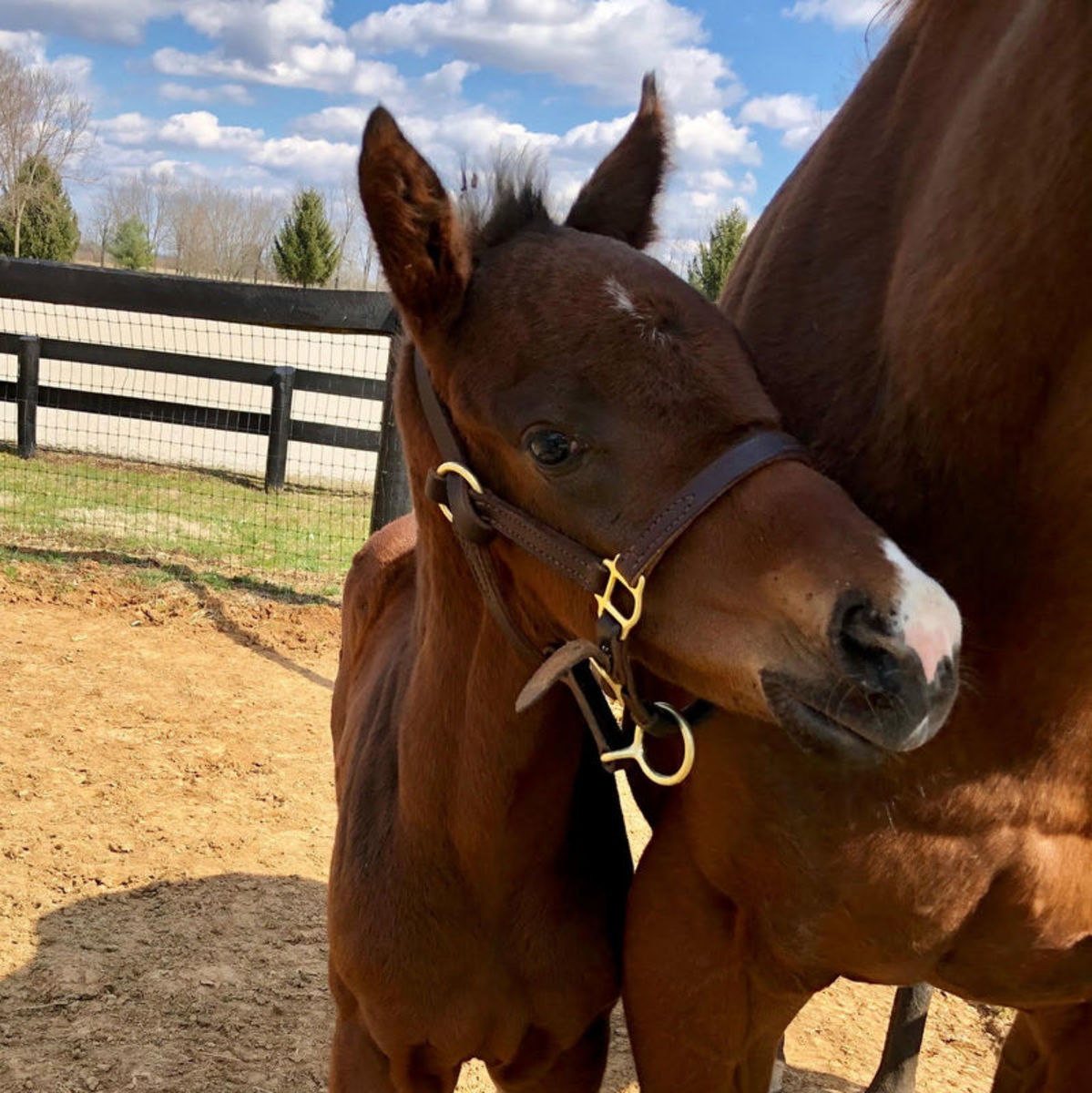
We The People with his dam, Letchworth

The couple nicknamed the colt “Buckworth” due to his propensity for kicking up his heels as he ran in circles around his mother.

“He was a handful, you'd turn your back and he'd run after you,” Roy continued. “He loved playing with humans, and all the way up to doing sales prep with him we could never put another horse in front of him. He always had to be first.”

The Barbes sold their colt at the same year's Keeneland November sale, realizing $110,000 for the weanling from Machmer Hall. Resold through both the Keeneland September sale and the Fasig-Tipton March 2-year-old sale, the colt is now owned by WinStar Farm, Siena Farm, and CMNWLTH and trained by Rodolphe Brisset.

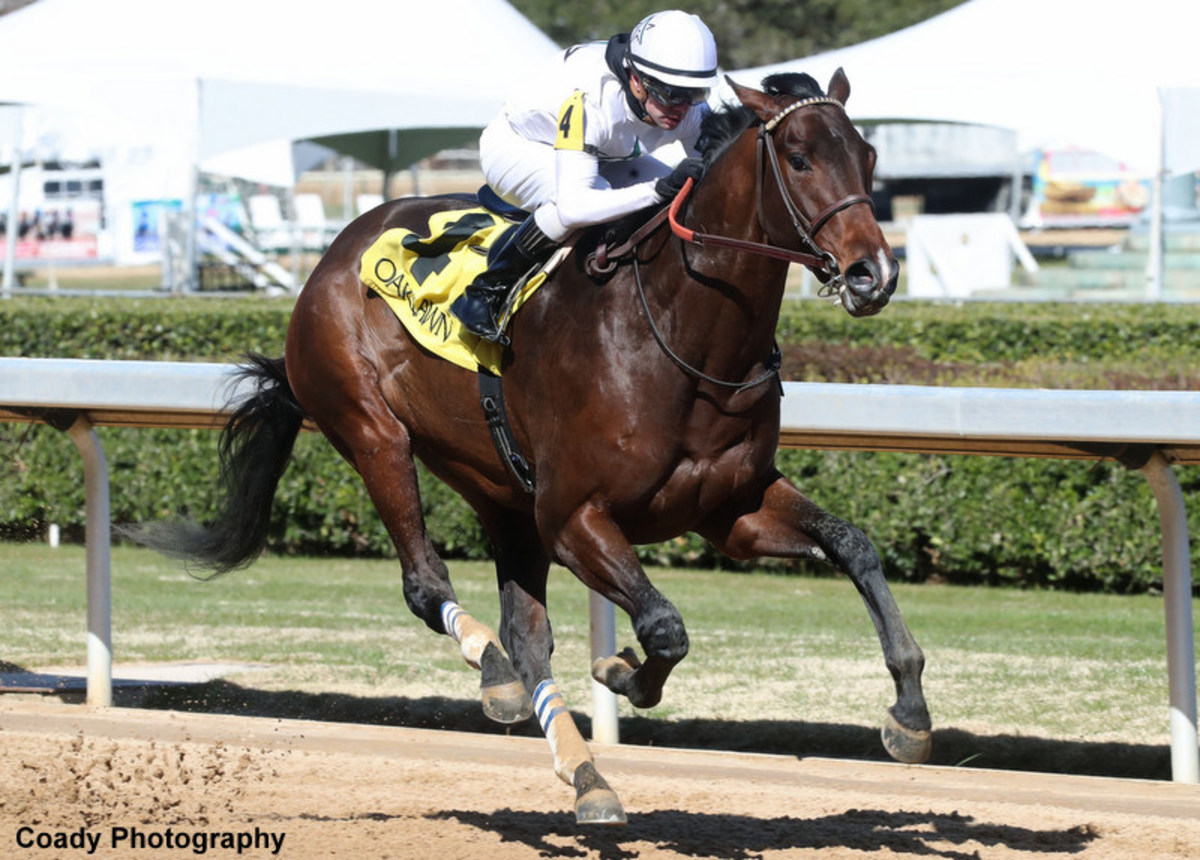
In his first start at Oaklawn Park on Feb. 12, 2022, We The People was the only first-time starter in the field but couldn't have been more professional under Florent Geroux. He rallied three-wide and drew off to win by 5 ¾ lengths, completing a mile in 1:38.93.

One month later in a first-level allowance in Hot Springs, We The People showed a bit more patience when waiting to take the lead until the far turn. Given his cue by Geroux, the colt pulled away to win by five lengths, completing 1 1/16 miles in 1:43.66 over a main track rated “good.”

We the People

Now, connections are planning to enter We The People in the Grade 1, $1.25 million Arkansas Derby on April 2.

“We tell people we weren't in it to win the lottery,” Jana said. “Our approach was to breed progeny that would be commercial, desirable, have good conformation and be likely to race successfully. We weren't gambling on breeding trying to get the next Kentucky Derby winner, which is why We The People is so cool.”

It feels right to have such success on the farm named for Jana's late heart horse, a show hunter named Henley. 

“I had a terrible fall, was carried out of the ring on a stretcher, and Henley was the one who taught me to ride and jump again,” Jana said. “When you drive into the farm, you'll see a picture of Henley on the gate. He was my once-in-a-lifetime horse.”

Today, they keep both their own retired horses and a few retired grand prix jumpers for a friend on the property alongside their burgeoning Thoroughbred program.

“Four of our geriatrics are still rideable; I ride them and so do my daughters when they come to visit, and they like to have a job,” said Jana. “I like to say, 'I've lost a step, they've lost a step, so everybody's happy.'”

On the Thoroughbred side, the Barbes built their broodmare band slowly, increasing from three mares in 2019 to eight in 2022. Jana did most of the research into the mares' pedigrees, she explained, seeking the best, most-established broodmare sires and breeding them primarily to stallions that are fresh off the racetrack.

They don't plan to grow the herd too much more, however.

“Everyone has the option of going large quantity scale, but what we find when we visit some other places is that they become such herd animals and are not as well-adjusted to humans,” said Roy. “Ours are socialized! They kind of get to explore that personal time, they are handled every single day, and we really get to see all the different personalities that just kind of shine.”

For example, one of their current yearlings, a filly sired by Mendelssohn out of a daughter of Ghostzapper, is extremely strong and independent, seeming to believe she's above the antics of all the other babies.

Another colt has developed a reputation for jumping over his four-foot paddock fence, going uphill.

Though most of the foals will be sent through the sales ring, the Barbes keep close track of every horse they've bred. 

“We want to be the type of breeders that, in the event there's not a place for our horses in the Thoroughbred world, we want to offer them a home back here,” Jana explained. “We care deeply about it. We're a small, boutique farm; we've got the land, we care a lot about all of our animals, and we wouldn't want to see anything bad happen to them.

“We get told that our horses know how to take treats, to give kisses,” she continued. “We're here because we want to live with our horses. They always have a home here.”


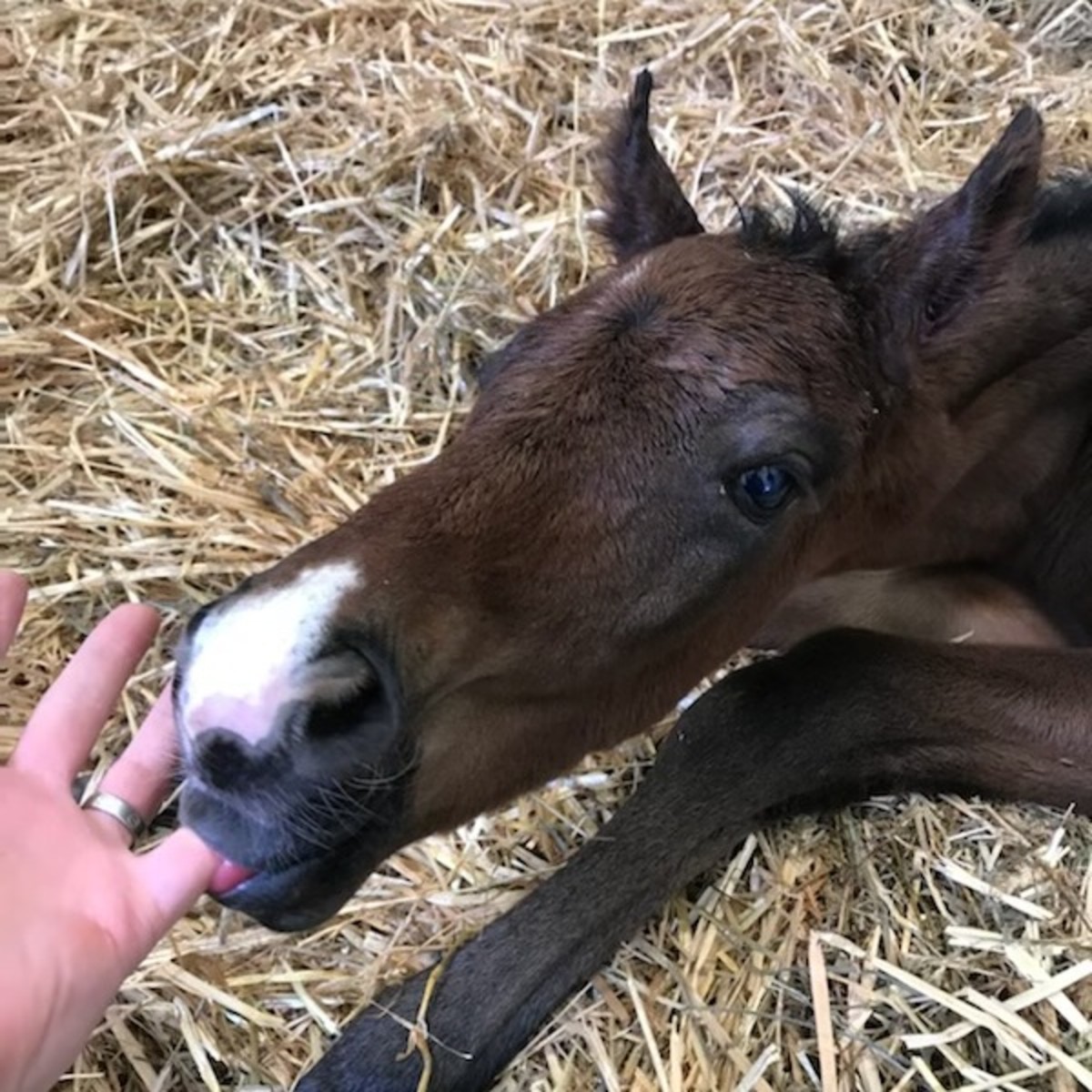
We The People as a foal


The post Breeders’ Cup Presents Connections: First Time’s The Charm For Henley Farms appeared first on Horse Racing News | Paulick Report.

Source of original post

Pour Moi Filly Tops Festival Sale At £370,000

Henry de Bromhead celebrated his two Grade 1 winners at Cheltenham this week by adding the top lot of the Tattersalls Cheltenham Festival Sale to his string. 

The daughter of Pour Moi (Ire), named Kudasheva (Ire), was an eye-catching winner on debut in a point-to-point in Ireland on March 6 and brought a final bid of £370,000. Offered as lot 18 by Pat Doyle's Suirview Stables, the 4-year-old is out of a Hernando (Ire) half-sister to Cheltenham Gold Cup winner Don Cossack (Ger) (Sholokhov {Ire}).

Gordon Elliott will take charge of two of the sale's leading lots after going to £350,000 for Better Days Ahead (Ire) (Milan {GB}), a 4-year-old gelding sold by Warren Ewing of Bernice Stables, whose previous graduates include Tuesday's track-record-breaking Constitution Hill (GB) (Blue Bresil {FR}), winner of the G1 Supreme Novices' Hurdle. Lot 12 was another recent winner from his sole start at the end of February and he will race for Noel and Valerie Moran of Bective Stud.

Elliott also bought lot 5, the 5-year-old gelding Stellar Story (Ire) (Shantou), for £310,000 from Donnchadh Doyle's Monbeg Stables. 

The sale, which took place in the parade ring after racing, turned over £3,353,000 in just over an hour for the 23 lots sold at an average of £145,783.

The post Pour Moi Filly Tops Festival Sale At £370,000 appeared first on TDN | Thoroughbred Daily News | Horse Racing News, Results and Video | Thoroughbred Breeding and Auctions.

Source of original post

Familiar Arguments at Hearing for Baffert’s Stay of Suspension

The hearing on the motion for a stay to be granted for Bob Baffert's 90-day suspension by the Kentucky Horse Racing Commission (KHRC) was held on Thursday, Mar. 16 in the Franklin County (Ky) Circuit Court, with both sides repeating what are now familiar arguments about the initial ruling.

Thursday's court hearing was held after the original hearing scheduled on Mar. 2 was postponed when it became apparent that the KHRC would be holding a special meeting two days later to consider and rule on Baffert's request for a stay. This meeting was held on the appointed day and the KHRC voted 10-0 to deny stays of penalties while Baffert and owner Amr Zedan appeal the drug positive rulings related to the disqualification of Medina Spirit in the 2021 GI Kentucky Derby. These penalties include a 90-day suspension and $7,500 fine for Baffert while Zedan was ordered to forfeit Medina Spirit's purse winnings.

After the KHRC board denied Baffert's appeal for a stay on Mar. 4, the matter was taken to the circuit court before judge Thomas Wingate, who did not give an indication of his final decision after Thursday's hearing but said a ruling would be determined by Monday, Mar. 21.

Baffert attorney Craig Robertson was the trainer's sole representative present in court on Thursday while fellow Baffert attorney Clark Brewster appeared later in the hearing over Zoom.

As Robertson began his opening statement, Wingate asked for clarification on the matter of the penalties that came out of Arkansas in May of 2020 when Gamine (Into Mischief) and Charlatan (Speightstown) tested positive for lidocaine. Both horses were initially disqualified and Baffert was handed a fine and a 15-day suspension, but the disqualifications and suspension were later overturned.

“What the facts showed were numerous issues with the original findings of the stewards,” Robertson explained, citing how one sample that supposedly came from Charlatan was incorrectly labeled as a sample from a gelding. “In the end, they set aside the stewards' ruling with no disqualification.”

In Robertson's opening statement, he discussed how the KHRC was attempting to paint Baffert as having a problematic drug violation history, but said that Baffert's violation record stacks up to virtually every trainer in America.

“Their narrative is false,” he said. “By any objective measure, Mr. Baffert has been a tremendous ambassador for horse racing.”

He continued in pointing out the significance of a 90 day suspension because the California Horse Racing Board (CHRB) has confirmed that they too will honor the suspension set forth by the KHRC. Trainers suspended 60 days or more are banned from all CHRB premises and must forfeit their stalls.

“It would essentially end his Hall of Fame career,” Robertson said. “It's preposterous that we would end a Hall of Fame career over a topical ointment. What's even more preposterous is that we end his career before he can appear in court.”

The KHRC is scheduled for a full hearing regarding Baffert's appeal on April 18th. Up to four days of proceedings are scheduled if needed.

“I'm not asking for you to rule today that Mr. Baffert wins on the merits of this case. That day will come. What I'm asking is that he not be forced to serve his penalty now until his case is heard. If he's forced to serve his penalty now, he can't get those days back if he subsequently wins the appeal. It's not uncommon for stewards' rulings to get reversed by the KHRC itself or by this court,” Robertson said, citing the 2015 Graham Motion case where Motion appealed a suspension and fine handed down by the KHRC. Both were later thrown out by Wingate.

Robertson's arguments placed heavy emphasis on differentiating betamethasone valerate–found in the topical ointment Otomax–and the intra-articular injection of betamethasone acetate. Test results obtained from the New York Equine Drug Testing and Research Laboratory confirmed the finding of betamethasone valerate in Medina Spirit's system.

Robertson noted that while KHRC regulations state that a 14-day stand-down period is required for the intra-articular administration of the corticosteroid as betamethasone acetate, he said that no such violation took place because there was no intra-articular injection of betamethasone as a corticosteroid. In addition, he said that KHRC regulations state that the presence of a detectable concentration of more than one corticosteroid will constitute a violation.

“They only prohibit injections of betamethasone acetate,” he said. “There is no prohibition or regulation of the topical ointment betamethasone valerate and no limit of detection standard unless there is more than one corticosteroid. The KHRC could have specified limit of detection for one corticosteroid or they could have specified for betamethasone topically. They didn't. They are asking for you to read things into the rules that simply don't exist.”

Jennifer Wolsing, the general counsel for the KHRC, began her statement by saying, “There has been a lot of talk about the unprecedented nature of the KHRC's action to deny the stay. It is our position and I would like to submit that Mr. Baffert's conduct is also unprecedented and justifies the stay denial that we have before us today.”

Wolsing went on to explain how Baffert's accrued penalties are “literally off the charts,” how the suspension is justifiable because he presents an elevated risk of re-offense and also how the suspension serves to protect racing participants, the horses, integrity in racing and the public's confidence in racing.

In response to Robertson's comments about the overturned rulings in Arkansas, Wolsing pointed out that Baffert still received fines for the positives from Charlatan and Gamine because the commission found that Baffert was “the absolute insurer of the condition of the horse.” Because Baffert was still fined for both horses, the KHRC considers these occurrence as two separate violations.

Judge Wingate asked Wolsing about the difference in the administration of betamethasone topically and intra-articularly.

“[Regulations] explicitly state, 'Except as expressly permitted in [in 810 KAR Chapter 9], while participating in a race, it is a violation if a horse carries in its body any medication that is foreign to the horse.'”

She went on to state that betamethasone is not expressly permitted, referencing the KHRC's Drug Classification Schedule where betamethasone is listed as a Class C medication. She explained that because the KHRC did not make a distinction as to the form of betamethasone, it therefore indicates that any form of betamethasone is considered a Class C violation. She also notes that a warning is listed on the withdrawal guidelines that states medication administered outside of the guidelines may lead to a positive test result.

“The source of betamethasone is pharmacologically irrelevant to its impact on the horse,” she said. “When betamethasone valerate is absorbed, valerate is cleaved off and you have pure betamethasone in a horse's system.”

When Wingate asked Wolsing about Robertson's earlier point about the KHRC attempting to put Baffert out of business, Wolsing responded by saying that it was not her understanding that the 90-day suspension would put Baffert out of business. She explained that he could transfer his horses to another trainer for that period and said that the trainer could apply for the same stall space and Baffert's employees would not necessarily need to be laid off.

Wolsing concluded, “At the end of the day, we have to look at who is more likely to prevail. Our regulations are very clear. Betamethasone, in whatever form, is completely prohibited on race day…We have unprecedented behavior and it is totally allowable for the KHRC to deny a stay. If it's allowable, this presents the appropriate case to deny a stay.”

Robertson did rebuttal several points from Wolsing's statement.

Addressing her statements regarding the medication specifically, he said that she is relying on a “catch-all” term that betamethasone is a foreign substance, but in looking at the regulations for betamethasone, regulations are clear about the intra-articular injection of betamethasone acetate but nothing is said about topical administration.

“There's nothing in there that says betamethasone valerate is prohibited,” he said. “They could have stated that, but they didn't. They can't go around punishing this man-and putting him out of business and ending his Hall of Fame career– for something they didn't put in their regulations.”

Addressing the fact that Baffert did pay fines for the positives of Charlatan and Gamine at Oaklawn Park, Robertson said that the stewards did not overrule the fines because of political pressure and that while Baffert could have appealed the fines and won, he did not because he considered the overturned disqualification and suspension a victory.

In regards to Wolsing's points about Baffert transferring his horses to another trainer if he is forced to serve the suspension, Robertson pointed out that such a transfer would have to be agreed upon by the other trainer and the horses' owners, and the other trainer would also have to agree to take on Baffert's employees.

“It's not nearly as simple as Ms. Wolsing tried to paint it,” he noted.

KHRC executive director Marc Guilfoil was called to witness to talk about denying Baffert's request to a stay.

When Wolsing asked about his decision, he responded that he put a lot of thought into it and cited the KHRC's mission statement of maintaining integrity and honesty in horse racing. He said that he reflected on Baffert's announcement in November of 2020 where he made several statements including that he would hire Dr. Michael Hore of Hagyard Equine Medical Institute to “add an additional layer of protection to ensure the well-being of horses in my care and rule compliance.” Guilfoil said that to his knowledge, Baffert failed to fulfill the promises made in the public statement.

“Trainer 101 is to look at a medication you're giving and see if there are any prohibited substances,” Guilfoil said, then referencing how Baffert's four medical violations within a one-year time frame averaged to one per 88 starts.

When Wolsing asked Guilfoil how Baffert's case compares to others he has worked on in the past, Guilfoil said, “The word unprecedented has been thrown around quite a bit and I do agree that it is unprecedented, and the two [violations] in Kentucky were two premiere races in the state of Kentucky.”

When Robertson had the opportunity to question Guilfoil, he asked Guilfoil if the executive director could conclude, without question, that he knew Baffert had not attempted to fulfill the promises made in the public statement, to which Guilfoil ultimately said he could not.

Attorney Clark Brewster, who represents both Zedan Racing Stable and Baffert, also gave a statement via Zoom. He too emphasized the distinction of betamethasone administered as a topical or an intra-articular injection and pointed out that prior to Medina Spirit's drug positive, Baffert had only had one medication positive in 29 years of racing in Kentucky. He ended by stating that he was confident that Baffert would ultimately be exonerated.

In order for Wingate to grant Baffert a stay, the judge must conclude that Baffert's stable would suffer irreparable harm without a stay and must also determine that the trainer's appeal could reasonably lead to an overturned ruling at the April 18th hearing.

The post Familiar Arguments at Hearing for Baffert’s Stay of Suspension appeared first on TDN | Thoroughbred Daily News | Horse Racing News, Results and Video | Thoroughbred Breeding and Auctions.

Source of original post
Verified by MonsterInsights