Arizona Stewards Find No Rule Violations, Take No Action In Creative Plan Case

Roughly ten days after the sad story of Creative Plan was received with shock and disgust by many in the racing world, stewards in Arizona have concluded their investigation.

According to a spokesman for Arizona's racing commission, no action will be taken against licensees involved in the horse's care in his last months of life.

“The stewards interviewed multiple individuals regarding Creative Plan and determined no rule was broken surrounding this case,” wrote Maxwell Hartgraves via email. “That said, the Division of Racing continues to evaluate this matter and find improvements to horse racing in Arizona.”

Creative Plan was euthanized Feb. 11 after a veterinarian determined he had injuries too severe to be rehabilitated.

Creative Plan was claimed in his last start at Turf Paradise on Jan. 7, where veterinarians conducting a pre-race examination noted the horse as “racing sound with a choppy jog.” Curt Ferguson, the trainer who claimed the horse said he came out of the race “obviously lame” but not vanned off, and that the horse's previous trainer acknowledged the horse's condition was not unusual for him following a race. Ferguson gave Creative Plan to an employee, believing the employee would rehabilitate the horse for a racing career. Instead, the employee took the horse to a nearby livestock auction and refused to sell him to a group of aftercare advocates, instead abandoning the horse on site. The underbidder on the horse at that sale was allegedly a dealer who has been known to purchase horses for slaughter.

At the time of his death, the horse had an injury to the suspensory ligament so severe that pastern had dropped considerably. Veterinarians who reviewed a copy of a radiograph taken of the same leg in January also noted multiple chronic areas of damage and injury to the suspensory and to the bones in that leg.

Read our complete reporting on Creative Plan here.

Subsequent to the case, Turf Paradise has re-instituted a policy prohibiting licensees from selling a horse for slaughter.

In a meeting of the Arizona Racing Commission on Feb. 15, commissioners and staff indicated the track could see a few reforms aimed at improving safety, including implementing third-party furosemide administration and unspecified changes to claiming rules. Dr. Sue Gale, one of two veterinarians responsible for examining horses pre-race at Turf Paradise, also requested more help in flagging horses in need of further scrutiny based on identified risk factors.

At the time of that Feb. 15 meeting, the fatality rate for the current Turf Paradise meet was 2.98 per 1,000 starts — more than twice the national average of 1.41 per 1,000 starts in 2020.

The post Arizona Stewards Find No Rule Violations, Take No Action In Creative Plan Case appeared first on Horse Racing News | Paulick Report.

Source of original post

Horowitz On OTTBs, Presented By Excel Equine: Good Horse People Know There’s Always Something To Learn

Horses can be a lot to handle, and Thoroughbreds, being regarded as hot-blooded compared to other breeds, can be particularly extreme in both their positive and challenging moments. 

For starters, most horses can outweigh their riders by about 1,000 pounds. When riders ask horses to do something, whether it be on the ground or in the saddle, there can be a lapse in communication hindering the achievement of the desired outcome for a multitude of reasons.

For example, let's take galloping a horse on the racetrack or trotting a horse through water. While the mechanics of galloping and trotting are natural to horses—they will display those gaits when left to their own devices in a pasture or in the wild—it may not go as smoothly with a rider on their back in the environment the horse and rider now find themselves together. 

A horse may be unsure or overwhelmed by the environment. A horse may not understand what the rider is actually asking. Or, because horses, and especially Thoroughbreds, are incredibly perceptive, free-thinking, and not just robots that can be programmed to do whatever their user wants, they may simply say “no” to what's being asked. Because Thoroughbreds are extreme, as I wrote about last month in “'Quirky' Kubo Cat Dished Out Challenges On Path To Success,” that “no” may be accompanied by a metaphorical middle finger.

At this point, the rider gets to choose a response. The challenge is that the ends of the spectrum in the severity and expression of that response are both wrong and potentially dangerous for both horse and rider.

On one end of the spectrum is doing nothing. Now the horse is in control. The rider is relegated to passenger. A poll conducted by Morning Consult in September 2021 found that 47 percent of people believe self-driving cars are less safe than human-operated cars. So, now consider a self-driving horse. As appealing as a driverless car with the technology that Tesla is developing might seem to some, imagine that technology programmed by a horse.

On the other end of the spectrum is excessive force, and the horse racing industry and equestrian world at large are currently reckoning with a disturbing video of Mark Todd, a seven-time Olympic eventer and now a racehorse trainer based in England, hitting a horse with a branch multiple times to encourage the horse and rider to go forward into water at a training clinic that took place in 2020. The British Horseracing Authority has suspended Todd, and Todd said in a statement that he “is very disappointed in myself” for violating “a mutual respect between horse and rider and that patience and kindness is the best way to get results.”

The Todd video is a lesson in what not to do. However, we (considering myself as part of the horse racing industry and equestrian world at large) can do more than just express our outrage at Todd's behavior. Don't get me wrong, it's important to express that outrage. However, what's wrong about the video is pretty clear from the video itself. It doesn't require every person feeling like they have to post the video and establish that they are against that type of behavior.

What's more important is that we go a step further and have a meaningful discussion about the tough topic of teaching and disciplining horses. Best practices across all sports are evolving. Football may be the most notable sport that has had to reconcile with player safety. How coaches encourage players to “get back in the game” has evolved from a stern warning about toughening up to specific protocols to follow if a player suffers a concussion. The key is that the focus is shifting from what's best for winning to what's best for the athlete's health and wellbeing.

Horse racing is still trying to figure out that shift. What's accepted at the track is still mainly driven by winning. Many medications are given to horses because it gives them the best chance to win. The perception, unfortunately, is that even the ones caught administering medications improperly—whether that be those that are illegal, those that are present above an allowable threshold, or those that are not prescribed for that specific horse—still only receive a “slap on the wrist.” Pushing horses to compete through injuries, perhaps minor ones, is about winning when taking a little extra time off may be in the best interest of the horse. 

If Todd, for whatever positives he contributed to the equestrian world that earned him a knighthood, should get his license suspended for his actions in the video that has surfaced because people believe he put the wellbeing of the horse in jeopardy at the expense of the horse's development in the sport of eventing, there should be more accountability for similar actions that are not in the best interest of the horse but are still accepted as standard practice.

I don't know whether using a lunge whip or a crop on the horse in the Todd video would have made the situation better. I don't know whether using a lip chain to walk a horse is always the best option and how that compares to a nose chain or just a plain lead line. However, I do know it's time we start asking some questions and having difficult discussions rather than just assuming we have the answers and posting about that on social media. 

Sometimes a little curiosity and being open to new ideas are just what we need to actually get to the answers that will ultimately make a difference. It doesn't matter how long someone has worked with horses; good horse people know there's always something to learn. Bottom line, let's educate ourselves, learn from our mistakes, and grow from them. 

The post Horowitz On OTTBs, Presented By Excel Equine: Good Horse People Know There’s Always Something To Learn appeared first on Horse Racing News | Paulick Report.

Source of original post

At 86, Lukas Eyes Kentucky Oaks Win With Secret Oath

Wayne Lukas has won the GI Kentucky Oaks four times, but should there be a fifth this year it would no doubt be among the most special accomplishments of this Hall of Famer's career.

He's no longer able to attack the race with an arsenal of well-bred, expensive and talented horses sent his way by some of the sport's biggest owners. Those days are long gone. Instead, the 86-year-old trainer will have to overcome the odds and an inherent bias in the sport against older trainers and try to win the Oaks with the best filly he has trained in some time, Secret Oath (Arrogate). Lukas is hoping she takes another step toward the Oaks with a win in Saturday's GIII Honeybee S. at Oaklawn Park, where she will likely be a solid favorite.

“I have been there already and have had that experience, but at 86 it's quite a nice feeling to know that there is maybe one more in the history books out there for me,” Lukas said.

It's not just Lukas. The sport has a way of turning its back on older trainers, no matter how successful they may have been at one point. Lukas has averaged 17 winners a year since 2018 and, prior to Secret Oath's win in the Martha Washington, his last stakes win came in the Apr. 4, 2017 GIII Commonwealth S. at Keeneland with Warrior's Club (Warrior's Reward).

“I don't want to be shuffled to the back burner,” he said. “I don't want the young guys who weren't around when we were having so much success… I don't want them to look over and say, 'That old man over there, he used to win races.'”

The dominant trainer in the sport in the eighties and for much of the nineties, Lukas was forced to reinvent himself about 20 years ago. Once having a 100-plus horses with barns spread out across the country, he's down to one division, which divides the year between Oaklawn and Churchill Downs. Lukas has 25 horses and no longer has the luxury of working for deep-pocketed owners who supply their trainers with an assembly line of talent. Typical of the type of owners Lukas has, Secret Oath, a homebred, is owned by Robert and Stacy Mitchell, and she is their only horse in training.

“We didn't start out with six fillies like this one,” Lukas said. “We started out with one. We're probably beating the odds that an old man like me with a one-horse stable could take this to the next level.”

Yet, Lukas has never shown any signs of bitterness nor has he allowed himself to feel sorry for himself. Rather, he's gone about his business the same as he always has since getting started with Thoroughbreds in 1977. That means showing up the barn early every morning and putting in a full day of work while trying to get the best out of every horse in his stable. He may have slowed down some, but just some. For someone his age, his energy level is remarkable.

“I love the competition,” he said. “I've always wanted to win the big ones. My energy level comes from a passion for the game. I'm getting a lot more speaking engagements where people want me to answer that question, what keeps me going? I don't think about it. It just comes natural. It's something I've been doing my entire life and as long as my health is good, which it is, why stop?”

His daily routine includes getting on a pony and supervising morning training from that vantage point. He's not about to stop doing that, but he admits it's no longer as easy as it used to be.
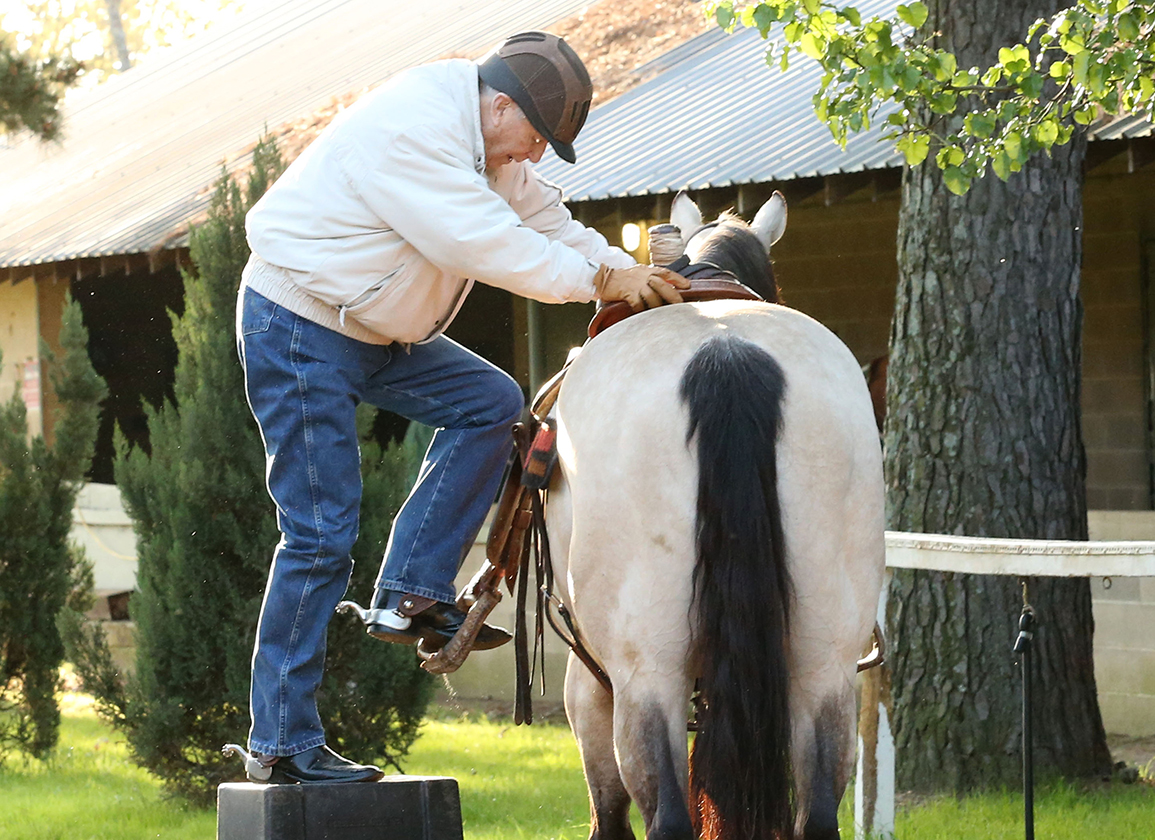
“I have a little more trouble getting on the pony and a little more trouble getting off him.” | Coady photo

“I have a little more trouble getting on the pony and a little more trouble getting off him,” Lukas said. “I don't just bounce off him. I call one of the assistants over and say that I'm getting off, catch me if I fall.”

He says that he is enjoying training a small stable, which has its advantages.

“I like the fact I can go out there and get on my horse every morning,” Lukas said. “I get on my saddle pony and I am able to deal one-on-one with every horse in the barn. Even if it were offered to me, I wouldn't want a stable in New York, one in California and one here. Those days beat me up. It doesn't have any appeal anymore.”

Secret Oath took a while to figure things out. She won one of her first three starts while posting modest Beyer figures and was drubbed when trying stakes company in the GII Golden Rod S. last fall at Churchill Downs, where she was fifth, beaten 11 1/4 lengths.

Everything changed in a Dec. 31 allowance at Oaklawn. Out of nowhere, she won by 8 1/4 lengths while earning a 93 Beyer figure. Lukas brought her back in the Jan. 29 Martha Washington S. and she turned in another huge effort, winning by 7 1/4 lengths.

“We thought from the very beginning that she would win races,” Lukas said. “You never know how far they are going to go. She gets over the ground so beautifully. She tipped her hand. We ran her in that allowance race with some good horses to see where we were at and that race was beautiful. You couldn't have scripted it any better than that. When she came back in the Martha Washington, we were looking for that same type of performance and actually we got a full duplication of that race. We are high on her and we're getting optimistic. We will go into the Honeybee full of hope. When she accelerates she does so so quickly she just breaks their heart.”

Lukas will also be represented in the $1-million GII Rebel S. Saturday at Oaklawn with Ethereal Road (Quality Road). He's coming off a maiden win where he broke slowly, was last of 12 and then closed with a rush to draw off to a four-length win. He'll be a longshot in the Rebel, but Lukas said he is high on his chances.

“Our little barn has some balance to it,” he said. “We might have a Kentucky Derby prospect, too.”

Thirty-two years after he last won a Kentucky Oaks in 1990 with Seaside Attraction, Lukas seems comfortable in his role as the sport's elder statesman. He said he finds it gratifying when younger trainers come to him seeking his advice, which he is happy to give.

“At this stage of my career, I think I owe it to the industry to do the best job that I can,” he said.

Should Secret Oath get to the Oaks, Lukas will be the story, the octogenarian trainer seeking one more coveted win. His glory days are well behind him, but it's not like he has forgotten how to train a good horse. He's been doing his very best to show that 86 is just a number. So is five, the record for most wins in the Kentucky Oaks, which is held by Woody Stephens. Lukas needs just one more win to tie him. Can he do it? Why not?

The post At 86, Lukas Eyes Kentucky Oaks Win With Secret Oath appeared first on TDN | Thoroughbred Daily News | Horse Racing News, Results and Video | Thoroughbred Breeding and Auctions.

Source of original post

Jockeys’ Guild Praises Santa Anita Management’s Quick Action After Riders’ Turf Concerns

A pair of scratches were necessitated in Sunday's finale at Santa Anita Park in Arcadia, Calif. when jockeys Flavien Prat, Drayden Van Dyke, and Ryan Curatolo declined to ride in the six-furlong turf contest for maiden 3-year-old fillies. According to the Daily Racing Form, the jockeys made that decision based on the condition of the turf course.

“To me, it's slippery,” Prat told DRF. “I didn't feel safe riding. I don't know why it is like this. To me, you can't ride properly.”

With holiday racing scheduled for Monday, track maintenance crews went to work late on Sunday and continued early Monday morning. DRF reports that the course was mowed and aerated.

A group of jockeys, track officials, representatives of the California Thoroughbred Trainers Association and of the California Horse Racing Board all walked the course prior to racing, and four races were conducted without incident.

The Jockeys' Guild released the following statement on Thursday:

“Over this past weekend, an issue with the turf course at Santa Anita came to light and brought to the attention of management by the jockey colony. Any safety issues were addressed by management as quickly as possible. After the jockeys walked the turf course on Monday morning, they were confident the situation had been resolved and rode the entire card.

“The turf course at Santa Anita is acknowledged as one of the best in the world and the jockeys appreciate that the management of Santa Anita always makes the safety of the riders and horses their top priority. The jockeys will continue to work with management to resolve any issues that may arise in the future.”

The post Jockeys’ Guild Praises Santa Anita Management’s Quick Action After Riders’ Turf Concerns appeared first on Horse Racing News | Paulick Report.

Source of original post

Verified by MonsterInsights