Sir Dudley Digges, the winner of the 2016 Queen's Plate, has been sold to Signature Equestrian in Stayner, Ontario, where he will both stand as a stallion and be trained for hunter and jumper events, Canadian Thoroughbred reports.
The 9-year-old son of Gio Ponti entered stud last year at the Ontario farm of Cole Bennett, who purchased the horse for $6,700 at the 2020 Keeneland November Breeding Stock Sale. He did not have any activity on The Jockey Club's Report of Mares Bred last year in terms of Thoroughbred mares, and Bennett kept riding the stallion.
Bennett listed Sir Dudley Digges for sale last week on social media, which drew attention from a broad spectrum of the North American racing sphere. He was ultimately sold to Candice Rainey of Signature Equestrian, which has experience standing Paint Horse stallions, and offers a variety of services from breeding and boarding to show training.
Sir Dudley Digges won seven of 32 career starts and made $939,690. In addition to his Queen's Plate score, he won the Old Friends Stakes at Kentucky Downs, guaranteeing him a spot at Old Friends Equine Retirement in Kentucky, should he need it. Owners Ken and Sarah Ramsey also shipped the horse to Barbados, where he won the Sandy Lane Barbados Gold Cup in 2018.
The 2021 Irish Thoroughbred Breeders' Association National Breeding & Racing Awards will be held on Sunday, Feb. 27, 2022. In person for the first time in two years due to the covid pandemic at The Heritage in County Laois, the awards will be live streamed from 10 p.m. local time and are available to view on the ITBA's website.
At first glance, it looks like a movie you've probably seen already. A horse-crazy girl leads her family into racing and, against all odds, they end up in the winner's circle after a big race. Only, for Gaylene Smith and her family, it's no movie. It's real life after Smith's 8-year-old granddaughter London asked for a racehorse early last year. Less than a year into operation, Smith's Willow's Green Stable won its first stakes race with Timeless Bounty (Elusive Hour), a $15,000 claim who took the family to Santa Anita for the GI Malibu S. last December and who will represent them in the GIII General George S. at Laurel Park Saturday.
“It all started with my granddaughter, she's a horse person,” Smith explained. “She started riding when she was five. She wants to do barrel racing and is working towards that as we speak. She is obsessed with all things Heartland and all things Secretariat and Seabiscuit. We were sitting there one day and we had just watched a race on T.V. and she had watched those two movies about 400 times. She said, 'I think we should have a racehorse.' I was originally kind of shocked. I said to my son, 'What do you think we have to do?'”
Smith's son Jeremy threw himself into the new endeavor.
“My son is a research person, so he started researching,” Smith said. “Last spring we got our first horse. And now we have 11.”
Before venturing into racing, the family had already come together to care for Smith's ailing 97-year-old mother at their Ohio home.
“We bonded because we all have shifts,” she said. “We all live together now because of my mom. We insist on keeping her home and I work full time, besides having race horses. So my son and his family, they have their shifts. My grandson is 21 and he has his shift. We bonded over my mom.”
Focusing on racing became something else for the family to bond over. And they aren't just weekend warriors. The Willow's Green horses, trained by longtime family friend Dave Wilson, Jr., are stabled on a farm where they receive individualized attention.
“Some people say we have a petting zoo,” Smith said. “They are all so different, they are all trained by Dave according to their personality. They don't all train exactly the same. It's the same basics, but the approach is different. We don't do anything with them for a few weeks. We let them evolve and try to figure out what their heads are like. Some of them are a little more difficult than others. And some of them are like big dogs.”
She continued, “We just have a different approach from what we've seen. We don't let them out in the pasture and do crazy stuff like that, but they are happy when they are at the farm. We
can be more hands on. We do have people to do stalls, but we do them, too. Dave is involved. Tim Maxey, our farrier, is like a family member, too. And we are all just kind of rocking and rolling with the horses and the races, and discussing which race is the best one.”
London Smith may just be the family's secret weapon.
“London came along and she's different,” Smith said with a chuckle. “They call her the horse whisperer. It doesn't matter if we just bought a horse that day, she wants to go in the stall and get them to lie down and lay down with them and talk to them. She says, 'I need to talk to them.'”
Last October, Willow's Green Stables made what would turn out to be its biggest acquisition to date, claiming then 3-year-old Timeless Bounty for $15,000 at Thistledown. Just two starts later, the colt became the stable's first stakes starter when he went postward as a 59-1 outsider in the $250,000 Steel Valley Sprint S. In an ending worthy of Hollywood, Timeless Bounty produced a powerful late rally to defeat a field which included established stakes performers Jaxon Warrior (Munnings) and Baby Yoda (Prospective) and earned over 11 times his claiming price.
“We got him in October and we didn't really know him that well when he shocked the hell out of everybody,” Smith said. “That day is a day I will never ever forget in my life. I would have been ecstatic with fourth or fifth because there were some nice horses in that race.”
Asked what it was like to watch her colors carried to victory in a stakes race, Smith said, “It was such a shock. My son just literally collapsed. We were speechless. I kept saying, 'Oh my God. Oh my God.' I'm crying, my son is crying. And London was saying, 'Daddy he just won.' Like why are you idiots crying? No matter what happens in the future, no day will be like this one.”
In recalling the day, Jeremy Smith used the word surreal more than once.
“We shed a lot of tears,” he said. “Our family has been going through quite a bit here lately with my grandmother not doing well. We've had some ups and downs as a family. The hugs, the tears and the embracing, was something that I don't think any of us will ever forget for the rest of our lives. It had nothing to do with the money–I don't think any of us could have told you what we'd won. That's what I think was neat about it. He was a representation about what our family has been through. He was off the pace, a 59-1 longshot, kind of an underdog. You get knocked down, some people give up on you, but you don't give up on yourself and you find a way to dig down deep and keep going. That's what he did in there. He wasn't expected to win. No one gave him a shot and I think he was just a representation of who and what we are as a family. If that makes sense.”
The victory earned Timeless Bounty and the Smith family a trip out West to test the deep waters in the Dec. 26 GI Malibu S. where he would finish fifth behind superstar Flightline (Tapit).
“He deserved the opportunity to be in that race,” Gaylene Smith said. “He had earned the right to be there. And so we flew him out there. I flew out there with some of my family and some of my family were already out there with him. There were lots of people–it's not like races out here– and we got the royal treatment, the meal, the whole nine yards. It was quite an experience. It was so different.”
Jeremy Smith described his first trip to Santa Anita like visiting the historic home of baseball's Chicago Cubs for the first time.
“It was an honor to be at Santa Anita–just going there and seeing the backdrop of the place. It was kind of like going to Wrigley Field for the first time,” he said. “You just felt the history of the place. It was beautiful.”
Of competing against a horse like Flightline, Jeremy Smith added, “Flightline is a special horse and it was an honor to be in that horse's presence and watch him run. He ran so effortlessly. It was an honor to be in a race with him.”
Timeless Bounty will get another try against graded company when he faces six foes in the seven-furlong General George Saturday at Laurel.
“We are excited,” Gaylene Smith said of the upcoming race. “I hope he does very well and makes himself proud.”
Smith is also looking forward to retiring from a 30-plus career in the food services industry to spend more time with her growing racing stable.
“I would love that. I would absolutely love that,” she said.
Looking at the winding road that has led to the 11-horse stable, Jeremy Smith said, “We have just been blessed and are enjoying the journey. That's what it comes down to. We didn't get into this business thinking it was going to be something that would take over our lives. But ever since we got into it, it's pretty much consumed all of us. There are no days off, it's around the clock. But honestly, I don't know if any one of us would change anything. Win, lose or draw, I think these animals have touched our lives in a different way. If none of them ever ran a race again, I think we would have a very tough time getting rid of any of them. They have become part of the family. They have welcomed us into their herd and we are blessed to have them in our life.”
Gaylene Smith is looking forward to the stable settling into its second year of existence.
“Last year, we had to start up, we didn't have anything,” she said. “We didn't have tack. We had to get everything. So hopefully this year, it will be a little bit more relaxed. As a family effort, it has been absolutely marvelous.”
According to statistics presented by Arizona state veterinarian Dr. Susan Gale at a special meeting of the Arizona Racing Commission on Feb. 2, 22 horses had died at the track since the start of its current meet on Nov. 5, 2021. That's a rate of 2.8 per 1,000 starts. The national average in 2020 was 1.41 per 1,000 starts.
At that meeting, a frustrated commissioner Rory Goreé went so far as to declare, “we keep killing horses like this, we're going to be out of business … and I have to ask myself – how did we get to this point?”
The commission is due to have a regular meeting on Feb. 15, where Gale will give a track safety report, presumably including updated fatality numbers. One horse who likely won't be included in that running total is Creative Plan.
The 5-year-old gelding by Creative Cause was euthanized Feb. 11 shortly after arrival at Premier Equine Rehab in California. He ran his last race on Jan. 7, a starter optional claiming event in which he struggled home last of nine.
“Upon our veterinarian's evaluation yesterday which included X-rays, it was determined Creative Plan never should have been allowed to run at Turf Paradise on 1/7/2022 and would never be able to live a life without pain, even as a pasture pet,” said Jenny Earhart, owner of Premier Equine Rehab, in a Facebook post published Feb. 12. “I asked [the vet] so many different ways [if the horse could be rehabilitated] he started looking at me like I had lost my mind.”
Earhart's veterinarian diagnosed Creative Plan with severely compromised suspensory ligaments and soft tissues in his left front leg. Both front fetlocks had osselets, but the right front was not evaluated further after the veterinarian saw the severity of the issues in the left front. That suspensory ligament was so swollen and had dropped so far against the back of the horse's leg that the skin containing it had begun to split and ooze.
An image Earhart took of Creative Plan's left fetlock prior to euthanasia showing the swelling and breaks in the skin she attributes to a failed suspensory ligament, among other issues
Earhart said she gave the horse a dignified last day before scheduling humane euthanasia.
“He got to eat grass,” she said. “When I got up to his stall, I try to stay really strong about everything, but when I got to his stall, he hobbled around and did an about face to me. He knew. He was smart. He was a good boy.
“It's mind boggling to me that it was allowed to go on. It just seemed like it was so preventable.”
For many people, the story of how Creative Plan came to be euthanized at Earhart's facility a month after his last start is a symptom of the way the system has failed to protect horses at the often-embattled racetrack.
The bay gelding began his career in summer 2019, when he was running in Maryland and Kentucky in maiden special weights. He finished third in the listed Mystic Lake Derby at Canterbury Park in 2020 and spent 2021 bouncing between New York, Louisiana and Minnesota before ending up at Turf Paradise for a $16,000 tag in a starter optional claiming race in late 2021 with Wade Rarick. On Jan. 7, trainer Curt Ferguson claimed Creative Plan from Rarick for $8,000 on behalf of his wife, Debbi.
Ferguson said in a statement to the Paulick Report that he became aware pretty quickly there was something wrong with the horse.
“When this horse came back to our barn, he was obviously lame and should've been vanned off,” read Ferguson's statement. “We picked him up from the claim pen and took him back to the barn. It was clear that the horse was injured. Having spoke[n] with the previous trainer he said 'Oh, he's been like that and in two or three days he'll be bouncing and playing.' That was true to a small degree, but I knew this horse should never race again.”
Photos taken around the time of that early January race show the horse with swelling in his front fetlocks and noticeably different pastern angles. Ferguson asked Dr. Jenyka Bergsma to evaluate and radiograph the horse on Jan. 11. One of those images would later end up in a Facebook post that went viral, and Ferguson said he did not authorize its publication.
According to veterinarians consulted by the Paulick Report, the radiographic image showed multiple serious issues in the horse's pastern and fetlock, and also evidence that the suspensory ligament had some chronic damage. The angle of the leg in the image suggested that the suspensory ligament was still seriously damaged, preventing the joint from functioning normally. With the caveat that they had not examined the horse personally, the veterinarians agreed the damage evident on that image was not all recent, and had probably been ongoing for months prior to the image capture. They also indicated the horse would have shown signs of discomfort as he incurred that damage.
There seems to be some confusion as to what happened next. In a series of stewards' meetings about the incident some weeks later, there would be conflict surrounding veterinary opinions. Ferguson and the Arizona Department of Gaming say Bergsma determined on Jan. 11 that the injury was “not severe enough to cause the horse to be euthanized and recommended stall rest at that time,” according to a spokesman for the department.
Rehoming advocates told the stewards a number of veterinarians had seen the horse's radiographs in January and declared the horse a euthanasia case then.
Ferguson ultimately gave the horse to an employee named Joey Prentice. Prentice reached out to Mary Tate and Ashlee Wolf, who co-manage a service advertising retiring horses for sale to second careers and screening potential purchasers to ensure good matches. Tate and Wolf both saw the horse on or about Jan. 17, some ten days after his race. At that point, Tate recalled, both front legs were swollen and warm to the touch and the right fetlock made a clicking noise when the horse walked. Prentice told them he wanted to list the horse for sale for $750, but Tate and Wolf were hesitant to do that without more information about the horse's prognosis.
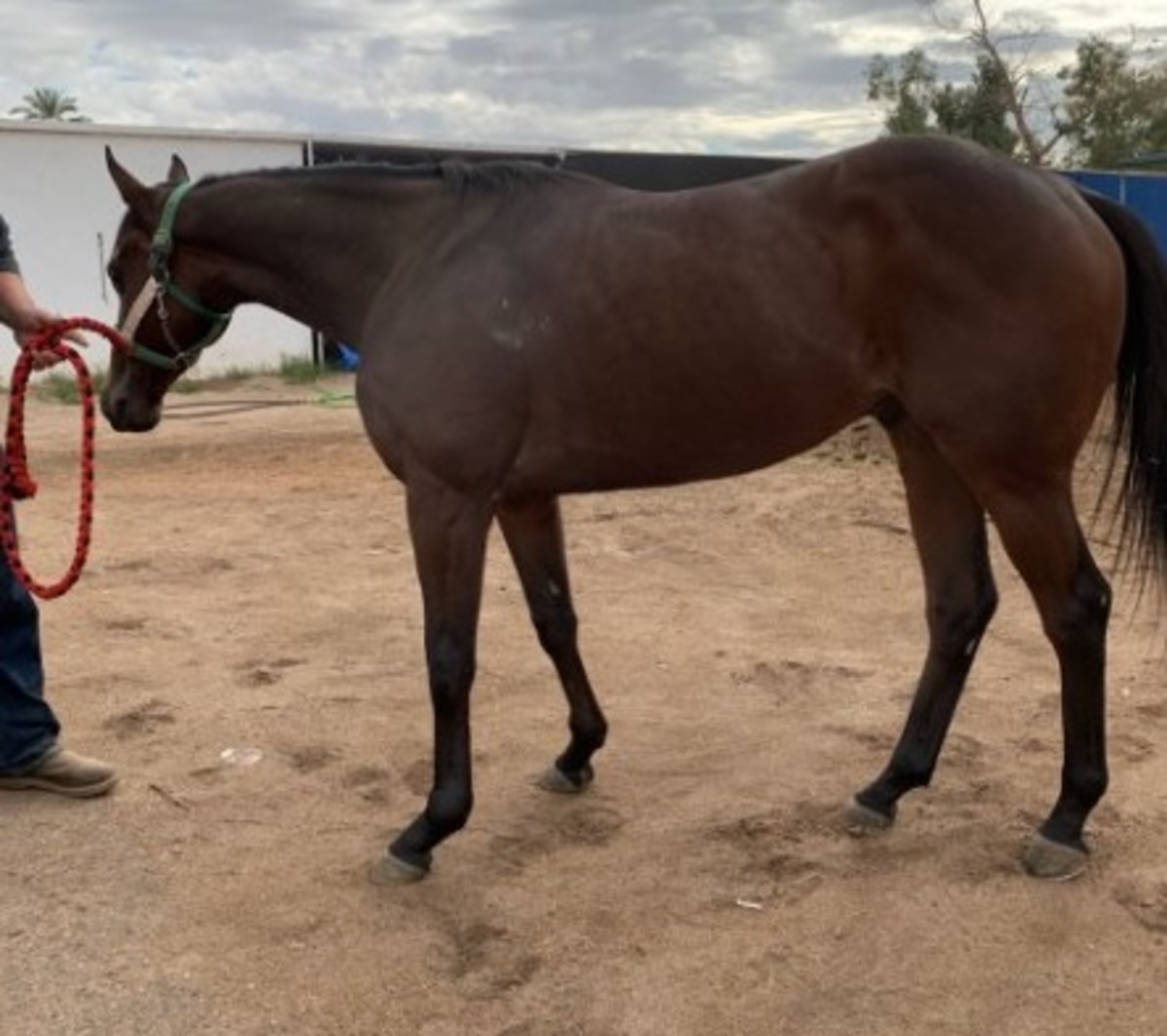
An image taken of Creative Plan after his last race in January
“Neither of us were OK with the situation because the horse was in obvious pain standing, had an obviously dropping fetlock and he made that noise when he walked,” Tate said.
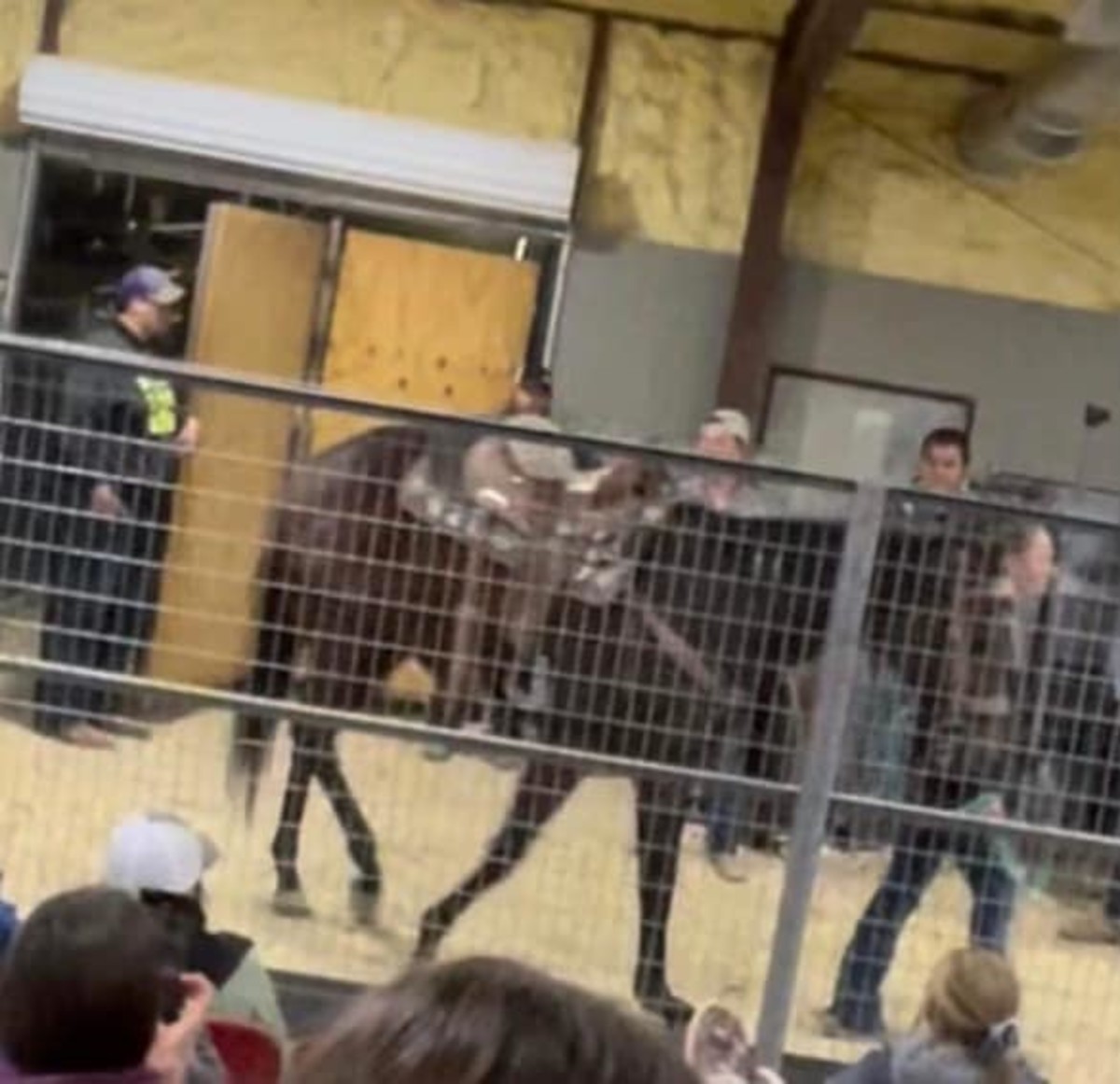
Tate offered to purchase the horse from Prentice to give him the humane euthanasia she believed was necessary. Prentice declined, and took the horse to Murphy's Livestock Auction in Buckeye, Ariz. It was there, on Feb. 5, that Tate and others saw Prentice walk the horse to the auction ring.
Tate says she bid $500 for the horse and that the underbidder at $450 was a trader well known for purchasing horses for slaughter. Tate believes Prentice recognized her, and declined to sell the horse. He would later abandon the horse at the auction house.
“When I gave [the horse] away, I was told that they were going to give him time off to heal and rehabilitate,” said Ferguson. “Sometime later I found out on wonderful, trusted social media that he was taken to an auction. It has been said he was taken to a kill auction, it was not a kill auction, and in fact kill auctions are illegal in the state of Arizona. The auction also said they do not allow kill buyers into the auction.
“The person whom took the horse to the auction pulled the horse from the sale because they believed the people bidding (were) in fact buying the horse to euthanize. There were unwise decisions made through the sale issue but when I found out that the horse was at the sale barn and then left, I instructed someone to go and get the horse and bring him to my house immediately. I was not going to allow for this horse to fall through the cracks any further and be mistreated under any circumstance.”
Accounts of the horse's trip, from claiming race to livestock auction and back again, hit social media the week after Ferguson sent a representative to pick the horse up from Murphy's, and prompted many people to cast aspersions – on Rarick, on Ferguson, and on others, which Ferguson says he feels is unfair.
An image shared on social media showed Creative Plan going through the auction ring at a livestock sale in early February
“After all of this, I am not only out the money it cost to claim the horse whom should have never raced but I have been defamed and slandered on social media from people who do not know me and did not have the facts,” said Ferguson. “Not one single fact. For people to jump on the bandwagon further spreading lies and disinformation is a horrible thing for someone to do.”
It also has people asking questions about how this could be allowed to happen.
According to Maxwell Hartgraves, public information officer for the Arizona Department of Gaming, there are two veterinarians responsible for conducting pre-race examinations on horses in the morning – Drs. Sue Gale and Jenyka Bergsma.
(The Paulick Report requested an interview with Gale but was told she could not be made available and directed a list of questions to Hartgraves instead. Bergsma did not respond to an email requesting an interview.)
Bergsma maintains an active client base on the backstretch at Turf Paradise and works as a private veterinarian when she's not doing pre-race examinations, which is why she was called to assess Creative Plan on Jan. 11 after Ferguson claimed him.
It was also Bergsma who examined the horse on the morning of Jan. 7 and cleared him as fit to start from Rarick's barn.
“The horse was found racing sound with a choppy jog (shortened stride),” said Hartgraves of the horse's pre-race exam on Jan. 7. “This was the horse's third race at the Turf Paradise meet. The two previous pre-race exams found the horse racing sound.”
Hartgraves said that in cases where there are “conflict of interest concerns” regarding a client of Bergsma's, Gale performs the pre-race examination.
[Story Continues Below]
Creative Plan had a history on the veterinarian's list in other jurisdictions. He was placed on the list in December 2020 in New York for unsoundness and then cleared from the list in February 2021. He ended up on the stewards' list in New York on March 7, 2021, for poor performance in a $16,000 claimer and was cleared from the list April 22, 2021. He didn't return to the post in New York after that.
At that time, Creative Plan was trained by owner Karl Broberg, who moved the horse to Louisiana Downs for his next start on May 4, 2021, where he was fourth running for a $7,500 tag.
This image shows the condition of Creative Plan's ankles just prior to euthanasia in February. Photo courtesy Jenny Earhart
A report generated by the Arizona Department of Gaming examining the spike in breakdowns in Arizona in 2017-'18 indicated that pre-race exams were performed for the first time that season and consisted of palpation of limbs and observation of horses at a jog. At that time, horses were selected for pre-race examination based on a set of risk factors including the frequency of races and workouts, previous poor performance, age, and others. Back then, the report indicated there were consistently more horses identified as at-risk than could be examined in a day. The state's website now indicates that all horses are examined prior to racing.
Trainers who spoke with the Paulick Report have mixed opinions as to whether those pre-race examinations necessarily go the way they're outlined in state code. One indicated that horses weren't always palpated and may only have to jog a few steps, while another said the outlined procedures were consistently followed and that horses may sometimes be jogged a second time for veterinarians who wanted a closer look.
Turf Paradise general manager Vincent Francia said the track is adequately staffed in the afternoon with veterinarians to oversee racing, but was unaware whether Creative Plan was added to the veterinarian's list after leaving the claiming pen with Ferguson on the January day Ferguson said the horse came out of the race lame. Hartgraves did not indicate the horse had a history on the veterinarian's list in Arizona.
Pre-race examinations are not the only area of concern when it comes to safety oversight at Turf Paradise. There have been multiple incidents since the start of the meet in which the equine ambulance has in some way failed to assist an injured horse – one where the horse was loaded improperly, and one in which the ambulance was unable to access the injured horse.
The same state codes that guide pre-race veterinary procedures also outline procedures for some therapeutic medications. One non-steroidal anti-inflammatory drug may be given up to 24 hours pre-race in Arizona. A second may be given if it's withdrawn 48 hours in advance of the race.
There are no procedures outlined for corticosteroid administration, or any other medications being injected into the joint. When injected intra-articularly, corticosteroids can be used to promote long-term healing in a joint, but can also produce a temporary analgesic effect for a horse suffering from injury. In other jurisdictions, regulators and racetracks have set, then backed up, the administration windows for corticosteroid joint injections, citing concerns that the medication could mask pain during a race or during a pre-race veterinary inspection.
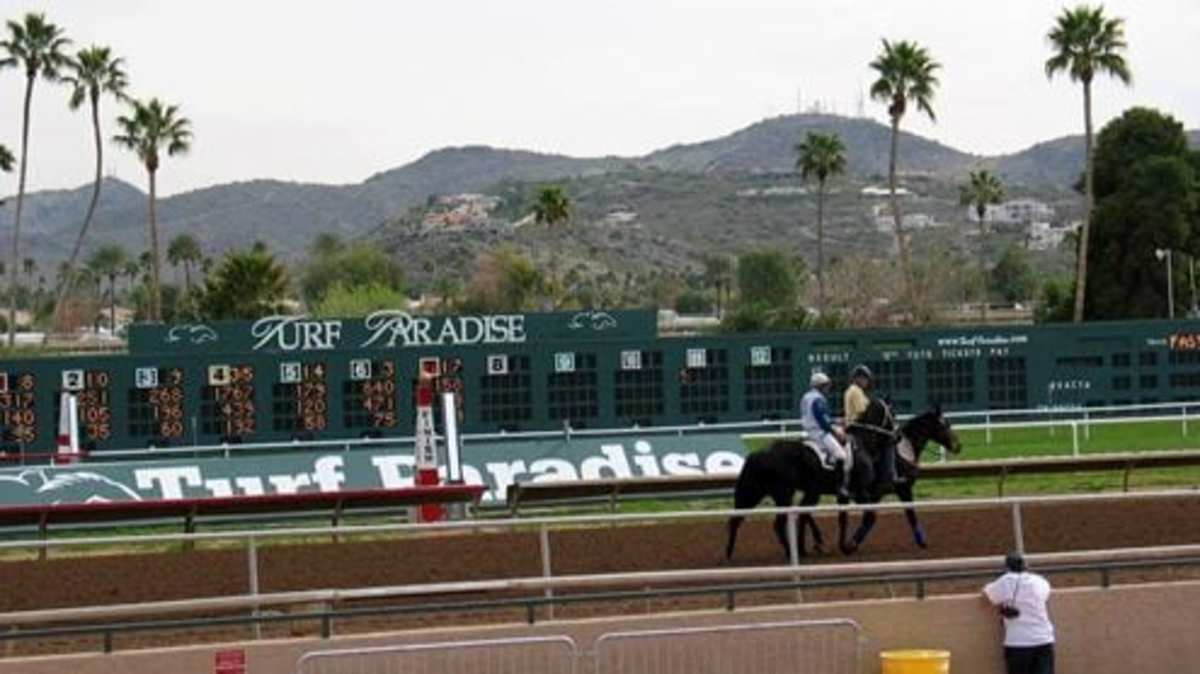
Turf Paradise racetrack in Phoenix, Ariz.
Trainer Justin Evans said from where he sits, the track was just barely able to get enough veterinarians pitching in to do morning examinations on horses, but the backstretch is still short of privately-practicing veterinarians. That can be a serious problem when it comes to pre-race medication like NSAIDs and corticosteroids, he said. When there aren't enough veterinarians around give pre-race medications, trainers may resort to doing some drug administrations themselves.
“Racetrack vets, it's a dying deal,” he said. “To be a racetrack veterinarian, it's 24/7. It's like being a trainer.
“We've got a bunch of weekday warriors. They want to practice five days a week, they don't want to work weekends. And what I'm surprised we don't have more of is bad tests. Now they're using bute paste and Banamine paste and we don't know the levels. How does the paste go through the horse's system instead of injectable? Now we've got bute paste and Banamine paste in the hands of people who might say, 'If this much is good, more is better.'
“We're missing veterinarians there day in and day out, managing these horses.”
As to the situation with Bergsma, Evans said he does worry about potential conflicts of interest that create an unlevel playing field.
“They kind of had to do it to keep the meet going,” he said. “I don't know what rule there is against it. I don't think it's ethical. I don't think a vet who's doing work for the barn across from me, and getting paid $2,000, $3,000 a month to do vet work over there, if his horse is a little sore and mine's a little sore, whose do you think she's going to scratch in the morning?
“Perception is reality.”
Francia said last week that the stewards are continuing their investigation into the Creative Plan case and have not yet determined whether they will take action against any licensees involved in the horse's last weeks.
For the racetrack's part, there is a new house rule designed to discourage anyone there from sending a horse through the slaughter pipeline. The rule appeared on the overnights last week and reads: “Anyone licensed by the Arizona Department of Gaming, Racing Division (ADOR) based at Turf Paradise who sells a horse for slaughter that was previously stabled at Turf Paradise will have his/her stalls revoked, be immediately removed from the grounds and will be denied future stall applications. The track stewards may take further action.”
Francia said the facility had had a house rule in place several years ago, but the Creative Plan case caused him to dust it off and make it harsher. The rule cannot be triggered simply by the horse appearing at an auction — Francia said a rule prohibiting someone from selling their animal this way wouldn't survive a legal challenge — but can be triggered if a horse is purchased by a kill buyer.
“There has to be some responsibility from the people involved with every horse towards that animal,” said Francia. “No track wants to have its name attached to something like this. It's morally wrong. It outrages, it hurts, it disgusts. I could go on. It makes me angry.”
Francia said the track had made inquiries about purchasing Creative Plan at one point with the goal of financing his rehabilitation before he found a home at Premier Equine.
In the end, Gale conducted an examination on Creative Plan where he landed at Ferguson's ranch and Ferguson sent him to Premier Equine with high hopes for a happy ending. It didn't pan out.
Since racetrack fatalities are typically defined as taking place within 72 hours of a racing or training event, Creative Plan's death doesn't count towards Turf Paradise's numbers.
Ferguson, Francia, and Earhart all agree that they hope he will count for something else – reform for the horses who come after him.
“Creative Plan's ankle had no support of ligaments or structure and was merely skin holding everything together, so much that it had started 'weeping' as the skin was beginning to split,” Earhart wrote on Facebook. “One wrong step and it would have been catastrophic. There was only one ethical and kind thing to do for this sweet boy, and that was to put him out of his misery.
“Please do not let Creative Plan's sad ending go unnoticed or in vain. There is no time like the present to change things, and the time is now at Turf Paradise.”