Hot Rod Charlie Back For More In Sunday’s San Antonio

One of America's most consistent and talented 3-year-olds throughout 2021, Hot Rod Charlie heads a field of seven 3-year-olds and up in Sunday's Grade 2, $200,000 San Antonio Stakes at Santa Anita. An iconic prep for the G1 Santa Anita Handicap, the San Antonio will be run for the 84th time and is one of six graded stakes on a blockbuster 11-race Opening Day program.

Most recently fourth, beaten 4 ½ lengths by presumptive Horse of the Year Knicks Go in the G1 Breeders' Cup Classic on Nov. 6, Hot Rod Charlie has been a gem of consistency, while on occasion very unlucky, for O'Neill. A handy winner of the G1 Pennsylvania Derby two starts back on Sept. 25, he was disqualified from a hard fought nose victory three starts back in the G1 Haskell Invitational.

A massive second, beaten 1 ¼ lengths by A-Lister Essential Quality in the G1 Belmont Stakes June 5, he was a troubled third, beaten one length by Medina Spirit in the G1 Kentucky Derby five starts back on May 1.

A winner of the G2 Louisiana Derby in his second start of the year on March 20, Hot Rod Charlie is 7-2-1-2 on the year, with 2021 earnings of $2,087,500. Owned by Boat Racing, LLC, Gainesway Stable (Antony Beck), Roadrunner Racing & William Strauss, Hot Rod Charlie will reportedly use the San Antonio as a prep to the G1 Dubai World Cup in March.

Freshened since running third to Medina Spirit in the G1 Awesome Again Stakes Oct. 2, C R K Stable's Express Train has been in the money in six out of his seven career starts at Santa Anita and rates a big chance off the bench. Trained by John Shirreffs, Express Train's last win came three starts back in the G2 San Diego Handicap on July 17. With an overall mark of 14-4-4-3, this 4-year-old colt by Union Rags has earnings of $695,800.

A half-length winner of the G3 Native Diver Handicap on Nov. 20, Bob Baffert's Azul Coast could rate second billing as he seeks his second graded stakes win. Owned by Mike Pegram, Karl Watson and Paul Weitman, Azul Coast, who has four wins from 10 starts, will be ridden for the first time by John Velazquez.

THE GRADE 2 SAN ANTONIO WITH JOCKEYS & WEIGHTS IN POST POSITION ORDER

Race 6 of 11 Approximate post time 1:30 p.m. PT

  1. Extra Hope—Tyler Baze–121
  2. Express Train—Victor Espinoza—125
  3. Go On—Mario Gutierrez–119
  4. Hot Rod Charlie—Flavien Prat—123
  5. Eight Rings—John Velazquez—121
  6. Kiss Today Goodbye—Kent Desormeaux—121
  7. Azul Coast—Juan Hernandez–123

First post time for an 11-race Opening Day card Sunday is 11 a.m. Admission gates will open at 9 a.m.

The post Hot Rod Charlie Back For More In Sunday’s San Antonio appeared first on Horse Racing News | Paulick Report.

Source of original post

Zarak Makes Fast Start To Stud Career

When Aga Khan homebred Zarak (Fr) retired to stud at Haras de Bonneval in 2018, he boasted exemplary credentials: by the sire-making Dubawi (Ire), Zarak was a Group 1 winner out of the Aga Khan's great champion mare Zarkava (Ire) (Zamindar).

Zarak did his best running at four when he won the G1 Grand Prix de Saint-Cloud over 2400 metres for trainer Alain de Royer Dupre, and therefore his first 2-year-olds in 2021 could have been somewhat forgiven should they have required time. They, however, most certainly did not. Zarak will wind down the year as France's leading first-season sire; he currently has 18 winners from 37 starters-from a first crop of 84 foals-and two stakes winners in Germany: the G3 Preis der Derbysiegers winner Lizaid (Ger) and the Listed Grosser Preis der Mehl-Mulhens-Stiftung scorer Parnac (Ire), both fillies. The best-known runner from Zarak's first crop, however, is Purplepay (Fr), a two-time winner who was third in the G1 Criterium International in October before selling to Roy and Gretchen Jackson of Lael Stables for €2-million at Arqana's December Sale to continue her racing career in America. While Purplepay appears unlikely for the French Classics, Zarak nonetheless goes into the winter with another potential leading light for ParisLongchamp and Chantilly: Allan Belshaw's homebred Times Square (Fr), who won on debut at Deauville in July and was second in the G1 Prix Marcel Boussac.

Zarak retired among a competitive sire class in France, which was headed by the European champion 3-year-old Almanzor (Fr) and also included Group 1 winners Zelzal (Fr) and Al Wukair (Ire). But Georges Rimaud, longtime manager of Bonneval, said the confidence in Zarak began to build when his foals started hitting the ground.

“Zarak has been an expected success, because he kept covering a lot of mares every year,” Rimaud said. “Breeders were quite keen to go back to him every year, and that's generally a good indication. When he started to have winners early in the summer we started looking at him seriously, and we're very pleased with what he's done, having stakes winners in Germany, and Group 1 placings in France. With his pedigree, he suddenly appears as a very good prospect.”

On the surface Zarak may have appeared a later-developing sire prospect, but a close look would have revealed a horse with potential to hit the ground running. Zarak, after all, won his only start at two and was second behind Almanzor in the G1 Prix du Jockey Club. The unbeaten Zarkava won the Prix Marcel Boussac at two and swept the French fillies' Classics before winning the G1 Prix Vermeille and the G1 Prix de l'Arc de Triomphe at three.

“He was not really expected to be a champion 2-year-old producer I suppose, but it should have been expected for them to run at two,” Rimaud reasoned. “I suppose the breeders also knew that he had won his Group 1 at four and they needed to bring precocious mares. The breeders did what they should have been doing, and I think we should have expected him to have what he had this year, and I think we got a little bit more.”

Zarak covered in the neighborhood of 120 mares in each of his first four seasons at stud, with his fee remaining steady at €12,000 throughout. In today's commercially driven market where fees and book sizes ebb and flow, sometimes dramatically, before a stallion even has runners, that is a noteworthy accomplishment, and stands Zarak in good stead to build on his strong start with his subsequent crops. Zarak is booked full for 2022 at 130 mares-from almost 200 applicants–with his fee upped to €25,000.

As is typical for the Bonneval stallions-which currently also include the country's champion sire Siyouni (Fr) and Dariyan (Fr)-Zarak is syndicated, which Rimaud said also helped keep the horse's numbers high.

“The shareholders really supported the horse very well with nice mares,” he said. “I feel syndication is important to ensure the support from breeders. And I think it provides a bit of help in selling nominations-you have the shareholders talking about the horse, rather than just us.”

Those shareholders are already being rewarded, too: a 1/50th share in Zarak was sold through Arqana Online for €380,000 last week, and another for €350,000 in November.

“It's always a nice surprise when a stallion does well, so on that level it is a surprise, but should we really be surprised?” Rimaud said. “Not really, because he's extremely well-bred and he's covered some nice mares, and a good number of them, and he's had the results he has had. Breeders are very keen to use him, and he's very full this year.”

Zarak is situated in the Bonneval stallion barn kitty-corner to the aforementioned Siyouni, France's most expensive stallion at €140,000 and the sire of six Group 1 winners including this year's joint highest-rated 3-year-old St Mark's Basilica (Fr). Though Zarak has a high mountain to climb to match the exploits of his barnmate, he is thus far on the right track and their accomplishments at the same stages of their careers are not dissimilar. Siyouni had 19 winners in his first season with runners, one more than Zarak thus far, and four stakes winners. Siyouni started at €7,000 and like Zarak remained at that fee through his first four seasons before going up to €20,000 in the year that he had his first 3-year-olds. He has been on an uninterrupted upward trajectory ever since and interestingly, breeders are already taking advantage of the Zarak/Siyouni cross: Times Square is out of the Siyouni mare See You Always (GB). Zarak represents an interesting opportunity for breeders, being free from Danehill and Sadler's Wells, and is among a growing number of Dubawi sons excelling at stud, that list also including Time Test (GB) from the same cohort as well as Night Of Thunder (Ire) and New Bay (GB).

“They're not similar stallions, but they've had similar results in the first year and let's hope Zarak takes the same road; that would be very, very nice,” Rimaud said. “But we'll stay modest and see what happens. Stallions are a funny, funny business, and people can get off them very quickly. But Zarak's yearling sales have also been very good, and he produces very nice-looking horses.”

As a successful sire out of one of the very best horses raced in the Aga Khan colours, Zarak's accomplishments must evoke a great sense of pride for the operation that celebrates its 100th year in the sport in 2022. Zarkava, indeed, is one of just two horses raced by the current Aga Khan to win four Group 1 races, the other being Blushing Groom (Fr), while the great Derby winners Shergar and Sinndar are among those to have collected three. Unlike her son, Zarkava did not get off to the most distinguished start at stud, with none of her first three foals making it to the races, but she has since made up for that with Zarak, her fourth foal, followed by the listed-winning and Group 1-placed Zarkamiya (Fr) (Frankel {GB}) and the listed-winning Zaykava (Fr) (Siyouni {Fr}). Both fillies are now ensconced in the Bonneval broodmare band alongside their dam: Zarkamiya produced a Medaglia d'Oro foal this year and is currently in foal to Siyouni, while Zaykava is in foal for the first time to Zarak's sire Dubawi. Zarkava had a Siyouni colt this year but will be rested in 2022.

“Zarkava is doing well,” Rimaud said. “She's not in foal this year; she was barren to Lope De Vega (Ire). But she has had 11 or 12 foals in a row, so she gets a well-deserved rest this year and then we'll decide who she goes to next year; we haven't done the matings yet. She is well, but she is getting on, so we need to preserve her a bit.”

“The Aga Khan said, when Zarkava won the Arc, that it epitomized his breeding operation,” Rimaud added. “And that's just the continuity of it, really. That's the goal, what we're about; raising good racehorses to become nice broodmares or good stallions. So I think he's obviously very, very pleased with it [Zarak's success]. But we still need support from people with nice mares, and hopefully he can follow in the tracks of Siyouni.

“Zarak comes from a very true Aga Khan family; he descends from Mumtaz Mahal. Next year, we are celebrating 100 years of the Aga Khan's breeding operation, so that comes at a good time. These pedigrees have been really nourished; those very good Aga Khan pedigrees always show something, so it's quite interesting that it will be 100 years next year, and Zarak's 3-year-olds will hopefully do well. So everything is coming into place.”

The post Zarak Makes Fast Start To Stud Career appeared first on TDN | Thoroughbred Daily News | Horse Racing News, Results and Video | Thoroughbred Breeding and Auctions.

Source of original post

Value Sires, Part VI: Earning their Stripes

This can be a terrifying business. Here we are, for the first time in this series, assessing stallions that have at least put some sophomores through the starting gate. And already, commercially, the game appears to be up for many. So much so, in fact, that to give adequate competitive depth to our value podium, we're going to combine the consecutive intakes who were in 2021 respectively contesting the second- and third-crop championships.

Here's just one example of how ruthless the market is. I won't name the stallion, because he doesn't deserve the ignominy: I have long thought him exactly the type we should be embracing, amply satisfying the criteria of pedigree, performance and physique. But anyone who can be bothered to do a couple of minutes' research will soon figure it out. All I'll say is that since a brilliant sales debut, amply vindicating his status as one of the most expensive freshmen, he has produced three Grade I winners from three crops: the same as American Pharoah and one more than the acknowledged breakout of their class, Constitution. In 2021, he was down to 29 mares.

Perhaps he can still renew momentum as he merits. In principle, however, his treatment shows how this marketplace can menace a stallion with commercial extinction virtually overnight. Sure, as we've previously acknowledged in this series, it's fair enough to reach some tentative early conclusions about a stallion if he can't make the most of the huge opportunity that breeders, in their dread of exposure on the racetrack itself, will give to new sires. But we should at least allow their first couple of crops time to mature before making any such judgement. As it is, we tend to anoint just one or two immediate achievers in each intake, and dump the rest more or less on the spot. The commercial highwire tapers to a thread very quickly.

And the whole process, of course, becomes self-fulfilling. You might still get lucky, might still come up with a champion from a handful of mares, but this is a numbers game and the odds obviously steepen with the loss of volume. Little wonder so many stallions at this stage tend to disappear into overseas or regional programs.

At the other end of the scale, the chosen few tend to be very few indeed. With one or two marginal exceptions lower down, of this year's leading second-crop sires only Nyquist and Not This Time have managed to move up their opening fees; and among the preceding group, only Constitution, Liam's Map and Daredevil. The latter's history is a cautionary one, of course, the market having exceptionally repented of his banishment abroad.

So how do we identify value? Many stallions we might consider unfairly neglected could only be recommended to end-users, who might like to breed a runner for a cheap fee, as their sales trajectory is pointing to the door. The few who retain commercial credibility, meanwhile, are generally charged at a corresponding rate. Constitution, for instance, has made the grade in utterly convincing fashion, but he's no longer very accessible as a result. With even more than the usual diffidence, then, here are one or two subjective discoveries of residual value across these two groups.

Bubbling under: Okay, so most of us can't even think about paying $55,000 to cover a mare. But value is relative, and those who can afford to play at this level will be grateful for Darley's immediate retraction of Nyquist's fee hike to $75,000 last year (from $40,000). Because even though he had to wait until the other day for his first graded stakes winner since, when Slow Down Andy advertised his Derby credentials in the GII Los Alamitos Futurity, Nyquist has been extremely consistent in producing horses of elite caliber.

While he has so far managed to get no more than 125 of his 197 named foals onto the track, he now has no fewer than 22 stakes performers, 14 placed in graded company and six at Grade I level. He hasn't converted that presence to winners as efficiently as Not This Time–a horse we have esteemed from the start, and likely to do better yet with the improvement in his book quality–but there's no doubt that Nyquist has secured commercial viability, with his third crop of yearlings averaging $158,442; and his 2-year-olds $342,043, third among all sires in 2021.

No young stallion is more obviously equipped to get you a runner–literally–than Upstart, who has put 118 of 149 named foals onto the racetrack already, a dozen of them placed at stakes level. He was multiple Grade I-placed at two, three and four, so expect his stock to keep thriving. And while his third crop of yearlings were processed modestly enough, pinhookers will surely have noticed his fantastic yields at the 2-year-old sales: $113,250 this spring, after clocking $107,791 with his first crop. Stay on board, definitely, at $10,000 with Airdrie.
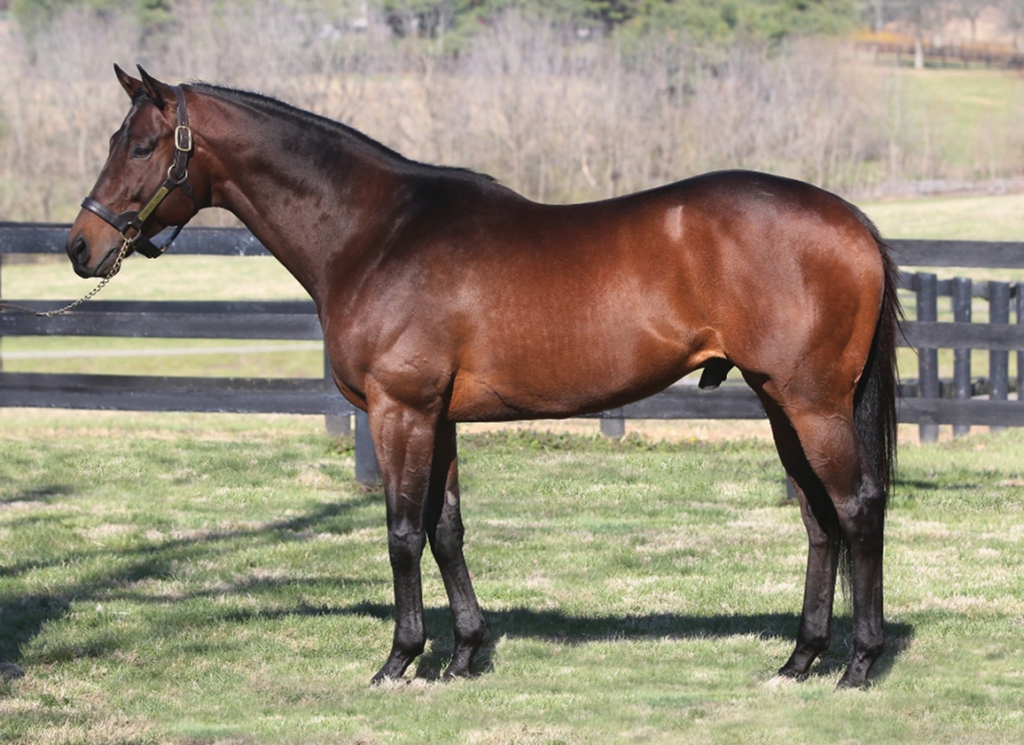
Firing Line | Crestwood

Bronze: FIRING LINE (Line of David–Sister Girl Blues, by Hold for Gold)
$5,000 Crestwood

Now here's an intriguing animal. You have to go some way down the second-crop table to find him, but that's no less than you would expect of a stallion with just 38 starters to date. But not only have 22 of them won; two members of Firing Line's second crop have placed in significant Grade II races.

The homebred Venti Valentine was runner-up in the Demoiselle S., having won a maiden and then a Listed race on her first two starts, while $25,000 yearling Nakatomi has also won in stakes company since finished third in the Saratoga Special S. Plenty of Firing Line's rivals, launched with industrial books, could do with that kind of footprint–not to mention a $210,000 2-year-old like Oscarette, who recently won her maiden at Churchill.

Firing Line missed a juvenile Grade I by a nose, won the GIII Sunland Park Derby by 14 lengths (track record) and was beaten only by a Triple Crown winner on the first Saturday in May. He derailed in the Preakness, failed to reward perseverance with a single disappointing start at four, and was doubtless further held back by a commercially unfamiliar sire and damsire. But he was actually working with a serious genetic package: out of a Grade I-placed half-sister to the dams of two Grade I-winning milers from a line tracing to matriarchs Kamar and Square Angel.

Firing Line is in exemplary hands, but has obviously only mustered very small books so far. Breeders of sufficient imagination and adventure will surely want to explore the way he has seized such limited opportunities at this budget fee.

Silver: TONALIST (Tapit–Settling Mist, by Pleasant Colony)
$10,000 Lane's End 

It has been uphill nearly all the way for this fellow, whose fee has come down yet again, but I have admired him throughout and he has had another solid year, maintaining black-type action at essentially the same ratio as Liam's Map. Few would dispute that his lauded studmate has earned his fee, which is four times higher, not least with his useful habit of hitting the bull's-eye with his best runners. It was typical of the understated style of Tonalist, in contrast, that after Country Grammer gave him a deserved Grade I breakthrough in the Hollywood Gold Cup, he promptly disappeared and has only just returned to the worktab.

Tonalist's 11 graded stakes performers through three crops represent 4.33% of named foals, almost exactly in step with Liam's Map (a dozen at a 4.17%). There are plenty of others in this intake, charging far more than Tonalist, who can't even nudge two percent.

Tonalist's books have been up and down but he does have one of 122 to keep him in the game with his 2022 yearlings, and their breeders can take heart from a median of $35,000 for the preceding crop. That's not at all bad for a sire standing at this kind of money, at this challenging stage of his career. But no bones about it, the real appeal of Tonalist is that he is shaping up as a sire who can outpunch his fee on the racetrack. Remember he reached his own peak at four and he has still only had one crop reach that stage of maturity, including his first Grade I winner.

Tonalist has always looked a quarry of old-school virtue, extending the same Toll Booth-Missy Baba line as Havre de Grace (Saint Liam) and author of 11 triple-digit Beyers in a $3.6-million career. Here was a horse that never stopped trying and breeders wanting to tap into Tapit, at an affordable fee, should take a similar approach.

Gold: KARAKONTIE (Jpn) (Bernstein–Sun Is Up (Jpn), by Sunday Silence)
$10,000 Gainesway

Have Antony Beck and his Gainesway team pulled off what has lately come to seem nearly impossible, and found a viable niche for a young turf stallion in Kentucky?

Karakontie has only been credited with 143 named foals to date but he has mustered seven black-type winners, four in graded stakes including Princess Grace, winner of two Grade IIs, two Grade IIIs and last month placed in her debut at the elite level. With his cosmopolitan pedigree, moreover, Karakontie has pushed the boundaries in terms of racing surface, too. Another Grade II winner, None Above the Law, has scored on turf, dirt and synthetics, while Sole Volante put himself on the Derby trail in the Florida preps last year.

Their sire has meanwhile maintained a useful sale ring capacity to hit one out of the park. He sold a $310,000 colt at Keeneland September, to follow on from yearlings that raised $500,000 and $220,000 at the same auction the previous year. And he has also consolidated quietly after suffering the customary slide from a three-figure debut book to just 43 mares in his third season. He has since covered 69, 88 and 76 mares, which may not look spectacular but suggests that people noticed his early achievements–like two first-crop yearlings, $6,000 apiece, making the gate for the G1 2,000 Guineas and GI Kentucky Derby–and gives him a legitimate foothold in a notoriously hostile environment even to the most eligible of turf stallions.

And that is just what he is, remember, having made his own stellar contributions to one of the most illustrious families in the breed today–his third dam is Miesque herself, so this is the Kingmambo clan–as a Group 1 winner at two and elite miling sophomore (French Classic/Breeders' Cup winner, 110 Beyer). This is a conduit of pure class, every way you cut it, and he has shown that he will take such chances as he's given.

Having this year started just nine juveniles (four winners so far, one stakes-placed) from that small third book, he has now got over the biggest bump in his road. And I'd be interested in odds about him siring a Grade I winner before the foals he breeds this coming spring go under the hammer. Overall this is a horse that really does offer hope that he can overcome the self-destructive prejudices of commercial breeding in Kentucky.

The post Value Sires, Part VI: Earning their Stripes appeared first on TDN | Thoroughbred Daily News | Horse Racing News, Results and Video | Thoroughbred Breeding and Auctions.

Source of original post

Red-Hot Going Global Will Try To Stretch Out In Sunday’s American Oaks

A winner of six out of her seven stateside starts, all this year, trainer Phil D'Amato's Irish-bred Going Global looms a standout among 11 sophomore fillies going a mile and one quarter on turf in Sunday's Grade 1, $300,000 American Oaks at Santa Anita. One of three G1 stakes and six Graded events, the American Oaks has been slotted as the final race on a big 11-race card with first post time at 11 a.m.

A winner of her last two starts, the G2 Goldikova Stakes at one mile on turf Nov. 6 and the G1 Del Mar Oaks at a mile and one eighth on turf Aug. 21, Going Global has bagged a total of five graded wins for D'Amato in what has been a truly sensational year.

Although she's in top form, Going Global has never tackled a mile and quarter, so that remains a question with regular rider Flavien Prat set to ride her for the eighth consecutive time. A winner of one of four starts in her native Ireland, Going Global, who is owned by CYBT, Michael Dubb, Saul Gevertz, Michael Nentwig and Ray Pagano, has seven wins from 11 starts and earnings of $648,792.

Trained by Chad Brown, eastern-based Fluffy Socks comes off a neck win going a mile and one eighth on turf at Belmont Park in the G2 Sands Point Stakes on Oct. 16 and will be ridden on Sunday for the first time by Mike Smith. Raced exclusively on turf through 10 starts, she has four wins, three seconds and one third-place finish, but will also be trying a mile and one quarter for the first time. Based at Belmont Park, she has a pair of half mile works over Santa Anita's main track, most recently, a half in 47.60 on Dec. 19.

Forwardly placed throughout, trainer Michael McCarthy's Irish-bred Nicest finished third, beaten a half length going 1 3/8 miles on turf in Del Mar's G3 Red Carpet Handicap Nov. 25 and has the look of a long-fused filly that will appreciate the Oaks distance. Owned by Katsumi Yoshida, Nicest will be making her second start for McCarthy and third in America when ridden for the first time by John Velazquez on Sunday.

In addition to Going Global, D'Amato will also be well represented by Irish-bred Burgoo Alley who has been freshened since taking the G3 Autumn Miss Stakes here at one mile on turf Oct. 30. Attentive to the pace in all six of her stateside starts both sprinting and at middle distances, she'll be trying a mile and one quarter for the first time with regular rider Umberto Rispoli. Owned by CYBT, Michael Nentwig and Ray Pagano, Burgoo Alley is 9-3-2-1 overall and has two wins from four tries over the Santa Anita lawn.

THE GRADE 1 AMERICAN OAKS WITH JOCKEYS & WEIGHTS IN POST POSITION ORDER

Race 11 of 11 Approximate post time 4 p.m. PT

  1. Fluffy Socks—Mike Smith—124
  2. Core Values—Abel Cedillo—124
  3. Closing Remarks—Joe Bravo–124
  4. Nicest—John Velazquez—124
  5. Going Global—Flavien Prat—124
  6. Charges Dropped—Kent Desormeaux—124
  7. Burgoo Alley—Umberto Rispoli—124
  8. Ivy League—Kyle Frey—124
  9. Queen Goddess—Juan Hernandez—124
  10. Eddie's New Dream—Mario Gutierrez—124
  11. Single Soul—Jose Ortiz–124

First post time for an 11-race card on Sunday is at 11 a.m., admission gates will open at 9 a.m.

The post Red-Hot Going Global Will Try To Stretch Out In Sunday’s American Oaks appeared first on Horse Racing News | Paulick Report.

Source of original post

Verified by MonsterInsights