New SoCal MRI Study Aims to Bring Clarity to its Diagnostic Role

Seeking a full stop to the spate of high-profile fatalities in the race that stops Australia, Racing Victoria this year tightened the veterinary screws. The practical rollout of these efforts can hardly be described as an unadulterated success, however.

One of these new measures was a precautionary CT scan of all runners in the days leading up to the G1 Melbourne Cup–a target that hit the skids when Racing Victoria's new $1.27-million CT unit suffered a malfunction with the Cup field only half scanned, leaving the rest to be X-rayed (with a machine that was also temporarily incapacitated).

But other, less-mechanical incidents highlight some of the more nuanced problems that come with using sophisticated–and still yet relatively new–imaging technologies to diagnose lameness in equine athletes.

Despite the results of a mandatory CT scan that gave French import Gold Trip (Fr) (Outstrip {GB}) the all-clear to train up toward the G1 Cox Plate, Racing Victoria's veterinary team scratched him on the eve of the race–a diagnosis that jarred with the horse's connections, who declared him sound.

In a further twist, Gold Trip was given the all-clear to run in Sydney in the Rosehill Gold Cup just a week later–only to be scratched once more due to the prevailing firm going.

In short, as more and more regulatory veterinarians turn to imaging modalities like MRI, PET, and CT to help diagnose lameness, they're left to wrestle with slippery conundrums.

What clear connection exists between the image before them and an increased chance of injury in the horse, for example? And without an extensive historic medical record at their fingertips, how can they be sure that any possible abnormality that appears on the image is significant?

A new standing MRI-focused study set to launch in Southern California seeks to provide some much-needed answers.

“Lameness is a precursor to fetlock failure, and maybe we find bone changes that help us identify lameness. But we should never get to the point where the fetlock fails–we want to do better than that. And that's the goal of the study,” said Florida-based John Peloso, the lead researcher on the study.

“We need to figure out when they're helping us,” Peloso added, of imaging modalities like the standing MRI. “We need to learn more.”
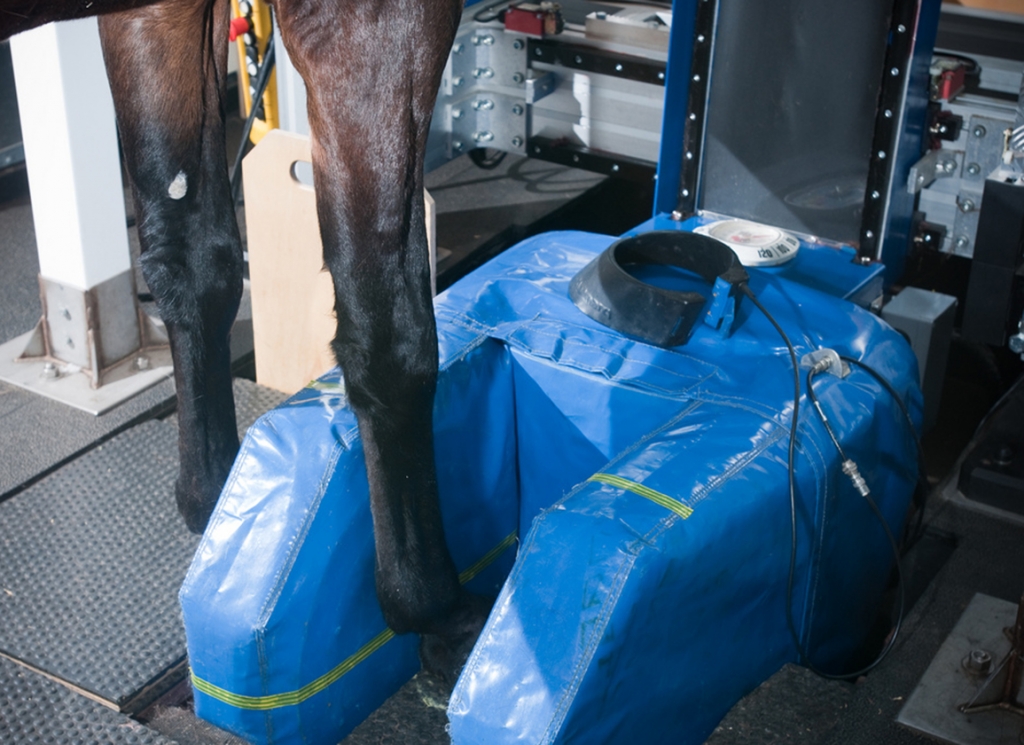
Standing MRI | UC Davis photo

Participants in the study–which is funded by the Dolly Green Research Foundation and the Southern California Equine Foundation–will be split into two.

There will be 23 case horses whose lameness has been narrowed to the fetlock region, and 23 control horses who exhibit no visible sign of lameness.

The 23 case horses will be selected by Dr. Tim Grande, the California Horse Racing Board (CHRB)'s chief official veterinarian, from a variety of scenarios where regulatory veterinarians commonly have to intercede in a horse's training or racing program.

These include a morning or race-day scratch, a voided claim, and lameness in the test barn or following a scheduled work or race.

The control horses–those with no visible lameness–will be selected as a comparative match in terms of things like sex, age, and class.

If a case horse is picked from a race, then the winner–if sound–will make an obvious control match. If a case horse is selected after a workout, then a suitable match will be selected using PPs.

And what exactly will the researchers be looking for? The answer encompasses four specific areas of concern within the fetlock joint, the primary site of musculoskeletal injury in racehorses.

Researchers will be looking for density within the proximal sesamoid bones and distal cannon bone, bone marrow edema–or swelling–in the cannon bone, and palmer osteochondral disease, a type of bone bruising commonly referred to as just “POD.”

To elaborate on these points, Peloso pointed to a couple of relatively recent papers he had co-authored connecting important diagnostic dots.

Two issues associated with fetlock failure are high density–noticeable bone development that predisposes a horse to a greater risk of fracture–in the sesamoid bone and palmer osteochondral disease, while condylar fractures are linked to bone marrow edema and high density in the distal cannon bone.

“It's because of those two papers that we've dialed in on those bone changes,” said Peloso. “Maybe the study will teach us something new, and so, there'll be something that gets added to it.”

The standing MRI unit has been part of the Southern California backstretch furniture since the start of last year. Since then, the unit has been used to scan hundreds of fetlocks.

Nevertheless, as a relatively newfangled diagnostic tool, the MRI is still looked upon with a touch of skepticism by some corners of the backstretch community, including attending veterinarians, admitted Peloso.

As such, this study is seen as an opportunity to increase the volume of MRI equine traffic. “It needs to be a real relationship so we can do best by the horse and best by the owner,” Peloso explained, before looking at the broader implications from this and other such studies.

“It'll be interesting to see to what degree some of these imaging modalities–PET, CT if it makes it, MRI–what role they play to help the regulatory veterinarian identify who's safe and who's not safe.”

The post New SoCal MRI Study Aims to Bring Clarity to its Diagnostic Role appeared first on TDN | Thoroughbred Daily News | Horse Racing News, Results and Video | Thoroughbred Breeding and Auctions.

Source of original post

Galawi Retired To Northview Stallion Station In Maryland

Galawi, a winning son of the world's most successful international sire Dubawi out of a Group 1-winning millionaire half-sister to the incomparable Goldikova, will stand his first season at Northview Stallion Station in Chesapeake City, Md., in 2022 for $2,000 live foal, payable when the foal stands and nurses.

A stakes-caliber runner who was retired early due to injury, 4-year-old Galawi, descends from generations of champions and Group 1 winners produced by the enormously successful stud and racing stable of Jacques Wertheimer, and in recent decades by his sons Alain and Gerard Wertheimer.

Sent to trainer Graham Motion earlier this year, Galawi impressed with his only U.S. start when accelerating from last to first in a mile and a quarter race over the Belmont turf course in June, getting the final quarter according to Trakus in :22.04.

“He was extremely impressive in the morning and had a real presence about him,” said Motion. “No doubt in my mind he was stakes caliber. He's just a very classy horse.”

Galawi, is out of Group 1 Prix Vermeille winner Galikova, a half-sister to seven stakes performers, led by Hall of Famer Goldikova. A champion in the U.S. twice and a champion in France four consecutive years, Goldikova won 14 Grade/Group 1 races, including three consecutive runnings of the Breeders' Cup Mile over males and four runnings of the G1 Prix Rothschild. Galikova's group-winning half-brother Anodin was second in the Breeders' Cup Mile and is a group stakes sire. The female line leads directly to Prix de l'Arc de Triomphe winner Gold River.

“He's stunning looking and has a phenomenal pedigree,” said Motion. “I feel he has a stallion's pedigree. I just didn't anticipate him having to be a stallion so soon.”

Galawi, is one of three sons of Dubawi now at stud in the U.S. Dubawi has sired more than 225 stakes winners, and had a stellar 2021 Breeders' Cup as the sire of three winners – Yibir (Breeders' Cup Turf), Space Blues (Breeders' Cup Mile), and Modern Games (Breeders' Cup Juvenile Turf).

“Turf racing takes up so much of our day-to-day racing – it's a natural to breed to a horse like this,” noted Motion. “There are so many more opportunities than there used to be for horses on the grass – especially for 2 and 3-year-olds. To get close to Dubawi and close to Goldikova – it doesn't get much better than that.”

The post Galawi Retired To Northview Stallion Station In Maryland appeared first on Horse Racing News | Paulick Report.

Source of original post

Jason Barkley, Norm Casse, Bentley Combs Elected To Kentucky HBPA Board

A trio of thirty-something trainers has been elected as newcomers to the Kentucky HBPA board with the addition of Jason Barkley, Norm Casse and Bentley Combs.

Rick Hiles was re-elected as Kentucky HBPA president, with Frank Jones re-elected as the owner vice president and Dale Romans as the trainer vice president. Also re-elected to the board were owners Mark Bacon, Buff Bradley (who switches over from the trainer side), Mike Bruder and Travis Foley and trainer John Hancock. Trainer R.C. Sturgeon and owner James Williams will serve as alternates.

Hiles, who has been president for 21 years with another 16 spent serving on the board, said he welcomes getting the millennials involved. Barkley (32), Casse (37) and Combs (33) join 37-year-old Foley, who was elected to a third term.

“Everything we've got we fought for,” Hiles said. “Every purse, every benefit, every program back here, the HBPA has fought for. I'm glad to see some young guys getting involved. I'm getting old, and so is Marty (executive director Marty Maline). They need to learn, because they're going to have to take this over. It's good to see some new young people coming to get involved. I'm tickled. It will be good for the organization.”

Barkley and Combs are graduates of the University of Louisville's Equine Industry Program in the College of Business. Casse is a graduate of Bellarmine University in Louisville. All three understand well the headwinds encountered when trying to build a stable.

Barkley and Combs said they both learned a lot participating in their first meeting when the board was seated and officers elected on Nov. 23.

“I was just trying to get my bearings, see how everybody goes about their business,” said Barkley, a fourth-generation horseman from the Evansville-Henderson area who began training full-time in 2017. “A lot of those guys have been there for a while. You try to take your cues from them. I want to be an advocate for the horsemen. Sometimes I feel like the big things get handled and maybe the smaller things can fall through the cracks — things we talk about on the rail, (I can) take those to the meetings.

“I hope there are things that I learned at U of L that I can bring over; hopefully give a fresh look to some of the things that the guys have been fighting for.”

Combs, participating remotely from Oaklawn Park, said he was amazed how much he learned from just that session, including possible repercussions with the scheduled implementation of the Horseracing Integrity and Safety Act (HISA).

“I learned a ton of stuff I didn't even know existed, frankly,” said Combs, who grew up in Lexington and also has an MBA from Ole Miss. “… Being on the HBPA board, you get to see the overall business side of it, as far as the money taken in, where it's going, the good causes. The health and welfare stuff they were talking about, I had no idea.”

Having stuck his toe in the water, Combs, who began training in 2017, said he's even more glad he ran for the board, adding, “I want to be a part of the conversation.”

Casse is a third-generation horseman from Louisville who began training in 2018 after 12 years as an assistant trainer for his father, Mark. Casse said his goal is to be “a great representative for the horsemen” and being on the board is one way he can give back to the industry.

“I feel like I've got a finger on the pulse, so to speak, of what we need,” he said. “I owe horse racing everything. It's the right thing for me to do, to start giving my time and helping other people as well.

“It's not like I have any preconceived notions. I'm very green when it comes to this type of the thing. But I want to look out for the horsemen and the best interest of the trainer. I feel it's part of my obligation to give the time to do that.”

The post Jason Barkley, Norm Casse, Bentley Combs Elected To Kentucky HBPA Board appeared first on Horse Racing News | Paulick Report.

Source of original post

Northern Farm Buys Dandalla For 750,000gns at Tattersalls December

Dandalla (Ire) (Dandy Man {Ire}) was the first mare to breach the 750,000gns mark at the Tattersalls December Mare Sale, which was in its second session on Wednesday. Northern Farm struck for lot 1735, who was consigned by Karl Burke's Spigot Lodge Stables on behalf of Nick Bradley Racing 28 & Partner. A winner of the G2 Duchess Of Cambridge S., G3 Albany S. and the Listed The Arran Scottish Sprint EBF Fillies' S., the Robert Norton-bred was also fourth in this year's G1 Commonwealth Cup at Royal Ascot. Dandalla originally sold for €15,500 as a Goffs November foal and brought €22,000 from Kelly Burke at the 2020 Tattersalls Ireland September Yearling Sale. Her winning dam Chellalla (GB) (Elnadim) is a half-sister to stakes winner Konkan (Ire) (Aussie Rules).


The post Northern Farm Buys Dandalla For 750,000gns at Tattersalls December appeared first on TDN | Thoroughbred Daily News | Horse Racing News, Results and Video | Thoroughbred Breeding and Auctions.

Source of original post

Verified by MonsterInsights
