She's the one, all right. The one and only, in fact–at least up until now. Who knows? Perhaps Neil Pessin's exemplary achievements with Bell's the One (Majesticperfection) might yet reward him with another Grade I winner or two. But after a lifetime in the game, and 36 years since saddling his first winner, he's neither expecting nor even desiring to transform the intimate scale of his operation.
“You know, I don't get jealous of anybody,” Pessin says. “I'm very happy with where I'm at. I've been successful with the numbers I've had. And I take my hat off to the big guys. I mean, I couldn't do what they do. I couldn't have hundreds of horses and keep track of it all, take care of it all. And I don't want to. I'm very happy with 10 to 16 horses. Yes, it is a numbers game. And the more horses you have, the better your shot of getting one like 'Bell'. But I also know you go through a lot of horses doing that. Some of those guys have 200 2-year-olds-and if five of them can run, those five will make a name for you. But I wouldn't like doing it that way. That wouldn't be me.”
As it is, the GII Honorable Miss H. success of Bell's the One at Saratoga last week took her trainer to a new high in year earnings (currently $724,298, the work of 11 winners from just 58 starters), with five months still to go; and keeps her on track for a return to the Breeders' Cup, where she made the podium last year after winning the GI Derby City Distaff S. on the postponed Kentucky Derby card.
Moreover you have to wonder whether a mare like this–now a stakes winner at two, three, four and five; and a graded stakes winner at three, four and five–might have got lost in a factory system.
In principle, Pessin is too modest to accept that proposition. “Good horses overcome a lot,” he says. “I don't want to say I've made her a good horse, because she's made me look like a better trainer. I think good horses run wherever they are. I can't take a lot of credit for her ability, because I think it's just natural with her. I think it's 90% the horse, and 10% the trainer.”
That said, he concedes that Bell's the One has always had her idiosyncrasies. Yes, she won her first four races, but her preparations had hardly been those of a point-and-press professional.
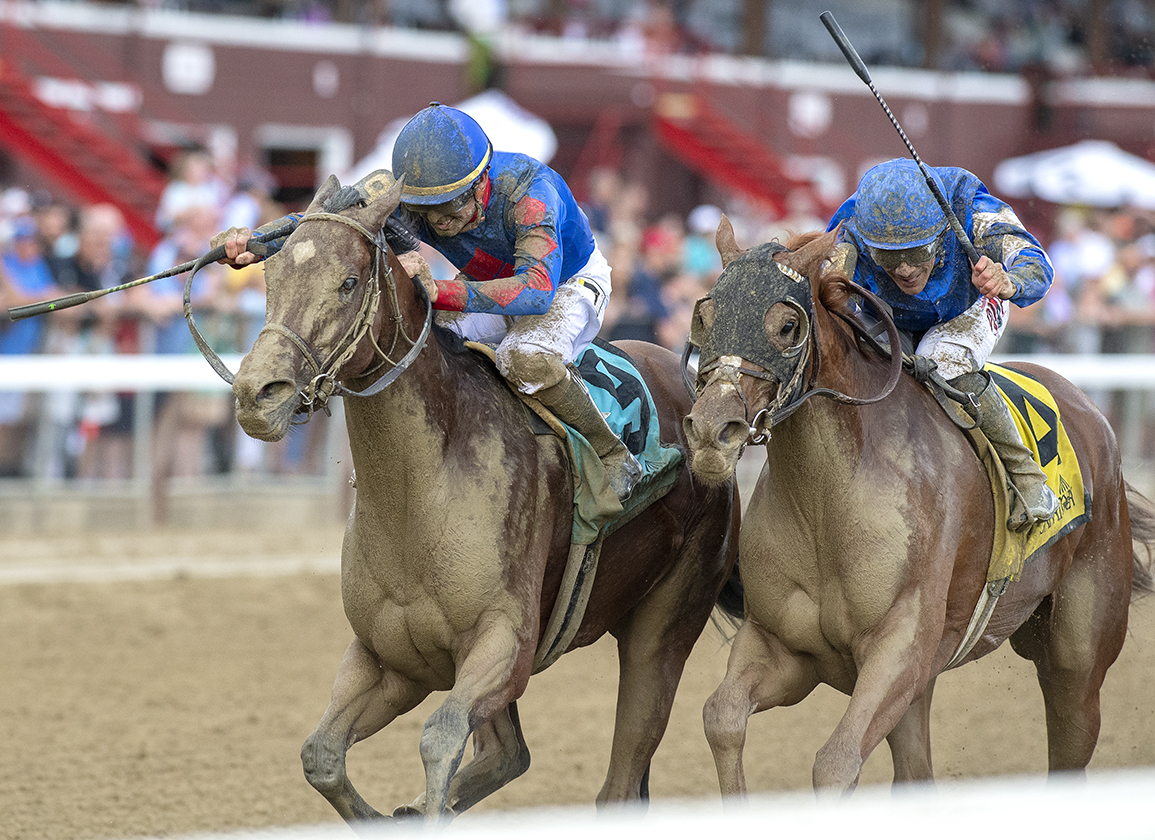
“A well-measured neck” victory in the Honorable Miss | Sarah Andrew
“The last two weeks before her first start, four different times she just pulled up galloping and we had to lead her off the racetrack,” Pessin recalls. “But we've gotten to where we can manage her quirks now. Going to the racetrack in the morning we'll let her stop and look and decide when she wants to go. It's an extra 15, 20 minutes every day, just to get her to the racetrack. But that's also because I allow her to do that. We're in no hurry. We can take our time with them.”
Pessin was talking from his summer base at Arlington, where he had just been lamenting with fellow horsemen the looming desecration and destruction of one of the jewels of the American Turf. But then you might argue that Pessin, raised and apprenticed in the pre-industrial era of horsemanship, is himself no less representative of a precious, threatened heritage. For his father was that most accomplished of veterinarians, Dr. Arnold Pessin, while his professional mentor Ronnie Warren had rounded off the input of names as storied as LeRoy Jolley and Woody Stephens.
Old school stuff, right? “Yes, and I'm still pretty old school myself,” Pessin says candidly. “So I take the horses first, and me second. And I've never asked a client to send me a horse. If they want to call me, then if I have room I'll take the horse. But I've never actually hustled to get horses. Just one of the ways I was brought up.”
And that upbringing was hands-on throughout. His father was such a highly regarded diagnostician that even people who weren't clients or friends would tend to consult him about their better horses. And Pessin was at his side through boyhood, watching and learning. He would run X-rays through all the various solutions before putting them in the dark room. With appropriate supervision he could even perform castrations.
“So I learned a lot about soundness,” he says. “And also why you don't do a lot of things that people do… I can only speak to my experience. I can't speak to what other people do. But my vet bills are very low. My dad was always of the view that the less you can do, the better. If a horse has a problem, we'll look at it, see what we can do, but nine times out of 10 he'll end up at the farm. You know, 90 days cures a lot. The other things you can do are usually temporary fixes. And then you have to give them 90 or 120 days, and you blew 90 days trying to get them right.”
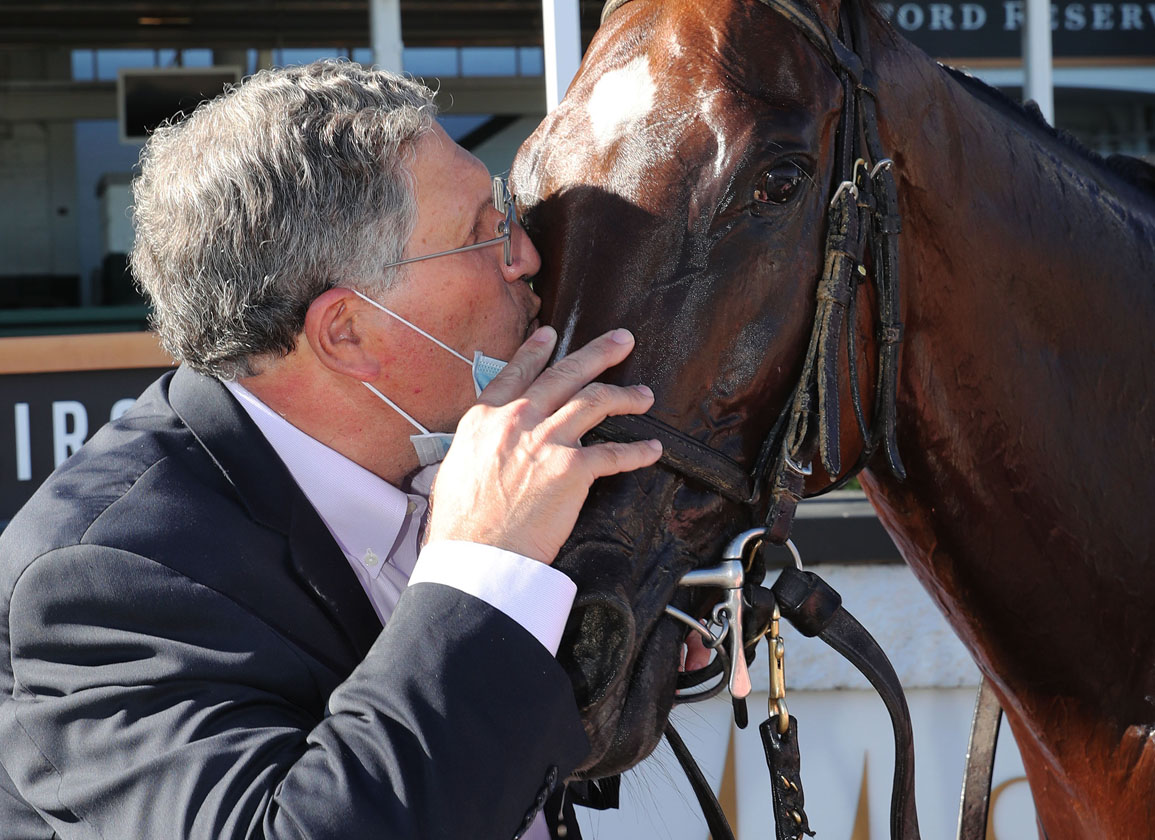
Pessin and his star mare | Coady
Though just into his 60s, Pessin is also well placed to corroborate a suspicion that the modern breed is less robust than it was formerly. His late father's remarkably diverse portfolio–he is best remembered, perhaps, for building the Kentucky Training Center (now The Thoroughbred Center) and the Dueling Grounds Race Course (now Kentucky Downs)–also embraced Winchester Farm, where he stood the likes of Olden Times, Candy Spots and Prove It. And Pessin feels that the 21st Century Thoroughbred, whether through inbreeding or mass commercial support of unproven sires, has suffered much physical dilution.
“We used to breed for conformation, pedigree and disposition,” he remarks. “Now they correct foals with surgery, so you don't know what you're breeding. You might think you've got two correct horses, when actually you got two horses that toe out so bad they'd trip you if you walked by. I think that's part of the problem with so many horses not making it to the races.
“And then, on top of that, cannon bones are half the size they used to be. The stallions we stood, I couldn't fit my two hands round their cannon bones. Now I can easily touch my other hand with my fingers. So I think between those things–foal surgeries and bone density–you can't train a horse as hard, or run as many times, as they used to. The major prep for the Derby used to be the Derby Trial, five days before. And they used to run in between the Derby and the Preakness. They'd run some of those 2-year-olds 20 times! Do that today, you'd go to jail.”
This was the environment Pessin so loved that his father told him to work the backside before he went to vet school, just to get it out of his system. (“It's almost out now,” he jokes. “But there's still just a little bit in there.”) In New York he hotwalked for Stephens, groomed for Jolley, watched nights for Joe Canty; and then he was appointed assistant to Warren, “an excellent horseman and good caretaker who did quite well all over the country.”
Nowadays, everything has become about volume. Unproven rookies cover five times as many mares as breed-shapers like Danzig, while “super trainers” corral more horses from a single crop than did Hall of Fame trainers past across a decade. Pessin, as we've already heard, feels no resentment on his own behalf. But he does feel that many others are wanting only in opportunity.
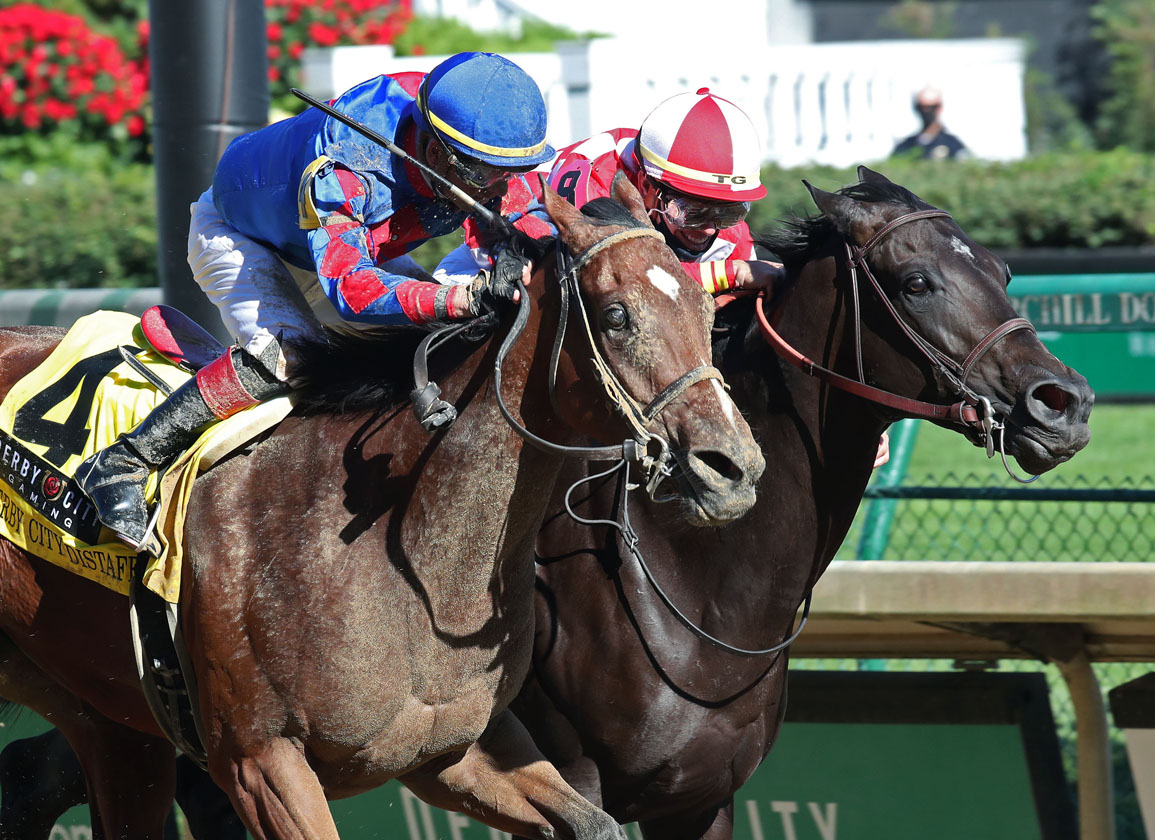
A nose win in last year's Derby City Distaff gave Bell's the One her Grade I | Coady
“There are a lot of horsemen out there, young and old, who nobody's ever heard of because they never get the chance of a good horse,” he says. “You can't take a bad horse and make him into a good horse. You can take a good horse and make him into a bad one, but you can't improve a bad one that much.”
So while he accepts that the idea is impractical, not least after seeing legal challenges to The Jockey Club's attempt to limit stallion books to 140, he does think wistfully back to the days when a trainer would be confined to 40 horses at one track, and for the most part obliged to saddle them in person.
At the same time, those limits did allow trainers to test the resilience of what Pessin has just identified as a stouter breed anyway. So now we instead have mega-trainers, with huge slack in their numbers, nonetheless suffering high attrition.
“Back then, horses were a little more sturdy,” Pessin reflects. “And they were trained hard. If a horse stood up to it, fine; if he didn't, you moved him out and another one was waiting to come in. The philosophy of those trainers was if you can't train, you can't run. And with good horses, that's pretty much true. And good horses were what they were looking for. They weren't looking for a maiden 10. But if you were to train like that today, you wouldn't have anything left in the barn. At least, I wouldn't. The big guys probably could do it, but I'd need to watch a little more closely.”
By the same token, nobody has more appreciation for the endeavor of cheaper horses. “If they're giving 110%, you can't ask them for any more whether it's a $5,000 claimer or a Grade I stake,” he says. “You got to respect that horse and love that horse because they're laying it on the line for you.”
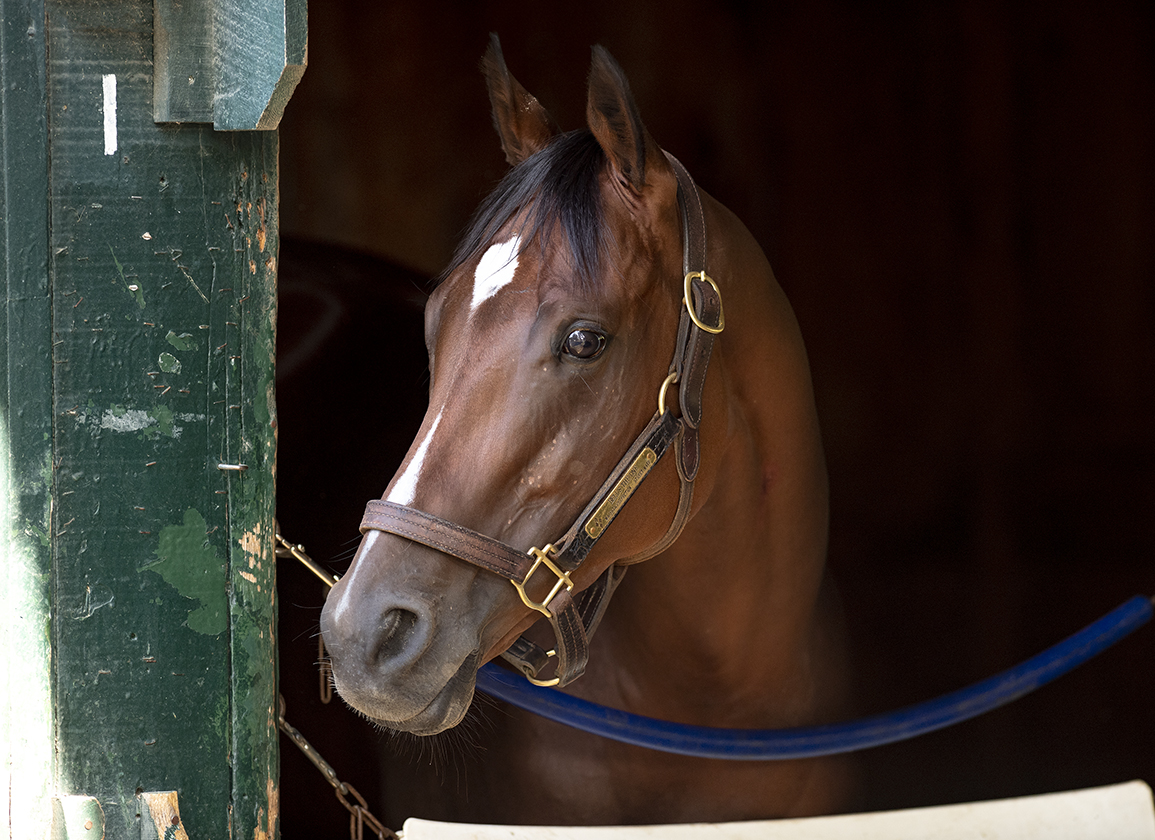
Bell's the One Sunday at Saratoga | Sarah Andrew
But the horses with physical capacity to show that desire tend to cost more. Pessin has due gratitude, then, to the owner of Bell's the One, Bob Lothenbach, as a model patron who has also given him the chance with improved raw materials. Pessin was in the Minneapolis businessman's scouting team when drawing his attention to a filly in the Brereton C. Jones draft at the Fasig-Tipton July Sale of 2017.
“She wasn't the most correct horse in the world,” Pessin admits. “But I think that's why we got her for $155,000, instead of $400,000. But she was just very athletic, in the way she moved, and that's what drew me to her.”
Bell's the One has since become a suitably old-fashioned achiever, with a nine-for-19 record in banking $1,126,825. Pessin feels she has seldom been adequately recognized, but you can absolutely set your clock by her. In her last nine works, she has been clocked behind only three horses out of an aggregate 437 others over the same half; and she is unbeaten over six furlongs. For once, however, she was top of the bill as odds-on favorite for the Honorable Miss.
“Her whole career, she's hardly ever gotten respect, no matter what she does,” Pessin says. “But at Saratoga I was very confident in her, and I stated going into the race that she was the best horse. If there was any pressure, it was pressure I put on myself. But she'll usually back me up, and she did.
“The first quarter-mile I was hoping she wasn't too far back, because they didn't go that fast and she was about 10 or 12 off of it. But when they got to the three-eighths pole, she was about five or six off, and I felt as long as he could get the outside I could be pretty confident. Because once she gets in a head duel, it's hard to beat her. She's very gutsy. So while she only won by a neck, I felt it was a well-measured neck.”
So let's salute this admirable mare, and the man who has drawn out her talent–especially as, typically enough, the Grade I prize they shared last year could not really receive due public celebration.
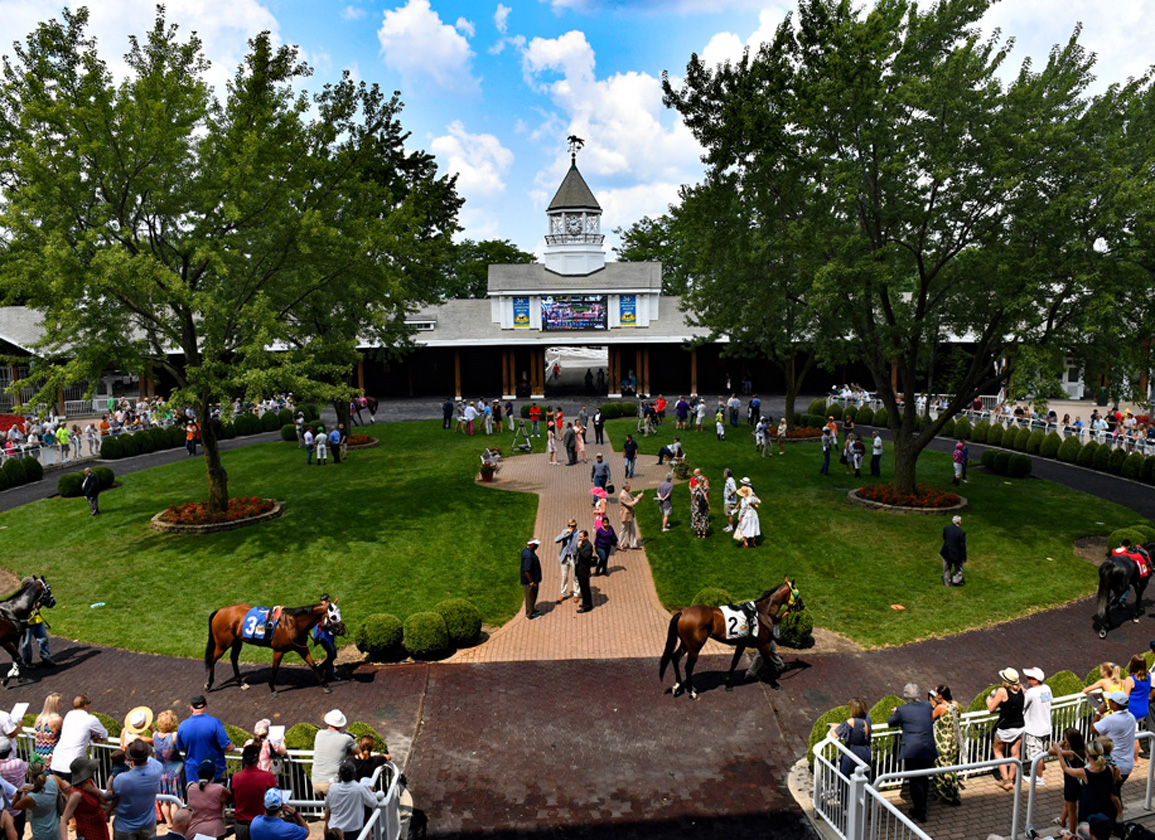
Arlington Park | Horsephotos
“It would have been nice to have the crowd there,” Pessin says. “But it really wasn't bittersweet at all: it was still a Grade I, still at Churchill, still on national television. And I was just very happy to have won. Normally I can call photos, but that one I could not and nor could Tom [Amoss, trainer of runner-up Serengeti Express (Alternation)]. I just felt lucky to come out on the right end of it.”
Bell's the One will now rest for two or three weeks at Chesapeake Farm, Lexington, before training up to the GII Thoroughbred Club of America S., at Keeneland in October, as a springboard to Del Mar. By that stage, sadly, Pessin may have left Arlington Park for the final time.
“It's hard to believe there's even a possibility of a wrecking ball going through that grandstand,” he says. “But give up? Hell, no. You don't give up so long as there's any flicker of hope. It's such a beautiful place, it would be such a shame to see it go by the wayside.”
So much more than bricks and mortar, after all, has already been smashed in our Turf heritage. Let's just be grateful, then, for the remnants that endure in sturdy horses like Bell's the One, and self-effacing horsemen like her trainer.

The post Pessin Savors an Honorable Success appeared first on TDN | Thoroughbred Daily News | Horse Racing News, Results and Video | Thoroughbred Breeding and Auctions.
Source of original post
