Bet to win.
Newbury 5.20 Foxtrot Sizzler – win bet.
Bet to win.
Newbury 5.20 Foxtrot Sizzler – win bet.
Tickets are now on sale for the 2021 Breeders' Cup World Championships at Del Mar racetrack, the iconic Southern California racing venue. This year's prestigious international event, which returns to Del Mar on Nov. 5 and 6 for just the second time in its history, will utilize 100 percent of seated capacity in accordance with state and local public health guidelines.
Fans can purchase tickets online at BreedersCup.com/Tickets or by calling the ticketing office at (859) 514-9428. Guests are encouraged to purchase tickets as soon as possible, as demand is expected to be high with patrons returning to the World Championships after being unable to attend in person in 2020 due to the COVID-19 pandemic. The 2021 World Championships promises to further cement the annual event as an unparalleled, luxury lifestyle experience showcasing the world's best horse racing and hospitality.
“We are elated to welcome fans back in full force as we return to southern California's beautiful oceanside racing venue, Del Mar racetrack,” said Breeders' Cup President and CEO Drew Fleming. “Breeders' Cup and Del Mar Thoroughbred Club have worked in close collaboration over the course of the past year to ensure our fans and participants receive a safe, best-in-class experience that showcases exceptional Thoroughbred racing.”
Historic Del Mar racetrack is located just 20 miles north of San Diego, where “the turf meets the surf.” In addition to elite international racing, attendees will enjoy Del Mar's scenic seaside city backdrop coupled with the vibrant nightlife of nearby San Diego.
Attendees can choose from premium dining packages, box seating options and reserved seating. Two-day dining packages are available for purchase ranging from $775 to $1,875 per seat, while box seating options include both single and two-day packages ranging from $375 to $975 per seat. Reserved seating is available in both single and two-day packages that range from $100 to $475 per seat. All tickets will be sold in advance of the World Championships and are subject to the availability at the time of purchase. No tickets will be sold on-site. More information on seating options and ticket pricing can be viewed at BreedersCup.com/Tickets.
General admission tickets will not be sold at this time; however, Breeders' Cup is in close communication with local public health officials and is hopeful that as conditions surrounding the COVID-19 pandemic continue to improve, general admission tickets will be made available closer to the World Championships. Fans are encouraged to sign up for the latest ticketing news and updates here.
Parking on-site at Del Mar is limited and only available to attendees with official pre-paid parking credentials. A complimentary public shuttle service will be operating to and from the track from a designated off-site park-and-ride location at Del Mar Horsepark on both Nov. 5 and Nov. 6. Additional transportation information can be found here.
The 2021 Breeders' Cup World Championships at Del Mar will be televised live by the NBC Sports Group.
The post Tickets Now On Sale For Breeders’ Cup World Championships At Del Mar appeared first on Horse Racing News | Paulick Report.
The Maryland Racing Commission voted unanimously on Thursday to dismiss penalties for five horses found to have the adjunct anti-bleeding medication Amicar in their post-race drug tests, reports The Racing Biz. The MRC made the decision based on advice from the medication committee.
Instead of the typical “Category C” penalty of disqualification and $1,000 fine, the trainers of those five horses were issued a warning. The Commission indicated that regular penalties for Amicar will resume on Aug. 1.
A total of 12 positives for Amicar (seven in harness horses) were returned in the spring after the Maryland Racing Commission changed its testing laboratory from Truesdail Laboratories in Irvine, Calif. to Industrial Laboratories in Wheat Ridge, Colo.
Those positives caused the Maryland Thoroughbred Horsemen's Association to issue a warning to trainers in late June, stating that utilizing Amicar or similar adjunct medications, for which there are no recommended withdrawal times, “runs the risk of a post-race positive test.”
Though the Thoroughbred trainers were not punished for the positives, the harness cases had already adjudicated with Category C penalties. MRC chairman Emmitt Davitt said the commission would research how to rescind those penalties issued to harness horsemen.
Around the same time, Thoroughbred trainer Claudio Gonzalez was notified that two of his runners had tested positive for the corticosteroid dexamethasone, and told the Paulick Report he believed the positives were due to the change in labs. Several other trainers were also notified of similar positives, and the MTHA issued another warning to horsemen in early July about dexamethasone usage. The commission will likely consider those positives at its next monthly meeting.
Read more at The Racing Biz.
The post Maryland Commission Unanimously Decides To Dismiss Amicar Penalties appeared first on Horse Racing News | Paulick Report.
So the big question is whether the out-of-town jocks, in the heat of a $1-million battle for the GI TVG.com Haskell S., can master the instinct to reach for the whip?
If any lifelong flagellants are anxious of their self-discipline, then they need only play back the 1988 running and remind themselves how Laffit Pincay, Jr. coaxed Forty Niner home, in withering heat, by a nose from Seeking the Gold. The whip is unsheathed, for sure, but so seamlessly with the horse's own efforts that the overall effect is like watching St. Francis of Assisi helping a fledgling back into its nest.
If only wider standards of horsemanship had maintained similar levels of empathy, then our house might never have become so divided against itself. As it stands, any hope that people might someday look back at Saturday's race after an equivalent interval of years may depend on the outcome of the experiment being boldly embraced this year, in defiance of some aggressive lobbying, by the New Jersey Racing Commission.
Like it or not, a first Grade I race without recourse to the whip feels like a big moment in the story of the American Turf. Our community has to remember two things. One is that we tend to be inured to the shock experienced by the layman who comes fresh to the ugly coercions of cruder riders. And the other, closely related, is that public policy in these matters will always be driven by mass perception, rather than any informed mitigations grasped by those inside the business. As one leading driver has wisely acknowledged of harness racing: “It doesn't matter if it's real or perceived. In our game, once it's perceived, it becomes real.”
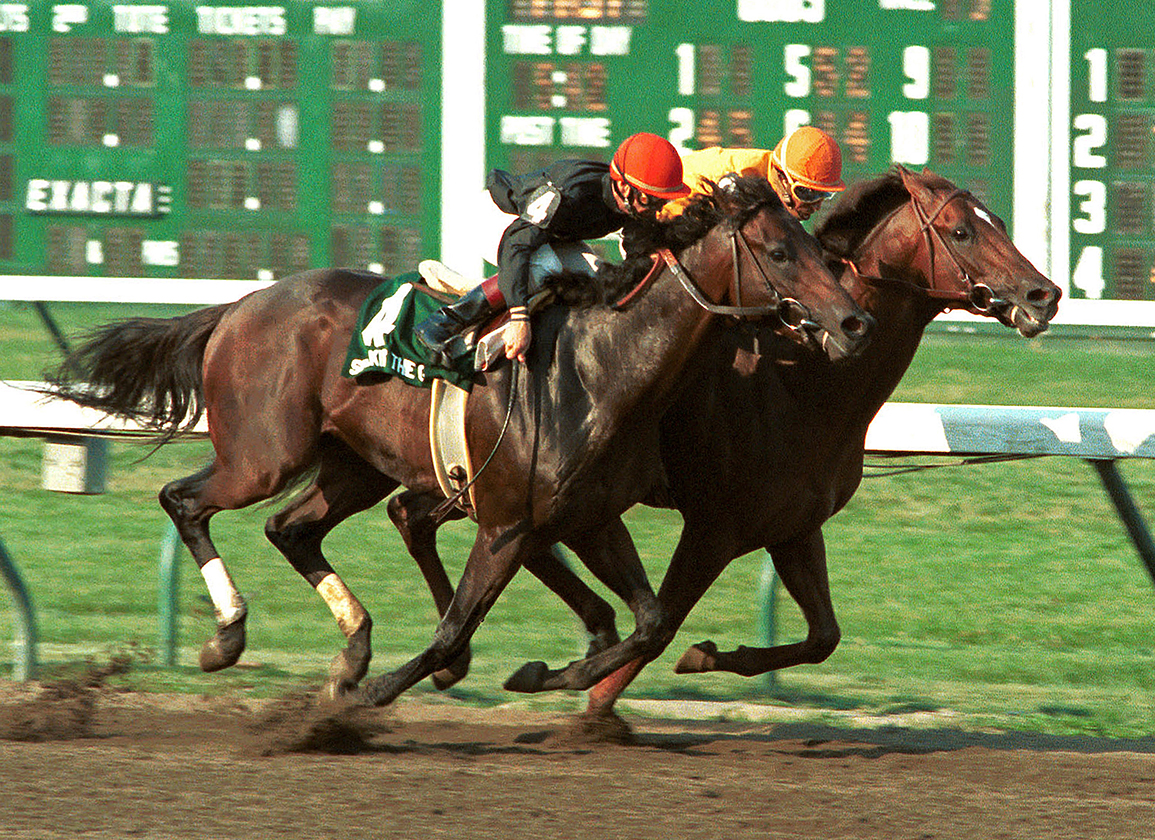
Forty Niner prevails in the 1988 Haskell | Equi-Photo
As it happens, pretty much the same might be said of the damage done to our sport by the charges against the Derby winner, which loom over the Haskell even in the absence of a trainer who last year won it for a record ninth time. For these leave the Derby runner-up Mandaloun (Into Mischief) striving awkwardly to live up to his potential promotion, and the burden of the accompanying asterisk; while Following Sea (Runhappy) has meanwhile defected from Bob Baffert's barn after Spendthrift “hit the pause button” on their association.
Whatever the ultimate determination of due process, in this particular instance, overall it seems fair to ask Baffert to understand that you can't push regulatory boundaries without doing the same to public confidence. He would not be the only trainer to view a veterinary toolbox rather as many jockeys do the whip, as somehow combining their own competitive interests with those of the horse. (Precepts of health and safety certainly seem usefully flexible.) But it is a wider failure to deal adequately with more flagrant offenders, whether with the crop or pharmaceuticals, that has only encouraged the wider world in judgements, however superficial, that authentically menace our sport's survival.
Races like this one, as cherished staging posts in our calendar, remind us that we are only ever passing a baton from one hand to the next. Pincay and Forty Niner are part of Monmouth Park heritage–and so, too, is the Virgil “Buddy” Raines Distinguished Achievement Award conferred on Baffert in 2015 for his commitment to the Haskell. Devised to salute integrity and professionalism in the service of New Jersey racing, this is exactly the kind of honor that should reinforce in its recipient an obligation to take no risks with the reputation of his community.
Buddy Raines, after all, was the incarnation of the fine character that can be drawn out of humankind by the Thoroughbred. His 80-year Turf career began when a trainer passing through rural Illinois was given hospitality by his parents. Gazing at so many hungry brothers seated round the table, the guest wistfully remarked that he could do with a strong young helper to help around the barn. “Well, hell, take that one,” said Mr. Raines, pointing at Virgil.
Buddy Raines came to mind this week on the passing of Hall of Fame jockey John L. Rotz, with whom he shared a career pinnacle in the 1962 GI Preakness S. won by Greek Money. Rotz had an exemplary career, working his way up from hotwalker to Midwest fairs to the George Woolf Memorial Award, and the manners that earned him the soubriquet “Gentleman John” also extended to his mounts, gaining him a particular reputation for the management of difficult temperaments.
Greek Money's Preakness is remembered best for Joseph di Paola's iconic photograph of Manny Ycaza on Ridan apparently trying to elbow Rotz as their tumultuous stretch duel neared the line. (Nor was Ycaza done, then having the temerity to lodge an objection for interference.) Rotz later absolved his rival of any contact, but also wondered whether Ycaza might have won had he confined himself to riding his own horse, rather than trying to control both.
Rotz rode enough good horses virtually to guarantee that you'll find his fingerprints somewhere behind the Haskell winner. In Mandaloun himself, for instance, the second dam of his sire is by Stop the Music, famously awarded the Champagne S. after Rotz took exception to a brief deviation in Secretariat's march to greatness; while Midnight Bourbon (Tiznow) is by a grandson of Relaunch, whose sire In Reality and damsire The Axe II were both partnered by Rotz.
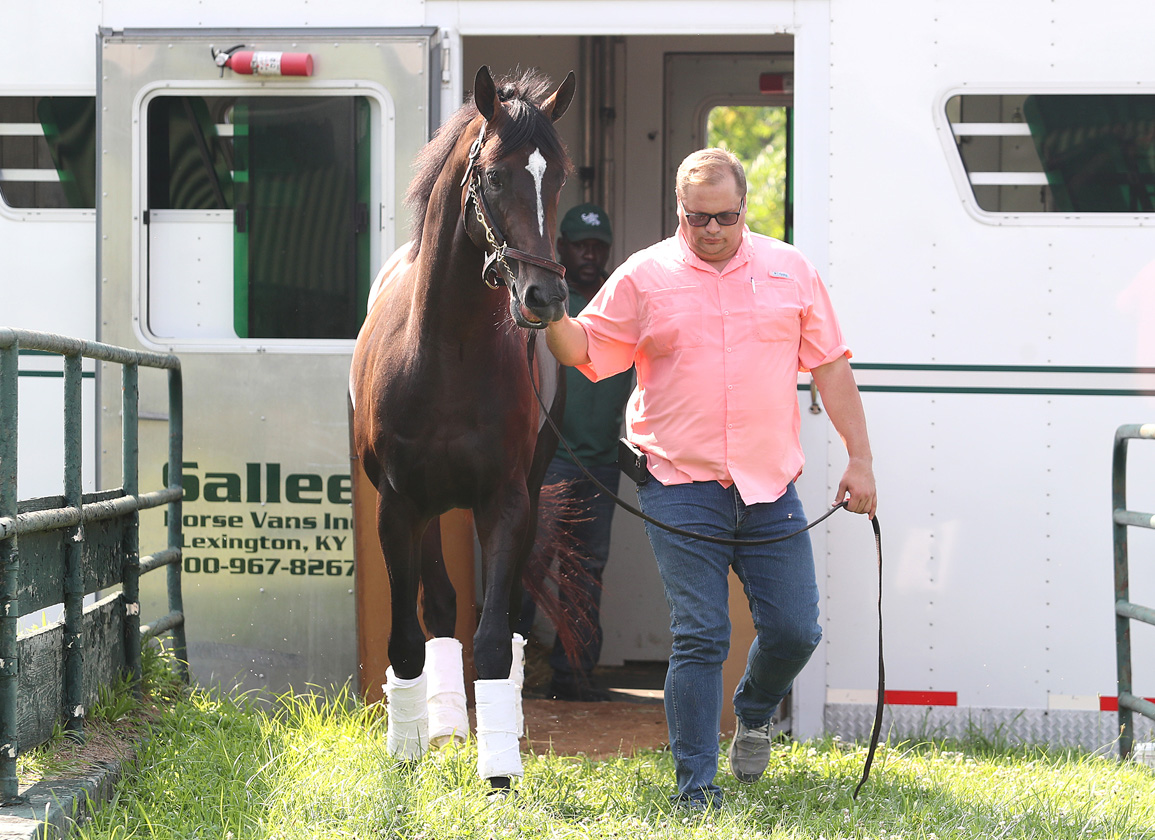
Midnight Bourbon arriving Thursday at Monmouth | Bill Denver/Equi-Photo
It's a fascinating race, pitching three Classic runners-up against the flagship of Runhappy's brilliant revival after a disappointing freshman campaign. Trying a second turn against elite opposition will certainly tell us what substance may underpin the dazzling style of Following Sea, but many neutrals will be hoping for a merited Grade I success for Hot Rod Charlie (Oxbow). As has been widely celebrated, “Chuck” set the fastest opening quarter in the long history of the GI Belmont S., and a :46.49 half bettered only by Secretariat, yet retained the reserves to pull 11 lengths clear of the rest in harrying crop leader Essential Quality (Tapit) all the way down the stretch. Perhaps the sport might have been spared much of its present embarrassment if he had been ridden with similar aggression in the Derby, instead of gifting control to Medina Spirit (Protonico), but the notion that he can eyeball a rival even better without blinkers (as well as without the whip) looks an intriguing gamble.
However things play out between them, the fact that all three of the Triple Crown protagonists converging here completed their springtime preparations in the GII Louisiana Derby means that there is already one guaranteed winner. And that's the Fair Grounds management, for having the enterprise to stretch out a race that has come to seem too close to the first Saturday in May–too close for the trainers of today, at any rate–to permit equivalent grounding with another rehearsal in between.
We credit much of “Chuck's pluck” to Oxbow, whose ardent Triple Crown campaign so shames the current crop–not one of whom contested all three legs this time round. True, the Mid-Atlantic stalwart Raines chose to sit out the Derby to bring Greek Money relatively fresh to the Preakness, but that didn't stop him running in the local prep race the previous Saturday. Who knows? Even as a son of Oxbow, Chuck might not have been able to dig so deep in the Belmont had he also contested the Preakness. But he's certainly made of the right stuff.
That, and an ownership team that transcends generations, gives us plenty of optimism for the future of the game. A precious commodity, right now, but this is a race (and racetrack) that has always engaged dynamically with challenges. That's how we can try a Haskell without whips; a Haskell with a $1-million bonus backed by the operators of a pioneering venture in fixed-odds wagering; a Haskell headlining a meet of boosted purses and turnstiles clicking cheerfully once again.
So, if it can also be a Haskell that honors the memory of “Gentleman” John Rotz, and indeed that of Buddy Raines, then people out there might once again start to accept our claims that we treat every horse right–not because of rules and regulations, nor because of cosmetics, but because it wouldn't even occur to us to do anything else.
The post This Side Up: Haskell Throwbacks to the Future appeared first on TDN | Thoroughbred Daily News | Horse Racing News, Results and Video | Thoroughbred Breeding and Auctions.
