Judge: Extra Testing In Medina Spirit Case Will Go On, Only Question Is Sample Size

At a hearing in Kentucky's Franklin Circuit Court on June 11, Judge Thomas Wingate determined that the legal team for Medina Spirit's connections will be permitted to do extra testing on a urine sample taken from the colt after the Kentucky Derby; the only question will be how much urine an independent lab will have access to.

Counsel for Medina Spirit trainer Bob Baffert and owner Zedan Stables filed a civil suit against the Kentucky Horse Racing Commission earlier in the week demanding their right to test the split urine sample, which sat undisturbed in the commission's freezer.

An initial post-race test from Medina Spirit was positive for betamethasone, and that was later confirmed on a split sample test. Attorneys for Baffert and Zedan now want to do further testing on biological samples from the horse in hopes of proving that the betamethasone present came from a topical cream and not an injection, which they say would be permissible under KHRC rules.

Jennifer Wolsing, general counsel for the KHRC, declined to speculate on whether a topical administration of betamethasone would require an exoneration in the case or whether it could be considered a “mitigating circumstance” with regards to penalty. She did point to the commission's drug classification guidelines, which make reference to betamethasone without specifying what form of betamethasone The only question at hand for this proceeding, she asserted, was what was to be done about further testing of the remaining biological samples.

Documents filed by the KHRC on Thursday revealed that in fact, the commission did not refuse requests from Baffert and Zedan to send blood and urine samples for additional testing after the split sample came back positive.

“This is a case about a litigant who will not take 'Yes' for an answer,” began the KHRC's response to the lawsuit.

After the split was positive, the KHRC agreed to release the remains of the primary blood and urine samples to an RMTC-accredited lab chosen by Baffert and Zedan, which was eventually identified during Friday's hearing as New York's Equine Drug Testing Program housed at Morrisville State College. There are four total samples at play here — two primary blood and urine samples, and two split blood and urine samples. Some of the primary blood and urine samples were tested after the race by Industrial Laboratories, which prompted the betamethasone finding in blood. The split blood sample was then sent to University of California-Davis for the split sample analysis. That means the split urine sample has remained in a freezer maintained by the KHRC. It also means each of the two labs may have some biological sample left over after they did their testing.

Industrial packaged portions it had left over of Medina Spirit's primary blood and urine samples and sent them off to New York. It turned out the vial containing the blood shattered, either en route or upon receipt at the New York facility. Since the vial was in the same bag as the urine container, Baffert and Zedan's attorneys voiced concerns that the leaked blood may have contaminated the urine container.

Then, KHRC said, it agreed to send commission equine medical director Dr. Bruce Howard to its freezer and film him opening the unused split urine sample, dividing it, and then have him personally transport a portion of it to the New York lab. When the Baffert/Zedan attorneys objected to the use of Howard, KHRC suggested it could find a substitute staff member and allow one or more team members from Baffert/Zedan counsel to also be present for the thawing and division of the sample. That option was also rejected.

As Wingate eventually determined, the parties agreed Baffert and Zedan should be able to test remaining blood and urine to see whether those samples could prove the origin of the betamethasone. They agreed that both the horse's connections and the commission should have representatives overseeing the move of the samples. Their only real sticking point was how much urine the New York lab should get for testing.

Wolsing argued that the KHRC needed to retain some of the sample, in case future testing should ever be needed.

“This is a situation where really anything could happen,” she said, pointing to the shipping issues with the blood sample as proof that it's a good idea to have some sample retained somewhere just in case.

Craig Robertson, attorney for Baffert, said he didn't want to restrict the New York lab to use a set amount of urine, since he didn't want them to be in any way limited in the quality of their testing.

The size of the split urine sample is estimated to be between 25 and 27 milliliters. Wingate said he would enter an order in the middle of next week requiring at least 3 milliliters to be kept by the KHRC, with the hope the two parties could agree to something privately before then.

Wingate did press Wolsing somewhat on the question of whether all of this will end up mattering — meaning, will the outcome of these tests impact whether or not Medina Spirit is disqualified. Wingate said that while he had not reviewed KHRC code, his initial feeling was that it wouldn't make much difference if the form of betamethasone Medina Spirit received did or didn't impact performance. Wingate also presided over the lengthy civil suit of Graham Motion, who fought a drug positive for methocarbamol. Wingate had overruled the KHRC in that case and was later reversed on appeal. He felt the methocarbamol did not influence the outcome of the race in question, but that the appeals court made it clear the rules did not allow for a determination about a substance's influence on race results.

“It's going to be very hard for this court to overturn [a potential ruling against Medina Spirit connections] based upon the Graham Motion case,” said Wingate, who clarified he was not pre-judging the Baffert case. “That's the way I look at it. I'm not prejudging it, but I've already dealt with the Graham Motion, which I thought was very unfair to Mr. Motion, I really did.”

Baffert did appear at the proceedings, which were held via video conference, but did not speak.

See the proceedings here:

The post Judge: Extra Testing In Medina Spirit Case Will Go On, Only Question Is Sample Size appeared first on Horse Racing News | Paulick Report.
Source of original post

‘Love What I Do’: Ageless Jon Court Carries On At Churchill Downs

Veteran jockey Jon Court is the elder statesman in the Churchill Downs jockey colony at age 60. However, the journeyman rider continues to ride at a top level and remains optimistic about the future of his career.

“I've been very fortunate and blessed to be able to have a body that still cooperates and to have live horses underneath me,” said Court, who had five wins through 28 days at the Spring Meet. “I know I'm at the top of the stretch in my career but that means I still have a quarter-mile left to go. I've been around the block for many years and love what I do.”

Court has won more than 4,200 races in his career that began in 1980 at the now defunct Centennial Race Track in Littleton, Colo. Court started his jockey career before eight of the current Top 10 riders in the Churchill Downs colony were born.

“When you get to this stage of your career, some of the younger riders come up and ask for advice,” Court said. “I'm very open and love doing that. It makes you realize you are very blessed to be in that sort of situation where fellow riders are asking you for advice. I'm very lucky.”

Court was named to ride six horses over the next three days of racing at Churchill Downs. Among his scheduled mounts was a 2-year-old named Curly Tail for trainer Dallas Stewart and owner Willis Horton. Stewart and Horton remained successful with Court earlier this year when he rode Will's Secret to a third-place finish in the $1.25 million Longines Kentucky Oaks (GI).

“There have been many loyal trainers and owners who have stuck with me for a number of years,” Court said. “This game is tough but loyalty goes a long way.”

The post ‘Love What I Do’: Ageless Jon Court Carries On At Churchill Downs appeared first on Horse Racing News | Paulick Report.

Source of original post

This Side Up: When the Going Gets Tough…

And so the dust settles on a Triple Crown in which not a single horse showed up for all three legs, with the one awaiting promotion as “winner” of the GI Kentucky Derby instead resurfacing this weekend in a non-graded stakes at Monmouth.

When they withdrew him from the Classic fray, the Mandaloun (Into Mischief) team obviously had no idea that he might abruptly find himself elevated onto the Derby roll of honor, albeit burdened with an asterisk. But they certainly captured the spirit of the age, one we deplored last week in celebrating the Classics as a historically reliable signpost to the genetic assets we should want to recycle.

To that extent, how we campaign horses actually involves making decisions on the same continuum–namely, the extent to which we're putting it all out there in a way that future generations can trust–as the more notorious ones made over the range of “therapies” today available from science.

From the outside, we can only judge what's happening inside a barn from the animal presented to the public. All of us with a stake in the breed, then, have a duty to try and identify (and, wherever possible, to invest in) those who are palpably working in its interests. So, for instance, owners who choose a barn with an extraordinary strike-rate need to ask themselves what kind of practices they might be supporting in the cause of self-interest.

Now there are certainly trainers who can settle any such questions in coherent and satisfactory fashion. I can think of some, for example, whose excellence has earned them patrons with elite resources in a field lacking due competition: in turf racing, perhaps, or in a pool struggling for depth, as is sadly the case at present in California. But there are other cases so egregious that their patrons should ask themselves whether they would sound any more convincing, after the barn is raided someday, than did those who piously pronounced their shock after the arrests of Jorge Navarro and Jason Servis.

Servis, of course, brought Maximum Security (New Year's Day) to the same race as Mandaloun–Sunday's Pegasus S.–for his first start following wildly contrasting fortunes at the Derby, only to be turned over at 1-20. However things play out for Mandaloun from here, I'm scandalized to hear people urging that the Triple Crown schedule be revised to accommodate the behavior of horsemen today. No sir! No ma'am! A thousand times, no. If the horses we are breeding (or their trainers) aren't equal to the time-honored test, then that's something we all need to know. Rather a weaker Triple Crown series than a weaker breed.

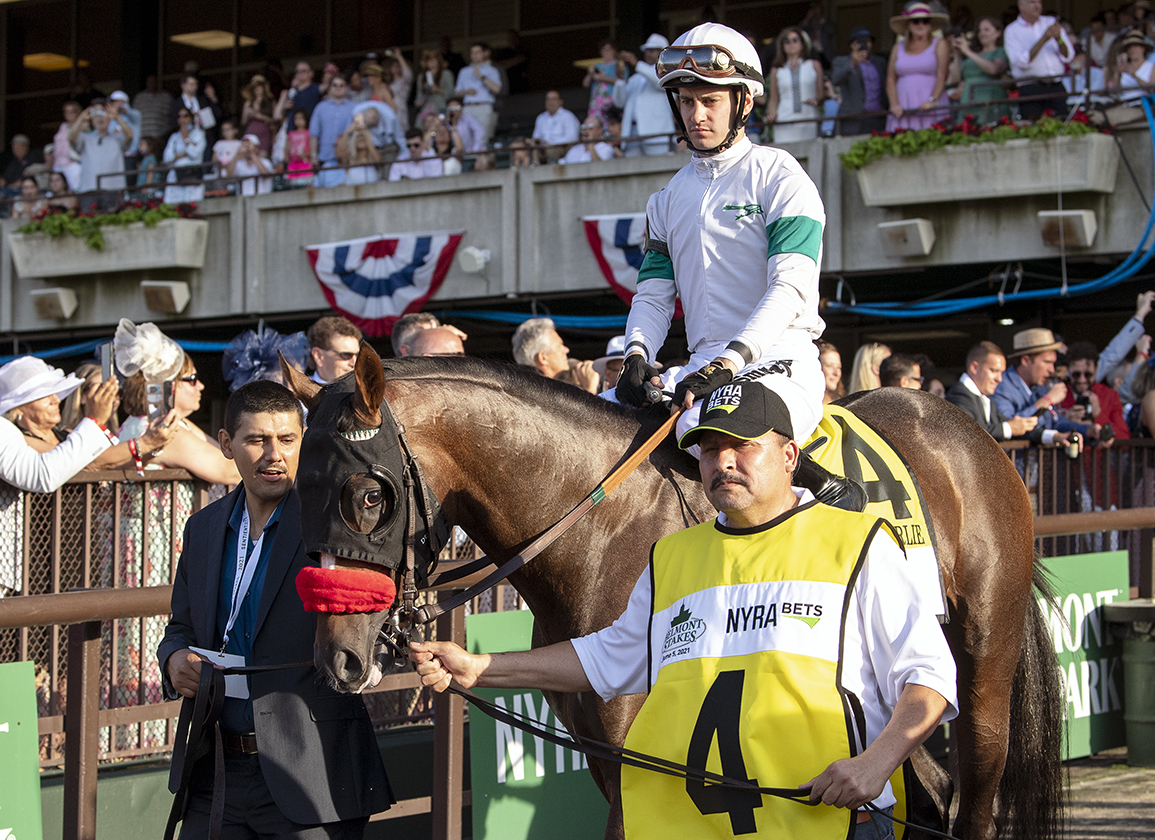
Hot Rod Charlie | Sarah Andrew

Now, so long as it's only a few mavericks of high principle who make a stand on resilience and constitution, then it's going to remain difficult for breeders to make that work at the marketplace. Oxbow, for instance, had begun to seem a pretty impossible commercial proposition by the time he came up with last week's GI Belmont S. runner-up Hot Rod Charlie. But if every other operation could meet the exemplary standards of Calumet, who gave Oxbow a thorough grounding before he ran a superb race in all three Classics, then breeders would know themselves for a fact to be using materials that have been honestly tested. (As it is, of course, very few farms do so–and that confines a branding guarantee to the likes of Oxbow, and others on his roster like Keen Ice and now Bravazo, effectively trading somewhat lesser performance eligibility for unimpeachable toughness.)

I have no idea whether Hot Rod Charlie has arrived in time to bring his sire back from the brink, but I do know that when his own time comes to go to stud, this nugget of a horse will owe his credentials every bit as much to Oxbow as to the remarkable mare who has also given us, in Mitole (Eskendereya), a champion sprinter by another unfashionable stallion.

Because what Hot Rod Charlie did last Saturday was absolute throwback stuff. Maybe he couldn't have done it, but for sitting out the Preakness. We'll never know now, obviously. But you'd like to have seen it tried, because this was one of the most heroic exhibitions of carrying speed in defeat you'll ever see.

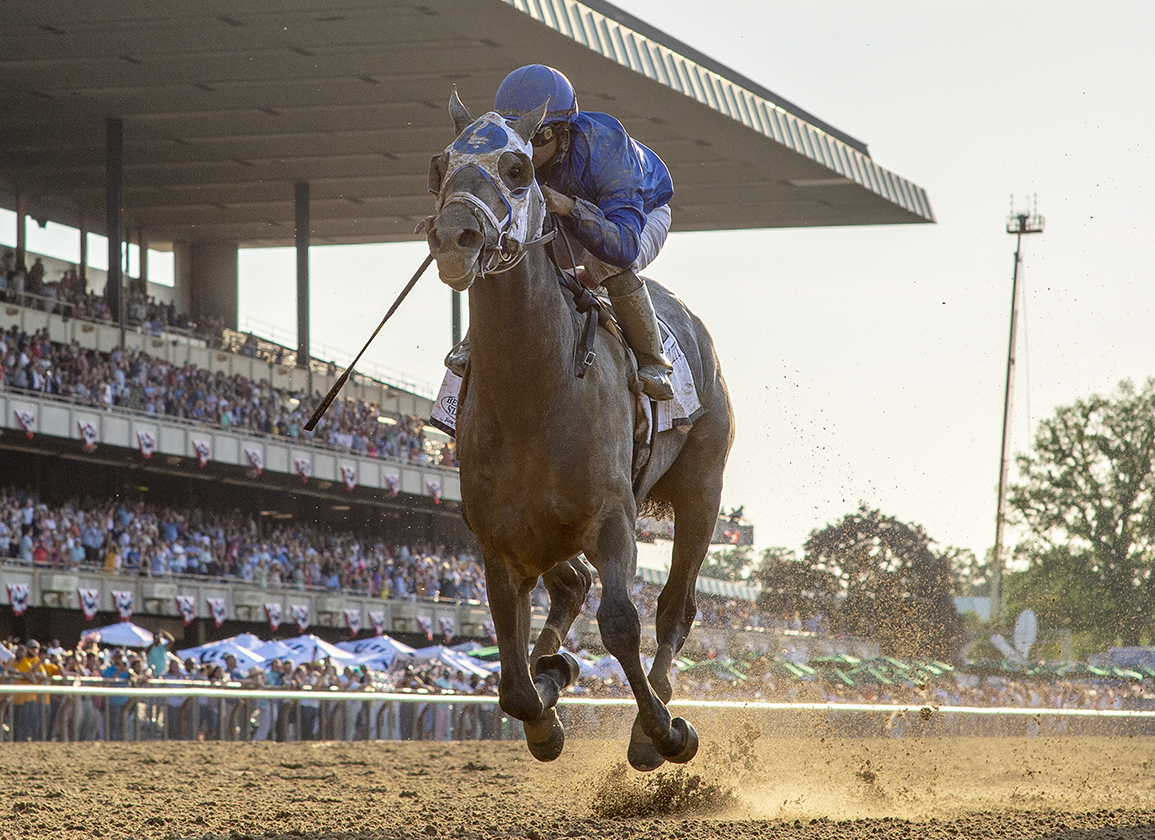
As has been widely remarked by now, Hot Rod Charlie's 22.78 opening quarter was the fastest ever recorded in the Belmont S. His 46.49 half was beaten only by a horse called Secretariat. Here, clearly, was the work of a sibling to Mitole. Yet while the two horses who shadowed this pace floundered into oblivion entering the stretch, Hot Rod Charlie responded to the challenge of the crop leader (and that, in terms of accomplishment, is plainly what the superbly professional Essential Quality {Tapit} remains for now) by summoning his inner Oxbow and opening a gap of 11 lengths on the Preakness winner.

Essential Quality | Sarah Andrew

Congratulations, then, to Antony Beck of Gainesway for having secured a place for this extraordinary young horse alongside his champion Tapit, now the only sire of modern times to sire a fourth Belmont winner. (On which basis, as we explored midweek, Tapit stands as a transatlantic foil to Galileo {Ire} himself, in terms of wholesome Classic influences.)

Perhaps the whole Derby trauma might have played out differently had Hot Rod Charlie not allowed Medina Spirit (Protonico) to control such a processional tempo. Regardless, the pluck of “Chuck” is going to land a big one at some point, perhaps on the doorstep of some of his younger owners at Del Mar in November. If so, he could offer the game valuable succour in this time of need. For if the $1,000 yearling who won the Derby has quickly proved a public relations disaster, then a $17,000 short yearling offers a pricelessly accessible combination: an enthusiastic, multi-generational group of sportsmen, on the one hand; and some truly venerable antecedents on the other. (As we've often noted, he's the final legacy of his late breeder Edward A. Cox, Jr.; and was raised at Hermitage Farm by a man, in Bill Landes, who condenses all the sagacity and dignity our business needs so sorely today.)

So let's look on the bright side, as is seldom hard to do with Saratoga and Del Mar on the horizon. Despite continuing legal ructions over the Derby, there are many more welcome “positives” brewing in our environment. For one thing, paradoxically enough in the circumstances, we've just negotiated a first Classic season without Lasix. We have happy crowds restoring vitality to our great occasions. We have a bloodstock market suggestive of impatient demand. And we have a renewed sense of vibrancy and relevance at that cherished bastion of tradition, Keeneland, in a series of flawless appointments starting with that of Shannon Arvin. This regeneration, which has since included the hiring of Tony Lacy and Gatewood Bell, was extended Thursday by the naming of Cormac Breathnach as Director of Sales Operations.

Breathnach will leave a void at Airdrie, but then it was only in measuring up to such a peerless farm that he proved his eligibility for wider responsibility in our industry. Rather like the people who gave us Hot Rod Charlie, Airdrie combines the best of the old school with the dynamism of youth. The standards Governor Jones has established are being scrupulously maintained by his son Bret, as vice-president, and Ben Henley as general manager. And so long as our community has such people in our corner, setting an inflexible premium on integrity and class, we'll keep producing not just the right kind of horses but also the right kind of horsemen.

The post This Side Up: When the Going Gets Tough… appeared first on TDN | Thoroughbred Daily News | Horse Racing News, Results and Video | Thoroughbred Breeding and Auctions.

Source of original post

Six-Time Dirt Stakes Winner Street Lute Tries Turf In Pimlico’s Stormy Blues

Lucky 7 Stables' Street Lute, already a six-time stakes winner on the dirt, is set make her turf debut as part of a field of 13 entered in Sunday's $100,000 Stormy Blues at historic Pimlico Race Course.

The 13th running of the Stormy Blues for 3-year-old fillies and the fourth renewal of the $75,000 Ben's Cat for Maryland-bred/sired 3-year-olds and up, both sprinting five furlongs, are among four scheduled turf stakes on a 10-race program. They are joined by the $100,000 Prince George's County at 1 1/8 miles for 3-year-olds and up, and $100,000 Searching for females 3 and older at 1 ½ miles.

Rounding out Sunday's stakes action is the $100,000 Shine Again for fillies and mares 3 and up sprinting six furlongs on the main track. Part of the Mid-Atlantic Thoroughbred Championship (MATCH) Series, it features undefeated multiple stakes winner Chub Wagon facing off against Anna's Bandit, Hello Beautiful and Dontletsweetfoolya, who have combined to win 29 races, 18 stakes and more than $1.37 million in purse earnings.

First race post time is 12:40 p.m.

Even as his young stable star has piled up wins on the dirt, trainer Jerry Robb has been waiting for a grass opportunity for Street Lute, a chestnut daughter of Street Magician out of the Midnight Lute mare Alottalute bred in Maryland by Dr. and Mrs. Thomas Bowman and Dr. Brooke Bowman.

“She's bred for grass top and bottom. Just off her breeding alone, I'd be shocked if she didn't take to it. She's got just a ton of natural ability,” Robb said. “I definitely want to try the grass if we have it, or I can go for the mud if we don't.”

Street Lute won the 5 ½-furlong Small Wonder last fall at Delaware Park over a sloppy track while all her other races have come over fast surfaces including victories in the 2020 Smart Halo, Maryland Juvenile Filly Championship and Gin Talking and 2021 Xtra Heat and Wide Country during a five-race win streak, all at Laurel Park at six or seven furlongs.

Third when stretched out to a mile for the March 13 Beyond the Wire at Laurel, Street Lute exits her first off-the-board finish when sixth following a troubled trip in the six-furlong Miss Preakness (G3) May 14 at Pimlico on the Black-Eyed Susan (G2) undercard, her graded-stakes debut.

Street Lute has had one timed breeze since the Miss Preakness, going three furlongs in 36.20 seconds June 5 at Delaware Park, the fastest of 22 horses. Regular rider Xavier Perez – who earned his 1,000th career win Monday at Delaware on Robb-trained In the Loop – climbs back aboard from Post 10 in a field of 13 that includes main track only entrant Malibu Beauty.

“Her last race she broke horrible, got pinched back and had no shot. Plus, it was a tough spot,” Robb said. “I'm looking for her to bounce right back.”

Trainer Wesley Ward, in England for the upcoming Royal Ascot meet, entered a pair of stakes winners in Wink and Irish-bred Amanzi Yimpilo. Stonestreet Stables' Wink, Group 3-placed in France last fall, was a front-running winner of the five-furlong Melody of Colors on the Gulfstream Park turf March 20. Last time out, the Midshipman filly ran last of nine after dueling for the lead in the May 8 Mamzelle.

Purchased as a yearling for $110,000 at Keeneland in September 2019, Wink debuted last June with a 1 ¼-length maiden special weight triumph at Belmont Park and was immediately stepped up to stakes company, winning the Colleen at Monmouth Park. Both victories came in gate to wire fashion.

From there, Wink and stablemate Campanelle traveled to France, where she ran second by a length in the Prix d'Arenberg (G3) at Longchamp Sept. 3. Two weeks earlier, Campanelle gave Ward his third career win in the Prix Morny (G1) at Deauville.

“She went over there to accompany Campanelle and she ran really, really good. It wasn't really a plan to race there but to bring her there for the other filly. There was a race there and now she's got graded-stakes placing. She led every jump but the last little bit, so she ran a real credible race there,” Ward said. “She's well-traveled, so right after the race we brought her home and gave her some time.”

Victor Carrasco has the call on Wink, who drew outside Post 13.

Susan Moulton, Marc Detampel and CJ Thoroughbreds' Amanzi Yimpilo ran seventh in the Mamzelle to open her 2021 campaign. By No Nay Never, a French Group 1 and American Grade 3 winner also trained by Ward, she won two of three starts at 2 including a head triumph in the 5 ½-furlong Speakeasy last fall at Santa Anita.

“She kind of lost it there on her comeback race day. She kind of got real hot and was worked up a little bit and just was sweating,” Ward said. “We've worked on that a little bit, brought her over a couple times to Churchill to breeze on the grass and she just got completely over that. I think she just had the nervous jitters coming back and I really look for her to run a big race.”

A $300,000 yearling purchase in September 2019, Amanzi Yimpilo breezed four furlongs in 48.80 seconds June 6, the fastest of eight horses, and will get the services of jockey Mychel Sanchez from Post 9.

“We paid dearly for her. She's by a sire that I trained … so I'm responsible for her success and failure. I want to keep moving forward with her. I think she's really going to turn out to be a nice filly. We gave her all time off this winter and she's a good, fresh filly,” Ward said. “I just think that first race was a throwout based on how she was acting that day.”

Beautiful Grace, Catching the Wind, Door Buster and What a Trick all enter the Stormy Blues off wins. Multiple stakes-placed Honey Pants, fifth by three lengths in the one-mile Sweetest Chant (G3) Jan. 30 at Gulfstream, ships in from New York for trainer Christophe Clement, while Kentucky-based Ben Coleman brings in April 10 Cheryl S. White winner Prodigy Doll. Can't Buy Love, Proper Attire and Whiskey and Rye – who finished behind Street Lute in the Gin Talking, Xtra Heat and Wide Country – complete the field.

The post Six-Time Dirt Stakes Winner Street Lute Tries Turf In Pimlico’s Stormy Blues appeared first on Horse Racing News | Paulick Report.

Source of original post

Verified by MonsterInsights