Letter To The Editor: Baffert Scandal Demonstrates What NCAA Would Call ‘Lack Of Institutional Control’

Do you remember the beginning of Aladdin, when the genie warns Aladdin to be specific with his wishes, otherwise he may not get what he intended? Does anyone else in the Thoroughbred industry feel like the last two weeks have been an endless barrage of wishes for racing gone wrong?

“I wish racing would get more mainstream media attention.”
Ok, but it will be about yet another scandal.

“I wish more people saw the need for national uniformity, consistency, and better drug testing.”
Sure, but it will be because of a drug positive on the sport's largest stage.

“I wish we had an underdog to cheer for, a horse the sold for a reasonable price beating the million-dollar yearlings.” Absolutely, but it's still going to be trained by a “super trainer” and comes with a side of scandal.

Just once, wouldn't it be nice if our wishes for racing could come to fruition, exactly as we want them to, in a positive and beneficial way?

I am far from the first person to offer commentary on the Derby scandal and ensuing fallout, and most certainly won't be the last. While many have shared their frustration, disappointment, disgust, etc., there is still a shocking number of people defending the situation, which (based on current information and admissions) seems fairly indefensible.

The best case scenario right now, assuming you believe the most current information provided by Bob Baffert, is that he (or his staff) gave a topical with an active ingredient that is a regulated substance inside the recommended withdrawal window. Then, it took him two and a half days to discover that it had been administered. He called a press conference, broke the news of the positive himself, swore the horse had never had the drug, and seemingly didn't bother to check the treatment records for the horse prior to casting doubt over the integrity of post-race sample.

Best case, Baffert is so uninvolved in his own shed row that he didn't know what was being administered, what was in that substance, or who to ask to find that information out. Because that answer should not have been hard to find before a press conference. I'm not going to be a “conspiracy therapist” and make accusations about the plausibility of this chain of events (though Natalie Voss brought up several excellent points in her piece “Show Us The Paper, Bob: Records To Back Up Baffert's Story Remain A Matter Of Trust”). I am simply going to take this admission of guilt for what it is, and what it is happens to be entirely inexcusable for any trainer, especially one of his caliber.

I see people saying things like, “people in glass houses shouldn't throw stones” or, “nobody's perfect”. But following the rules of a job you are paid (quite well) to do so as to not jeopardize your results is not perfection. It is adequacy. And in this case, Bob Baffert has fallen woefully short. Hall of Fame trainer, two-time Triple Crown winner, seven-time Kentucky Derby winner, cannot even meet the bare minimum expectation of a trainer. And yet I see his actions being defended.

To my fellow owners and breeders, imagine this scenario on a breeding farm — your farm manager gives a substance to your pregnant mare that damages the foal in utero, and the excuse is they didn't know the active ingredient. Is that level of ignorance acceptable to you? The vet that prescribed it did so knowing the mare was pregnant. Is that acceptable to you? Or would you move your horses to a different farm with a different vet? As trainer, the burden of responsibility falls to you — to hire a qualified staff, to employ competent vets. If you fail to do so, their failings are your own, whether or not you personally administered the medication.

Looking back at the last year of violations, across many jurisdictions, brings to mind a category of penalty that does not exist in racing, but does in the NCAA. They would call it a “lack of institutional control.” The determination of this severe infraction is made when an institution fails to display (source ncaa.org):

  • Adequate compliance measures
  • Appropriate education on those compliance measures
  • Sufficient monitoring to ensure the compliance measures are followed
  • Swift action upon learning of a violation

Sound familiar? Stating you don't know what betamethasone is used for, despite being cited in the last year for the use of that drug at the same track is not merely “failure to monitor”. These actions show a laissez-faire attitude towards drug regulations that this sport cannot allow.

The justification of “how small a picogram is” becomes invalid when you look at how little concern was shown for withdrawal windows and regulated substances. Trainers are aware of the sensitivity of testing; Baffert more than most. If you had two drug positives in one day from incidental contact with a stable employee, you would think you'd be well aware that substances applied to the skin will be absorbed and show up on testing.

I've seen it said that Baffert wouldn't have risked an overage at the Kentucky Derby because he knows the stakes. Though, by his own admission he did in fact administer the substance, so does he know the stakes?

Throughout his career, and particularly in the last year, he has been Teflon. Nothing sticks. Positive tests are hidden or he gets a proverbial slap on the wrist. Based on past precedent, what reason does he have to think anything would be different this time? And even if he was banned for life, he still retires comfortably. He can watch this industry burn around him in the pursuit of records, and know that it doesn't matter for him. Those of us a few decades younger seeking to build careers in this industry simply don't have that luxury. Unfortunately, we largely also lack the ability to fight the fire he set.

Whether betamethasone should be allowed at the track at all, or completely unregulated, is irrelevant right now. Whether we should test to picograms is irrelevant right now. Baffert admitted to administering the substance, with no regard for withdrawal recommendations. The time to change those rules is not when you get caught. Whether or not the amount in the horse's system was performance enhancing is not the question. The threshold is established and the information is readily available, and should factor into treatment decisions.

If a similar drug positive happened to one of the “little guys,” there would be no news coverage, no press tour proclaiming innocence. There would simply be punishment. Fines and suspensions are routinely handed out as the consequence of a drug violation, no matter how minor the violation or robust the reasoning. Whether Baffert has dodged these ramifications because of his success or his legal team, it is a ridiculous double standard within the training ranks.

Yesterday, Baffert requested racing fans “not rush to judgement” as he reiterated the topical administration of betamethasone was the only “possible” exposure so far. For someone who has dodged penalties on far more tenuous “contamination” stories, I wonder what 'get out of jail free' card he's hoping will appear. He paired the reiteration of the statement that neither his barn nor veterinarians administered betamethasone with the statement that it was administered topically. He acknowledged that he could have handled the press conference he called better, but I have yet to see him acknowledge he could have run his barn better. While misstating something in a press conference gives the media a soundbite to run with, disregard for drug policies leads to the press conference in the first place. By rectifying the latter, you can entirely avoid the former.

So where do we go from here? HISA is just a step, and it's still a long way off. We need a pubic relations department for our industry, we need uniform drug policies, we need transparency, we need tighter surveillance. By eliminating the question as to how a horse tests positive, racing can more harshly punish wrongdoers with the clear conscious of knowing they were at fault. By responding swiftly and appropriately to issues like this, racing can easily refute welfare claims about drugged up horses being run into the ground, and maybe encourage participation and growth from our fan base.

Graham Motion suggested on Twitter that perhaps racing needs/needed to hit rock bottom to improve. While I would like to have optimism that maybe this is the rock bottom needed to right the ship, hope seems Sisyphean when racing appears to be sitting at rock bottom holding a shovel yet again.

–Erin O'Keefe, Farm Manager & Bloodstock Services, BTE Stables

If you would like to submit a letter to the editor, please write to info at paulickreport.com and include contact information where you may be reached if editorial staff have any questions.

The post Letter To The Editor: Baffert Scandal Demonstrates What NCAA Would Call ‘Lack Of Institutional Control’ appeared first on Horse Racing News | Paulick Report.
Source of original post

Len Ragozin, 92, Creator Of ‘The Sheets,’ Passes

Len Ragozin, whose Ragozin Sheets revolutionized handicapping of horse races more than 50 years ago, died peacefully in Vermont on Thursday at the age of 92.

The eldest child of Sarra and Harry Ragozin, Len lived most of his life in Manhattan. He was frugal and devoted much of his efforts and the profits of the business he founded, The Ragozin Sheets, to anti-racist, pro-worker causes.

Len attended City & Country, a ground-breaking, progressive elementary school in Manhattan's Greenwich Village, and provided a life-saving mortgage in the 1970s when it faced financial difficulties. He also attended The Horace Mann Lincoln School and Harvard University.

In the pre-computer era, Len developed the algorithms that became The Ragozin Sheets, the outstanding individual thoroughbred horse performance records used by major owners, trainers and handicappers. He described that experience and his methods of handicapping in a book: “The Odds Must Be Crazy.”

When the now computerized company producing The Ragozin Sheets was sold, Len donated most of the sale proceeds to fund the Len Ragozin Foundation, which provides support to groups and individuals working on innovative ways to put progressive ideas into practice.

Len is survived by his sister, Nikki Keddie, his brother David Ragozin, a daughter, Alexa Manning, granddaughter, Adeline Manning, and ex-wife and longtime best friend Marion Buhagiar, who was with him during his final days.

As he wished, Len was cremated without ceremony. No memorials are currently planned. Donations from friends and comrades who remember Len and share his ideals are welcome at the Len Ragozin Foundation (lenragozinfoundation.com).

Read more about Len Ragozin here and here.

The post Len Ragozin, 92, Creator Of ‘The Sheets,’ Passes appeared first on Horse Racing News | Paulick Report.
Source of original post

Lessons from a Stallion Consultant

Grade I-producing sire Laoban is off to a fast start in Kentucky as he nears the completion of his first book at WinStar Farm. Meanwhile, his son Keepmeinmind, one of two graded winners for the son of Uncle Mo, readies for his bid in Saturday's GI Preakness S.

“He has settled in and is doing really well,” WinStar's President and CEO Elliott Walden said. “He's going to breed around 140 mares this year.”

The transition from Laoban's original stud farm, Sequel Stallions in New York, to WinStar was a breeze, thanks in no small part to Sequel's Stallion Consultant Charl Van Der Westhuizen, a South African native with a natural gift for putting any stallion at ease. Van Der Westhuizen made the trip alongside Laoban this year to help the young sire acclimate to his new residence and to properly introduce the team at WinStar to their new charge.

“Charl helped us tremendously in getting Laoban acclimated,” Walden said. “He's a first-class horseman. With the nuances of any horse, it's very helpful to understand their differences whenever you get a horse you don't know. Charl knew every detail about the stallion and was great at communicating his personality to us in a way that we could pick up the ball and go right away without having a learning curve.”

Van Der Westhuizen has served as stallion consultant at Sequel since March of last year. The farm's founder Becky Thomas said he has been a crucial member of their team since his first day on the job.

“Charl turned our program around last year,” she said. “It was my easiest year with our stallions. COVID of course made it difficult, but it was my easiest year behaviorally. He has such a natural way with our stallions. One of them is kind of difficult to catch, but he literally trots himself up to Charl. They're so comfortable with him and he has an exceptional relationship with each of them.”

Van Der Westhuizen has worked at stud farms around the globe, but he said the key to handling any stallion successfully is to recognize their individual personality.

“Over the years, I've worked with a lot of different types of stallions, and each and every one is different,” he said. “You have to cater to the needs of the stallion. You have to be a competent handler because they feel if you're nervous and they will take over. On the other hand, if you have a horse that doesn't get overly excited, you can intimidate him to the point where he doesn't want to breed because he'll be more scared of you than he is of the mare.”

Born in the heart of South Africa in Johannesburg, Van Der Westhuizen and his family eventually left their urban location and moved to the countryside where at 13 years old, Van Der Westhuizen met a kind, old broodmare at the family's new farm.

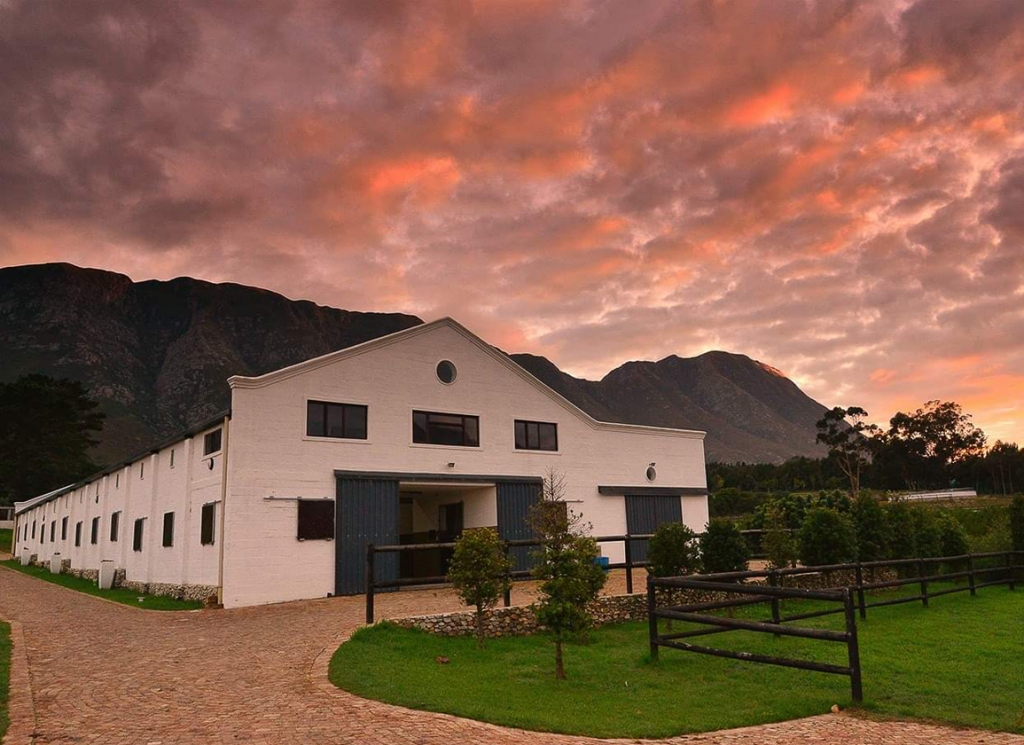
Nadeson Park Stud in Hermanus, South Africa | David Morris

“I traded in my skateboard and started riding this mare,” he recalled. “My interest developed and there was actually a small Arabian stud down the road. They showed me the ropes and started teaching me the basic necessities of horsemanship. Growing up, my mates and I would see all the cowboys in movies from America, so we actually brought in a couple of wild horses to train and would have our own private rodeos.”

Not long after turning 18, Van Der Westhuizen saw an ad in a magazine for an internship at Lakland North in New York, the farm now known as Sequel Stallions. He made his first journey to the U.S. in 2002 for the internship and quickly gravitated towards the stallion division.

“As an intern, you do all aspects of jobs on the farm, but I took an interest in the stallions,” he explained. “It was a challenge because each and every stallion is so different in the way they behave. You have to learn each of their little quirks.”

After completing the internship in New York, Van Der Westhuizen relocated to Sequel's location in Florida for a breeding season before returning to South Africa.

There he spent over a decade honing his stallion-handling skills by serving at stud farms across the country, from Lammerskraal Stud, Newbury Stud, Balmoral Stud and Nadeson Park Stud. At each farm, he picked up valuable lessons from each of the stallions he oversaw.

Western Winter, a Grade I-placed son of Gone West that relocated to Lammerskraal in 1997, was a champion sire in South Africa.

“He was a pleasure to work with,” Van Der Westhuizen recalled. “He was so quiet and gentle, it almost made it easy.”

But Parade Leader (Kingmambo), a full brother to former Lane's End Texas sire and GIISW Parade Ground, was quite the opposite.

“He was a really mean horse,” Van Der Westhuizen said. “You had to watch your back the whole time. He would literally try to take your head off if you went in the stall to catch him.”

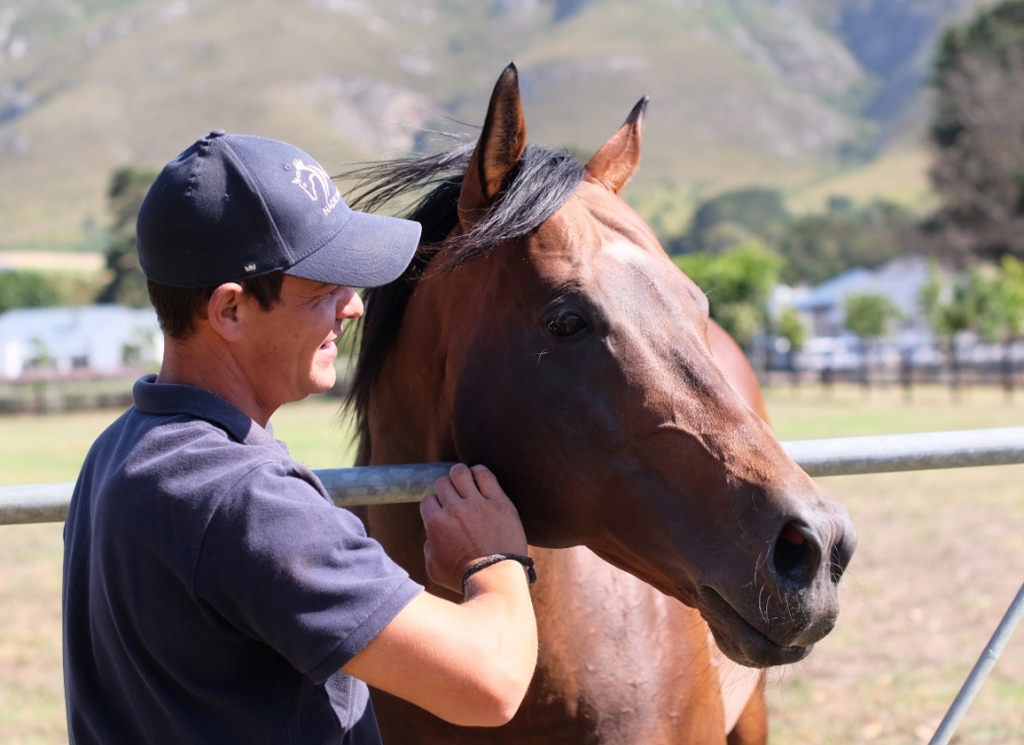
Van Der Westhuizen with Australian sprinter Time Thief (Redoute's Choice) at Nadeson Park Stud | David Morris

One of the most challenging stallion careers he remembers overseeing was that of well-regarded South African sire Rakeen (Northern Dancer), sire of the late multiple champion sire Jet Master.

“At first he was really mean, but we figured out he wanted to be close to the mares,” Van Der Westhuizen recalled. “So we put him in a paddock next to the broodmare barn and it immediately changed him.”

He remembers when Rakeen once fell and broke his hip. Even after the stallion had fully healed, breeding season the next year proved to be a challenge when he couldn't fully support his body weight when on his hind legs.

“We found a slope along the barn and he would stand on the slope and we would back the mare up into a hole so he could comfortably breed the mare,” Van Der Westhuizen explained. “When he would mount, we had a sling that we would put underneath his hindquarters and two guys would stand on either side to keep his weight up.”

Van Der Westhuizen said the breeding program in South Africa differs from the one in the U.S. in several aspects.

“[In South Africa], you'll do your selection a lot more on pedigree, where I would say here a lot of the breeding is based on conformation. They do not have a lot of juvenile racing as there is here, where the focus is on young 2-year-old colts running as quickly as possible, so the dynamic of the whole breeding program is slightly different. The process is similar, but I would say the end goal is different.”

Another major difference, Van Der Westhuizen said, is that most breeding sessions in South Africa take place outdoors.

“Only a few farms there actually have an enclosed breeding shed. While it varies from stallion to stallion, one thing I've noticed is that stallions seem to breed a lot easier in open surroundings and on natural surfaces than when you're in the shed.”

When Van Der Westhuizen arrived at Sequel last year, he had a few tricks up his sleeve based on what he had learned from his home country to help the stallions at Sequel succeed.

“Laoban always preferred to face the one side of the breeding shed towards the door,” he explained. “We figured out if we opened the door to the shed so he could see outdoors, he was happy. It was nice to be a part of a success story like him, changing up a few things in the shed before he moved to Kentucky to stand with the big boys. Ultimately, it was his progeny that got him there, but to work with a horse like that, it bolsters your confidence and keeps it interesting.”

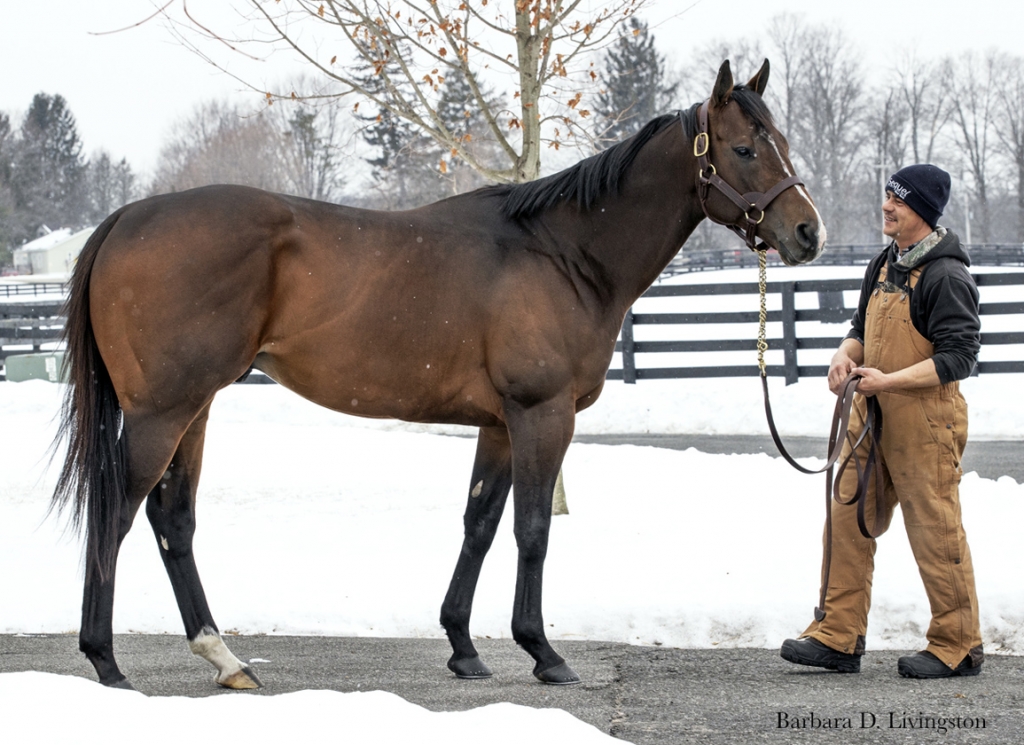
Van Der Westhuizen and Honest Mischief at Sequel Stallions | Barbara Livingston

Van Der Westhuizen learned early on in his career that his greatest pride came in teaching early lessons to young stallions as they first started stud duty. This year, he had the opportunity to show the ropes to stakes-winning Juddmonte homebred Honest Mischief (Into Mischief). See our video on the new sire here.

“He's doing great; he's been really busy,” Van Der Westhuizen reported. “I believe the way you start off a stallion provides the fundamentals for how he will breed for the rest of his career.”

One of the first young stallions Van Der Weshtuizen ever worked with was a son of Storm Cat named Freud. Now a perennial leading sire of New York-breds, the full brother to Giant's Causeway started his stud career at Sequel in 2002 when Van Der Weshtuizen was at the farm completing his first internship.

“I have almost a sentimental connection to Freud,” Van Der Westhuizen admitted. “I do prefer him out of all the horses in the barn. He has calmed down a lot. He's now 23, but he breeds like he's five. He has his own set way of breeding but the more you work with stallions, the more you pick up on each of their quirky ways.”

Van Der Westhuizen expressed his partisanship for Sequel Stallions as he's watched the farm's success from afar during his time in South Africa, in between his stint as a humble intern two decades ago up until his current position as one of the farm's top advisors.

“This is where my professional career started for me,” he said. “To see it grow into the farm it currently is made it so much easier to come back from South Africa to the States with my wife and daughter. To be able to focus on the stallions again, I can actually feel that the decisions I make impact not just the stallions, but the mares as well.”

Van Der Westhuizen said he's not done climbing the ladder of success yet in the industry, knowing there's a new lesson to be learned from every stallion he encounters.

“You always read about the old greats, people who have been a stallion manager and worked with these super stallions for many years,” he said. “Ultimately, I'd like to build up enough knowledge to specialize in stallion fertility and troubleshooting. I'd like to be at the point where people contact me if their stallion is having problems.”

He's on track to do just that. From a teenager playing cowboy in the South African countryside to a sought-after advisor for the world's top stallions, oh, the stories he will have to share.

The post Lessons from a Stallion Consultant appeared first on TDN | Thoroughbred Daily News | Horse Racing News, Results and Video | Thoroughbred Breeding and Auctions.

Source of original post

Starspangledbanner Filly In Naas Upset

There was an unexpected turn-up in the G3 Coolmore Stud EBF Fillies Sprint S. at Naas on Sunday, with the apparent “good thing” Contarelli Chapel (Ire) (Caravaggio) managing only fourth behind the Fozzy Stack-trained newcomer Hermana Estrella (Ire) (Starspangledbanner {Aus}). Slowly away and racing in rear early off the strong tempo, the 50-1 shot was behind Ballydoyle's 2-7 favourite at halfway but had to come around as that rival began to struggle. Responding to Chris Hayes's urgings, the debutante worked her way past the speedy but errant Quick Suzy (Ire) (Profitable {Ire}) inside the final 75 yards to secure a length success. “She's a very smart filly and Fozzy doesn't make entries like that unless they are good,” Hayes commented. “She's one of our nicer two-year-olds. She was green and raw, as you would expect going against experienced company but to me I was coasting and everything was going in slow motion. She was green and ran around, but won with her ears pricked. She is one to look forward to.”

Hermana Estrella is the second and final foal out of the unraced The Last Sister (Ire) (Lord Shanakill) who died after producing this talented performer. She was a half-sister to the G3 C L Weld Park S. and G3 Leopardstown 1000 Guineas Trial S. winner Lady Springbank (Ire) by Starspangledbanner's sire Choisir (Aus), who in turn produced the listed-placed Expressionism (Ire) (Galileo {Ire}). The third dam is the listed-winning and group-placed Santina (Ger) (Gimont {Ger}), whose descendants include the G3 Prix d'Arenberg scorer This Time (Fr) (Zafeen {Fr}) and the G3 Grosser Preis von Berlin winner Shinko's Best (Ire) (Shinko Forest {Ire}).

Sunday, Naas, Ireland
COOLMORE STUD IRISH EBF FILLIES SPRINT S.-G3, €68,000, Naas, 5-16, 2yo, f, 5f 205yT, 1:13.73, sf.
1–HERMANA ESTRELLA (IRE), 128, f, 2, by Starspangledbanner (Aus)
     1st Dam: The Last Sister (Ire), by Lord Shanakill
     2nd Dam: Severa (Ger), by Kendor (Fr)
     3rd Dam: Santina (Ger), by Gimont (Ger)
1ST BLACK TYPE WIN, 1ST GROUP WIN. (2,500gns Wlg '19 TATFOA; 40,000gns Ylg '20 TATIRY). O-D Keoghan & Partners; B-Castle Farm Stud (IRE); T-Fozzy Stack; J-Chris Hayes. €40,800. Lifetime Record: 1-1-0-0, $49,547. Werk Nick Rating: D+. Click for the eNicks report & 5-cross pedigree.
2–Quick Suzy (Ire), 128, f, 2, Profitable (Ire)–Snooze (Ire), by Marju (Ire). (€20,000 Ylg '20 GOFOCT). O-Eclipse Thoroughbred Partners LLC; B-Oghill House Stud & Jasleen (IRE); T-Gavin Cromwell. €13,600.
3–Missing Matron (Ire), 128, f, 2, Vocalised–Bring Back Matron (Ire), by Rock of Gibraltar (Ire). O-Mrs J S Bolger; B/T-Jim Bolger (IRE). €6,800.
Margins: 1, 5HF, 1 1/4. Odds: 50.00, 6.00, 14.00.
Also Ran: Contarelli Chapel (Ire), Freedom of Speech (Ire), Mambo Beauty (Ire), Heytesbury Lane (Ire). Click for the Racing Post result or the free Equineline.com catalogue-style pedigree.

The post Starspangledbanner Filly In Naas Upset appeared first on TDN | Thoroughbred Daily News | Horse Racing News, Results and Video | Thoroughbred Breeding and Auctions.

Source of original post

Verified by MonsterInsights
