Japanese Horses Clash With Locals on FWD Champions Day

Japanese-based gallopers have left their mark on FWD Champions Day at Hong Kong's Sha Tin Racecourse, and as many as five raiders from the nearby island nation will attempt to continue that trend this weekend in front of as many as 6,000 racegoers as COVID restrictions ease in the region.

The day's richest event at HK$25 million is the G1 FWD QE II Cup (2000mT), in which Japan owns four of the seven entries with a cloud hanging over the participation of 2019 G1 Longines Hong Kong Vase hero Glory Vase (Jpn) (Deep Impact {Jpn}). Reigning Filly Triple Crown winner and champion 3-year-old filly Daring Tact (Jpn) (Epiphaneia {Jpn}) looms the one to beat, even as she suffered a shock defeat as the $1.40 (2-5) favourite in the G2 Kinko Sho in her lone outing this season Mar. 14. Her stiffest challenge could come from Loves Only You (Jpn) (Deep Impact {Jpn}), like Daring Tact winner of the G1 Yushun Himba (Japanese Oaks) at home and exiting a tough third to Mishriff (Ire) (Make Believe {GB}) in the G1 Dubai Sheema Classic (2410mT) at Meydan Mar. 27. Kiseki (Jpn) (Rulership {Jpn}), whose sire took out this event in 2012, won the 2017 G1 Kikuka Sho (3000mT) and could be a pace factor, while Exultant (Ire) (Teofilo {Ire}) defends his title as one of three Hong Kong entries. Japanese runners have won the QE II five times since 2002 and twice in its last four runnings.

Danon Smash (Jpn) (Lord Kanaloa {Jpn}), who won the G1 Longines Hong Kong Sprint at longshot odds before adding last month's G1 Takamatsunomiya Kinen (1200mT), is clearly the one to beat from gate five in the G1 Chairman's Sprint Prize, a race won just once by a foreign entry (Chautauqua {Aus}, 2016). It can be said that trainer Takayuki Yasuda, who also conditioned Danon Smash's two-time Hong Kong Sprint-winning sire, holds the 6-year-old in fairly high regard.

“Last December I honestly thought Danon Smash was not equal to the level of Lord Kanaloa at that stage, but after winning that race, he improved a lot,” Yasuda said. “I think Danon Smash has reached the same point as Lord Kanaloa now.”

With top sprinter Hot King Prawn (Aus) (Denman {Aus}) on the shelf, the locals have a chance to sort themselves out in the pecking order. Wellington (Aus) (All Too Hard {Aus}) had won six of eight, but was no better than fifth to 178-1 Amazing Star (NZ) (Darci Brahma {NZ}) in the G2 Sprint Cup Apr. 5. Stronger (Aus) (Not A Single Doubt {Aus}) has just a single win in Class 2 to his credit this season, but was runner-up to Sky Field (Aus) (Deep Field {Aus}) in a Class 1 at Happy Valley two back and missed by a short-head in the Sprint Cup last time.

Golden Sixty (Aus) (Medaglia d'Oro) will be a long odds-on selection in the G1 FWD Champions Mile, a victory in which would take his current winning streak to 14. Only five others are signed on, including last year's winner Southern Legend (Aus) (Not A Single Doubt {Aus}), but Golden Sixty is likely to stay out of trouble and his late turn of foot should get the job done.

“I'm happy. I just had an easy gallop over six furlongs on him this morning and everything is good,” his regular rider Vincent Ho said. “There are no any concerns over him in any way. He feels very good.”

The last-start winner of the G1 Citi Hong Kong Gold Cup over 10 furlongs, Golden Sixty was for a time under consideration for the QE II, but lands in his sweet spot for this.

The post Japanese Horses Clash With Locals on FWD Champions Day appeared first on TDN | Thoroughbred Daily News | Horse Racing News, Results and Video | Thoroughbred Breeding and Auctions.

Source of original post

This Side Up: A Super Lesson for Racing

Sure, it's a very different game from our own. On the face of it, horse racing and soccer appear to have little more in common than the same generic umbrella as sports. But then it turns out that “soccer” is itself a very different game–or a very different industry, at least–from what the British know as “football.” And if you happen to have followed an extraordinary week for its European elite, then it would be remiss not to ask whether there might actually be one or two highly pertinent lessons for the Turf.

It's hard to convey to Americans quite how the launch and overnight collapse of the European Super League saturated not just the airwaves, but ordinary conversation wherever and however it can happen these days–from families round their kitchen tables, to friends shivering in pub gardens, to colleagues on Zoom calls. Pandemic, what pandemic? Hadn't you heard, the 12 richest clubs in Europe were going to start a breakaway franchise?

If you were taken aback by the uproar, then so were the owners of “the Dirty Dozen.” They knew to expect a furious, panicked reaction from UEFA and FIFA, whose tawdry supervision of the established set-up was doubtless assumed to have so alienated fans as to disable its defense. But they were clearly not expecting to see lifelong obsessives–whose tribal loyalty is so feverish that the Italian word tifosi traces to the word for typhus–burning replica shirts outside the stadiums to which they have been longing to return. In Britain the entire political spectrum, from government to opposition, united in immediately exploring a legislative response to challenge the viability of the project. Club legends, former players and managers, gave vociferous vent to their rage and disgust; and there were even some among those lucratively contracted to serve the present squads who had the moral courage to express alarm or distaste over their employers' plans.

The key to all this, and it turns out the key to fan engagement, was jeopardy. In principle, if you marshal adequate resources on and off the field, the present structure permits a team to play its way from the bottom of the pyramid to the apex. And, critically, you can also make the reverse journey. That makes business planning difficult, but also gives meaning to what happens when you send your players, hired at staggering expense on the back of fans' television subscriptions, over those white lines.

Three of the six English Premier League clubs who formed the core of the rebellion have American owners, long familiar with franchises where membership is secured. In European leagues, however, the system is meritocratic: underperform sufficiently, and you will be replaced by those who have earned promotion. Of course, the wealth of Manchester United or Liverpool makes their squads invulnerable to relegation; but only the top four league finishers qualify for the European Champions' League, the world's most glamorous and lucrative club competition. The Super League would have relieved them of this tiresome hurdle.

So this became a vivid public exercise in how capitalism functions. The fans stood up for the free market against cartels and rentier exploitation. Whether they now sit up and take notice of the equivalent processes in the global economy, similarly built on debt and megabrands buying out all competition, must be doubted. But for those of us who had bleakly assumed that the cynical agendas of globalisation were now inexorable, it was as edifying as it was astonishing to see how quickly the whole thing was unravelled by sheer grass-roots passion.

Yes, the 12 clubs and their fundraisers and analysts (take a bow, J.P. Morgan) made a valuable contribution in their scarcely credible ineptitude, and amply deserve the damage they have done to their own brands. But I do think their crass example has done our own world an inadvertent service.

Fan engagement and passion–in many forms–are key | Horsephotos

Because we have been reminded that we are nothing without the fans. And that the day we take their engagement and passion for granted is also the day when the lifeblood of our business begins to harden in the arteries of commercialism.

“Now, wait a minute,” you might say. “That's nuts. You can't compare us with these avaricious tycoons who can already rely on fans in Thailand to keep uncertainty within manageable bounds. All we have, all day every day, is jeopardy. We're just trying to squeeze some kind of living out of the most unpredictable investment vehicle in all sport. And everything we stake depends, if ultimately on luck, first and foremost on our own skill.”

All true. Nonetheless all of us who depend on the Thoroughbred for a living must never forget the only reason we have an industry at all; must never forget that all we are doing, every day, is commercializing the passion of the fans.

There were 1,200 juveniles catalogued at OBS this week. Yes, each one represents a precarious, flesh-and-blood project. But that doesn't alter the fact that every crop is processed on an industrial scale, so that a horse making his track debut may have changed hands four times already: sometimes in utero, and very often pinhooked twice over: weanling to yearling to breeze show.

As result, we are candidly breeding for the sales ring rather than the track. As I've often said, that is ultimately the fault of those who direct the spending of the end-user: the agents and trainers complicit with mass breeding to new stallions, most of which will soon be standing somewhere like Peru or Oklahoma. If pinhookers knew that “racehorse” stallions would get due commercial recognition at ringside, then that's exactly where they would invest.

As it is, it's not just the breed that suffers when the commercial market recycles so much genetic junk every year. How can we expect affluent people to indulge themselves with a horse in training if we are flooding the market with mediocre stock with scarcely any premium on the things they would ideally want: a naturally sound, durable animal that will last the course, will keep giving you a day out, will keep finding in the stretch? Not, in other words, one whose job is done the moment the hammer comes down.

In fairness to the American breeder, many of these assets remain more commercial than in the home of soccer. Investors in the American Thoroughbred do still aspire, above anything else, to be involved at Churchill next Saturday; they just don't support enough of the proven stallions who would improve their chances of making it there. But here, too, it is often speed that drives spending–not least on bullet breezers at OBS this week.
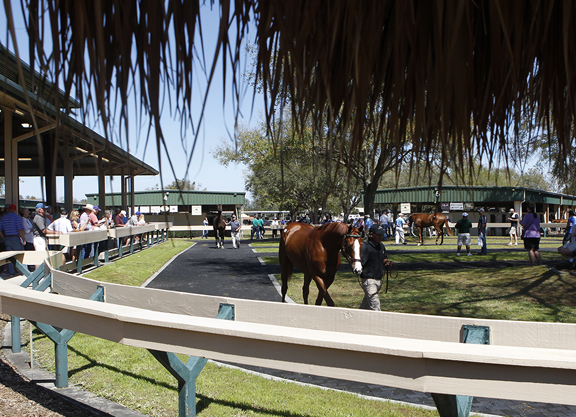
The OBS grounds | Photos by Z

Professionals in Ocala may have been too busy meanwhile to notice a staggering juvenile sale on the other side of the ocean. The Goffs UK Sale at Doncaster on Thursday bounced back from an excruciating spring for the sector last year to register record-breaking returns across the board. But this amazing boost to morale measured two things that are not easy to reconcile. On the one hand, this is actually an auction that prizes exactly the kind of ostensibly “commercial” precocity that is killing off those European stallions that have most to offer the breed in the long term, and racehorse owners here and now. At the same time, however, you couldn't ask for better evidence of the validity of the overall product. This amazing evidence of pent-up demand suggests that people who have survived the economic carnage of the pandemic can't wait to get back onto the racetrack and, blessed by a renewed sense that life is for living, it seems they don't even mind if the odds of reward are steeper than ever in Britain.

The type of horses we breed is just one dimension, of course. It just happens to be most relevant to our line of work. But there is much else for the sport to think about, in terms of its priorities. Because the bottom line is that owners are just fans with money. If we think about what works best for owners, we will also come up with something that will work for the fans. The success of micro-syndication confirms the personal stake of the ordinary fan in horses. Virtually all of us, after all, even if born on a horse farm, started out as fans: hooked by a particular horse or two, developing a remote but ardent bond. Maybe a Secretariat or a Kelso, but it could just as well have been some prolific old gelding who gained a cult following in claimers at your local leaky-roof.

If you're a pinhooker, you too need those fans. Apart from anything else, one of them will just have bought a pizza oven, or rented a cabin to sell a couple of used automobiles, and in 15 years' time will be wealthy enough to roll up at Saratoga or Book 1 at Keeneland.

But more fundamental are the $1 pickers of six, and the narratives that sustain their passion. That's the lesson of the European Super League. It's not a question of how fast is the fastest buck we can make, but how we keep those turnstiles clicking. That's our real bank vault, the true foundation of our sport. If we only remember that, then everything else will fall into place.

The post This Side Up: A Super Lesson for Racing appeared first on TDN | Thoroughbred Daily News | Horse Racing News, Results and Video | Thoroughbred Breeding and Auctions.

Source of original post

Owner Of Illegal Racehorse Doping Websites Scott Mangini Pleads Guilty In Federal Court

Audrey Strauss, the United States Attorney for the Southern District of New York, announced that Scott Mangini pled guilty today to conspiring to unlawfully distribute adulterated and misbranded drugs with the intent to defraud and mislead, in connection with the charges filed in United States v. Robinson et al., 20 Cr. 162 (JPO). Mangini pled guilty before U.S. District Judge J. Paul Oetken, and will be sentenced on September 10, 2021, before Judge Oetken.

U.S. Attorney Audrey Strauss said: “Scott Mangini created and flooded the supply side of a market of greed that continues to endanger racehorses through the sale of performance-enhancing drugs. Mangini designed and created dozens of products intended for use by those engaged in fraud and animal abuse. His products were manufactured with no oversight of their composition, in shoddy facilities, despite prior efforts by state and federal regulators to shut down Mangini's operation and strip his license. Mangini's guilty plea underscores that our Office and our partners at the FBI are committed to the prosecution and investigation of corruption, fraud, and endangerment in the horse racing industry.”

According to the prior Indictments, the Superseding Information to which Mangini pled guilty, and other court documents, as well as statements made in public court proceedings:

From at least in or about 2011 through at least in or about March 2020, Mangini and his conspirators manufactured, sold, and shipped millions of dollars' worth of adulterated and misbranded equine drugs, including performance-enhancing drugs (“PEDs”) intended to be administered to racehorses for the purpose of improving those horses' race performance in order to win races and obtain prize money. Mangini, a former pharmacist whose license was suspended in 2016, sold these drugs through several direct-to-consumer websites designed to appeal to racehorse trainers and owners, including, among others, “horseprerace.com” and “racehorsemeds.com.”

Mangini contributed to the conspiracy by, among other things, using his training to design and create custom PEDs that were advertised and sold online, using misleading labels, packaging, and return address information, including sales to customers in the Southern District of New York. Among the drugs advertised and sold during the course of the conspiracy were “blood builders,” which are used by racehorse trainers and others to increase red blood cell counts and/or the oxygenation of muscle tissue of a racehorse in order to stimulate the horse's endurance, which enhances that horse's performance in, and recovery from, a race, as well as customized analgesics that are used by racehorse trainers and others to deaden a horse's nerves and block pain in order to improve a horse's race performance. Mangini and his co-conspirators repeatedly touted illegal drugs sold on these websites as substances that “WILL NOT TEST” in the event of drug screens by racing officials. For example, Mangini's pain-numbing product “Numb It Injection” was advertised as a “proprietary formula and without question the most powerful pain shot in the market today AND WILL NOT TEST,” and customers were expressly directed to administer the drug by “injection as close to the event or extreme exercise as possible.”

The drugs distributed through the defendant's websites were manufactured in non-Food and Drug Administration (“FDA”) -registered facilities and carried significant risks to the animals affected through the administration of those illicit PEDs. For example, in 2016, Mangini and his co-conspirator, Scott Robinson, who was previously convicted and sentenced in this case, received a complaint regarding the effect of his unregulated drugs on a customer's horse: “starting bout 8 hours after I give the injection and for about 36 hours afterwards both my horses act like they are heavily sedated, can barely walk. Could I have a bad bottle of medicine, I'm afraid to give it anymore since this has happened three times.”

Commenting on this complaint to Mangini, Robinson wrote simply, “here is another one.”

Mangini is among 29 individuals charged to date in a series of Indictments arising from an investigation of a widespread scheme by racehorse trainers, veterinarians, PED distributors, and others to manufacture, distribute, and receive adulterated and misbranded PEDs and to secretly administer those PEDs to racehorses competing at all levels of professional horseracing. By evading PED prohibitions and deceiving regulators, horse racing officials, and the FDA, among others, participants in these schemes sought to improve race performance and obtain prize money from racetracks, all to the detriment and risk of the health and well-being of the racehorses.

Mangini, 55, of Boca Raton, Florida, pled guilty to one count of conspiring to violate the federal drug misbranding and adulteration laws. This offense carries a maximum sentence of five years in prison. The maximum potential sentence is prescribed by Congress and is provided here for informational purposes only, as any sentencing of the defendant will be determined by the judge.

Ms. Strauss praised the outstanding investigative work of the New York FBI Office's Eurasian Organized Crime Task Force and its support of the FBI's Integrity in Sports and Gaming Initiative. Ms. Strauss also thanked the New Jersey Attorney General's Office, the New York State Police, and the New York City Police Department for their support of this investigation, and the FDA and the U.S. Drug Enforcement Administration for their assistance and expertise.

This case is being handled by the Office's Money Laundering and Transnational Criminal Enterprises Unit. Assistant United States Attorneys Sarah Mortazavi, Anden Chow, Benet Kearney, and Andrew C. Adams are in charge of the prosecution.

The post Owner Of Illegal Racehorse Doping Websites Scott Mangini Pleads Guilty In Federal Court appeared first on Horse Racing News | Paulick Report.

Source of original post

The Jockey Club Announces Recipients Of Five Academic Scholarships

The Jockey Club announced today the recipients of its five academic scholarships, which will be awarded for the 2021-2022 academic year. In November 2020, The Jockey Club announced the creation of three new scholarships to support individuals from diverse backgrounds who are interested in pursuing a career in the Thoroughbred industry: The Jockey Club Advancement of Women in Racing Scholarship, The Jockey Club Vision Scholarship, and The Jockey Club Benevolence Scholarship. These awards are in addition to The Jockey Club Scholarship and The Jockey Club Jack Goodman Scholarship.

Julie Corral has been selected to receive The Jockey Club Scholarship, which provides $15,000 ($7,500 per semester) to a student who is pursuing a bachelor's degree or higher at any university and has demonstrated interest in pursuing a career in the Thoroughbred industry. Corral, a veterinary student at the University of Pennsylvania, aims to become a racetrack veterinarian.

Eric DeCoster has been selected for the second straight year for The Jockey Club Jack Goodman Scholarship ($6,000; $3,000 per semester), which is awarded annually to a student enrolled in the University of Arizona Race Track Industry Program (RTIP). DeCoster, a sophomore in the RTIP, is interested in pursuing a career in bloodstock.

The inaugural winner of The Jockey Club Advancement of Women in Racing Scholarship ($20,000; $10,000 per semester), which is open to women pursuing a career in the Thoroughbred industry, is Elizabeth Galletta. Galletta, a student at Midway University and farm manager of Daisy Acres, a breeding farm in Paris, Ky., intends to make her career in the reproductive sector.

Jeffrey Mitchell Jr. is the recipient of The Jockey Club Vision Scholarship ($20,000; $10,000 per semester), which is open to students from a minority racial or ethnic group who are pursuing a career in the Thoroughbred industry. Mitchell is working toward his master's degree in veterinary science at the University of Kentucky and is a research assistant in the Maxwell H. Gluck Equine Research Center's Reproductive Health Laboratory. He aspires to become a veterinarian.

The Jockey Club Benevolence Scholarship ($15,000; $7,500 per semester) is a need-based award to enable a student to attend a full-time program at a college, university, or trade program and gives preference to children of backstretch and farm workers. The inaugural winner is Vanessa Sanchez, a student at Pace University in New York, who is interested in equine marketing.

“Our expanded scholarship offerings are part of The Jockey Club's strategy to address diversity in the Thoroughbred industry, and we were heartened by the response to this initiative, with more than 150 applications submitted,” said James L. Gagliano, president and chief operating officer of The Jockey Club. “We are proud to support these five outstanding individuals and are confident that they will make a positive impact in their areas of interest.”

Applications for the 2022-2023 academic year will open this fall.

The Jockey Club, founded in 1894 and dedicated to the improvement of Thoroughbred breeding and racing, is the breed registry for North American Thoroughbreds. In fulfillment of its mission, The Jockey Club, directly or through subsidiaries, provides support and leadership on a wide range of important industry initiatives, and it serves the information and technology needs of owners, breeders, media, fans and farms. It founded America's Best Racing (americasbestracing.net), the broad-based fan development initiative for Thoroughbred racing, and in partnership with the Thoroughbred Owners and Breeders Association, operates OwnerView (ownerview.com), the ownership resource. Additional information is available at jockeyclub.com.

The post The Jockey Club Announces Recipients Of Five Academic Scholarships appeared first on Horse Racing News | Paulick Report.

Source of original post

Verified by MonsterInsights