Month: March 2021
Rachael Reigns Over Cheltenham
“Out of this world,” was how Rachael Blackmore described her week at Cheltenham so far, but it is becoming increasingly clear that the top echelon of National Hunt racing is very much her world.
The 31-year-old now leads the jockeys' table with five Festival winners in the last three days, with Jack Kennedy her closest pursuer on three. Two of her triumphs have come on horses owned by Cheveley Park Stud, which has now celebrated two winners at each of the last three Cheltenham Festivals. Wednesday's victory of Sir Gerhard (Ire) (Jeremy) in the G1 Weatherbys Champion Bumper was followed 24 hours later by the emphatic G1 Ryanair Chase triumph of Allaho (Fr) (No Risk At All {Fr}). The link between the two, apart from the owner and trainer Willie Mullins, was the brilliant, dominant riding of Blackmore, who on each horse dictated the race from the front, running her rivals ragged.
In the case of Allaho, his relentless pace started to force errors from those in pursuit of the 7-year-old, whose near-flawless jumping bought him lengths at each fence. Having dispatched his stable-mate and last year's Ryanair winner Min (Fr) (Walk In The Park {Ire}), who was eventually pulled up, he kicked into another gear for his final thrust up the hill, leaving the Joseph O'Brien-trained runner-up Fakir d'Oudairies (Fr) (Kapgarde {Fr}) 12 lengths adrift as he sailed across the line.
Add the Cheveley Park Stud brace to Blackmore's historic Champion Hurdle success aboard Kenny Alexander's Honeysuckle (GB) (Sulamani {Ire}) on the opening day, the victory of Bob Olinger (Ire) (Sholokhov {Ire}) in the G1 Ballymore Novices' Hurdle on Wednesday and, later on Thursday the daring late run on Telmesomethinggirl (Ire) (Stowaway {Ire}) to clinch another victory for owner Alexander and trainer Henry de Bromhead in the G2 Parnell Properties Mares' Hurdle. With one day to go and some enticing rides on Friday which include another Cheveley Park Stud runner A Plus Tard (Fr) (Kapgarde {Fr}) in the G1 Well Child Cheltenham Gold Cup, it seems likely that Blackmore will end the week on top.
While she rightly dislikes references to her being a female jockey, the fact remains that her outstanding achievements will ease the way for other women following in her wake. It is not unthinkable that Blackmore will become champion jockey in Ireland—she is currently battling it out with Paul Townend—and the same goes for Hollie Doyle on the Flat in Britain this coming season. Such an idea, that two women would be so dominant in the jockey ranks, could not have been entertained even five years ago.
Typically, though, Blackmore deflects the praise to the horses who have carried her to her lofty position. Commenting on the 7-year-old Allaho, she said, “For a jockey, when you're getting legged-up on these kind of horses for Willie Mullins and Henry de Bromhead, they just know their job, it's fantastic.
“He was just jumping and travelling. He's just a real galloper and that's how I rode him. It was either going to work, or it wasn't, and look, it worked. It was only when I came back in and people were saying that we went some gallop, but he felt in his comfort zone everywhere. It was fantastic.”
The last few months have brought a mixture of sadness and angst for those connected to Cheveley Park Stud. On Dec. 29, the organisation lost its patriarch David Thompson, who acquired the historic stud with his wife Patricia back in 1975. Though more readily associated with the Flat over more than four decades, it was Thompson's particular love of jumpers that prompted a rash of high-profile purchases in recent seasons and, though expensively procured, they have also been incredibly well selected.
The horse that was perhaps the most widely expected to secure his third successive Cheltenham Festival victory coming into this week was Envoi Allen (Fr) (Muhtathir {GB}), who was sent off as 4/9 on for the G1 Marsh Novices' Chase but fell at the fourth fence under Jack Kennedy. The 7-year-old was one of eight horses moved by Cheveley Park Stud in the wake of the publication of the controversial Gordon Elliott photograph, as was Sir Gerhard. Such a decision, with just two weeks to those horses' main targets of the season, would not have been an easy one to make and will undoubtedly have caused much consternation for the owners, who also have the unbeaten Quilixios (GB) (Maxios {GB}) as second-favourite for Friday's G1 JCB Triumph Hurdle.
Reflecting on her association with Cheveley Park Stud, Blackmore said, “It was a disappointing start to the day for [the Thompson family], but look Envoi Allen is up and he is okay, and so is Jack, and that's the main thing. They will live to fight another day. I'm very grateful to them for being so supportive of me and giving me the opportunities on their horses.”
Willie Mullins, who also trains last year's winner Min, added, “Allaho did everything right. The first thing I did when Rachael come back in was lift her number cloth to see if the lead bag was in there as it looked like Allaho was just carrying Rachael around there! He was just awesome. His galloping and his jumping, if you put it together I was hoping he could do that over three miles, but if he is only a two-and-a-half mile horse that will do me.”
He continued, “Watching him at home, all the time everyone has felt he is a galloper and a jumper and that you don't need to hold him up. I was sort of as gobsmacked as anyone else watching it as I fully expected the two horses in front to probably collapse coming to the third last and if they did you would have said they have gone too fast and took each other on, but that is their style of racing and that was the plan from the start and we just had to hope one of them would be good enough.”
Cromwell Floored By Success
While Willie Mullins and Henry de Bromhead been prominent this week with four winners apiece, the 17 victories for Irish-trained horses from 21 races have also been spread out among their compatriots. Gordon Elliott's stable, now under the care of Denise 'Sneezy' Foster, has had a winner each day, while Noel Meade, Paul Nolan and Paul Hennessy have also enjoyed winners. One of the most impressive performances, from another front-running ride, was that of Flooring Porter (Ire) (Yeats {Ire}), who made all, jumping exuberantly, to land the G1 Paddy Power Stayers' Hurdle.
The 6-year-old's trainer Gavin Cromwell first came to wider prominence when Espoir d'Allen (Fr) won the Champion Hurdle two years ago, the spring after his Princess Yaiza (Ire) (Casamento {Ire}) provided him with a major Flat win on Arc weekend in the G2 Qatar Prix de Royallieu. Tragically, Espoir d'Allen died just months after Cheltenham following an injury to his shoulder during training. Deservedly, the softly spoken Cromwell, who started out in the racing business as a farrier, now has another exciting young hurdler on his hands.
Admitting that it was a “fairytale” to win another of the Festival's championship races, he said, “We won a Champion Hurdle a couple of years ago and it was massive. I didn't think I'd ever win a race in Cheltenham, and to come back and win a second one is fantastic.”
He added of Flooring Porter, who was unsold at €5,500 when offered for sale as a 3-year-old and is owned by a syndicate led by carpet shop owner Ned Hogarty, “We came across this fella by accident. He was a very cheap store and progressed right through the ranks. It's a bit of a fairytale, really, and just goes to show that it is possible with a cheap one. He wasn't bought expecting him to be a Grade 1 horse.”
There was a sting in the tale for jockey Jonathan Moore, who has partnered Flooring Porter in 11 of his 15 starts but stood himself down on Thursday morning having failed to recover sufficiently from a race fall on Sunday. Danny Mullins instead took the ride and recorded his first win at the Festival.
Cromwell added, “Danny gave him a smashing ride. It's very unfortunate for Johnny Moore that he couldn't ride him. Thankfully, and rightfully so, he stood himself down, and he suggested Danny would be well suited to the horse. Johnny has ridden him all along and brought him all the way to here, and it is very unfortunate for him. Hats off to Johnny, it was so unselfish and I'm very grateful to him.”
Flooring Porter completed a Grade 1 double on the day for the four-time Ascot Gold Cup winner and Castle Hyde Stud resident Yeats following the win of JP McManus's Chantry House (Ire) in the March Novices' Chase. Yeats has also been represented this week by two impressive handicap-winning mares, Heaven Help Us (Ire) and Mount Ida (Ire).Â
The late Whytemount Stud resident Stowaway (Ire) has also had a good week, his four winners including the Grade 1 scorers Monkfish (Ire) and Put The Kettle On (Ire), as well as Telmesomethinggirl (Ire) and The Shunter (Ire), while Kilcruit was runner-up in the G1 Weatherbys Champion Bumper and Fiddlerontheroof (Ire) was second to Monkfish.
The post Rachael Reigns Over Cheltenham appeared first on TDN | Thoroughbred Daily News | Horse Racing News, Results and Video | Thoroughbred Breeding and Auctions.
The California Series: John Shirreffs
In a new TDN series, we curry lessons and wise counsel from veteran Californian figures who, like gold nuggets panned from the Tuolomne River in the High Sierras, have unearthed career riches on arguably the toughest circuit in the States. We begin this series with John Shirreffs.
Born at Fort Leavenworth, Kansas, Shirreffs was raised around horses on his family farm, and was deployed to Vietnam with the Marine Corps before embarking on a career in racing, using a 10-year stint at the Loma Rica Horse Ranch in Northern California as a springboard to a training career that would see him sift one of the rarest jewels of all.
Part I
Amid the tall spiking pines and jutting mountain cathedrals of Northern California's Grass Valley back when the sprawling Loma Rica Horse Ranch still hummed with activity and where the transatlantic phenom Noor would later be interred–to haunt the barns, some say–one stubborn son-of-a-gun yearling colt gave a young John Shirreffs an abject lesson in obstinance.
“He's in the stall rearing up and striking and I can't get the bridle on him,” said Shirreffs, remembering the scene from the safe hindsight of some five decades. The memory remains sharp, however.
Rolling up his sleeves, the young Shirreffs sniffed a challenge, which quickly turned from a wily game of wits into a war of muscle. He jumped on the colt bareback. He grabbed his ears. “We're having this Battle Royale.”
After a fashion, though, Shirreffs waved the white flag and with ego deflated turned to Henry Freitas, the farm's storied manager, for pointers on a less adversarial approach.
“Henry said, 'John, just stop all the B.S. Just go down the stall and put the bridle on the horse and quit all that crap you're doing.'”
Shirreffs was unimpressed. “I'm walking down the shedrow thinking to myself, 'what kind of help was that?'” Still, the relationship between pupil and master was one of deference to experience–decades worth, in the case of Freitas–and so, Shirreffs dutifully obliged.
“I went in the stall, put the bridle on the horse–the horse never moved. It was over.”
And what was the main takeaway? “The value of a timeout with horses,” he replied. “When you're caught up in the moment and things aren't working out, the best thing to do is just stop and give yourself and the horse a chance to have a moment of thought to recover.”
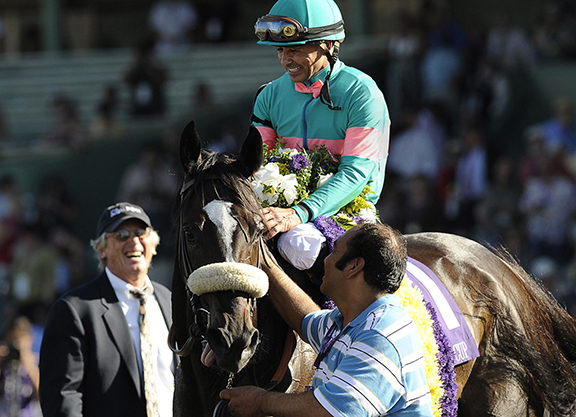
Shirreffs imparted the story one recent morning in his office at Santa Anita, the nearby San Gabriel Mountains draped in a cold, grey drizzle like a soggy blanket, as the veteran trainer reflected on a 45-year career looped into which is a Kentucky Derby win and multiple Breeders' Cups and the sort of horse in Zenyatta (Street Cry {Ire}) that comes along about as often as Halley's Comet.
This nugget of barn-spun wisdom also provides a useful barometer of the trainer's evolution as a horseman, familiar sounding to anyone long enough in the tooth to know that any career with racehorses is akin to a college course without end.
“When I was younger, I could dominate a horse, right? I could handle them pretty well through strength. But as I got older, horses started getting a lot stronger than I was. Most of them were starting to outsmart me. So, I learned over the years what a mental game it is.”
Indeed, from a world in which the economics of high-level competition has sprouted large military-run outfits–those where routine and repetition are bywords for necessity and thrift–the Shirreffs barn offers a refreshing alternative, where morning training is approached with the same certitude of an explorer setting foot on virgin terrain.
But while Cook and Columbus had in the North Star their guiding light, Shirreffs has for his something altogether more fluid and transactional.
“It's always about building the bond,” said Shirreffs, focusing in on what appears a central conceit of his.
“You have to build a bond between the horse and the person. I have to find a way where that horse has trust in whoever's handling him or doing something with them. So, it's always about the bond, because if that horse trusts the groom or trusts the person with them, then they will behave much better than if all they're thinking about is being nervous, being anxious about what's coming next.”
Big range of emotions
Wander down any shedrow and you'll hear horse behavior equated with everything from wayward teens to recalcitrant spouses to loving sweethearts. This isn't new–the instinct to anthropomorphize is as ancient as civilization itself.
What's unusual is to hear any trainer–especially those operating within the upper echelons of a sport where a business degree can sometimes feel like the most instructive qualification–talk of the complex emotional bandwidth of a racehorse, as Shirreffs does.
The foundations of this clearly stem from those early days under Freitas at Loma Rica Ranch, a 600-acre university for horsemanship, home as it was to stallion and mare, yearling and breaker, lay-up and foal.
“I think somebody should spend an hour in the stall with a stud, just to understand the range of emotion that an animal can have,” he said. “Sometimes, the thing that amazes me about horses is how much they are willing to communicate and how much they're studying us.
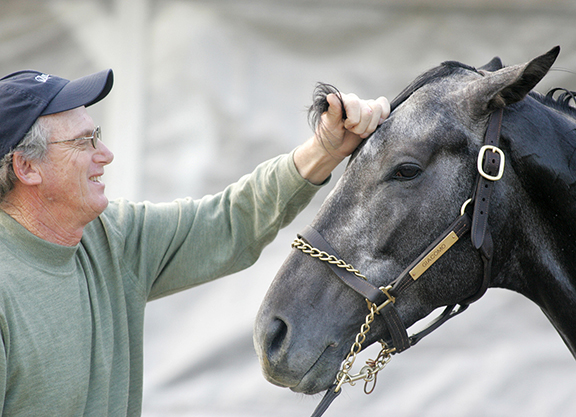
He added, “You have to realize that they are trying to make their environment as good as they can. And we are the biggest thing in their environment that they have to control. Right?” he added. “We're the ones that could endanger them. So, obviously they're studying what type of a relationship they're going to have with us.”
Like all relationships, the means define the ends. Of course, when it comes to understanding quirks and foibles, there are few substitutes for patience. “It's a matter of getting to know your horse,” he said.
“It's fun to watch the horses to pick up on their habits–I have the time to do that, when the work gets done and everyone's gone to lunch, I have that opportunity, when it's quiet, to watch the horses and see how they're behaving, see what's different about one or the other.”
This, he says, is particularly instructive to the early diagnosis of injury–arguably the biggest culprit of sleepless nights among insomniac license-holders.
“Horses are very stoic, right? You don't have an obvious sense of what's bothering them in the beginning [of injury], before there's any heat or any inflammation or anything like that,” he explained. “But how he eats is a good indication of how he's feeling, not only emotionally but also physically.
“Even then, by the time you notice that something's going on, he's probably been dealing with pain for probably quite some time.”
Such close scrutiny of behavior feeds into what he terms the “bio-rhythm” of a horse–the idea that a racehorse can be brought to peak performance only when, like a maestro vigilant of each section of the orchestra, they're mentally, physically and emotionally in balance.
“You have to figure out how to get things flowing together,” Shirreffs explained. “So, when they're physically at their peak they might not be mentally at their peak because you've trained them really hard, but mentally they're tired or emotionally they're off–you know, upset about being pushed so hard.
He continued, “So, you're going to have to lose a little bit of conditioning maybe to bring them up mentally and emotionally, right? It's always: How close you can get everything?
“That's the one great thing about campaigning a horse, because when they're campaigning they're conditioning–they're physically staying at a pretty high level. And as they campaign, and as they get used to the rigors of racing and training, mentally they're getting stronger, too. And then, if there's some sort of pleasure involved–some sort of reward for the horse–then they're emotionally getting better.
“So, it's all a question of balancing these three different things.”
The real pleasure a trainer gets
In those early days at Loma Rica Horse Ranch, Freitas came down with a nasty bout of flu, giving Shirreffs an early glimpse into the peculiar juggling act that operating a barn necessitates. Though perhaps baptism of fire would be more apropos.
“I knew the routine, right? I knew how everything ran. So, I was fine for about two or three days because I knew exactly what Henry would do.
“But suddenly, after about three or four days, I had to make new decisions based on ones I made a couple of days ago. That's when I got into trouble because I didn't have Henry to ask.”
Now, many an analogy befits a well-run stable, all shaped around a certain triangular hierarchy–an ant colony, for example, of an aforementioned branch of the military.
It's instructive then to hear Shirreffs explain the roles he's carved out for him and staff.
“I don't really need to know veterinary medicine, right? I don't need to know the name of drugs, all that kind of stuff,” he said. “[Veterinarians], they go to school, they know that. But I can learn what the shoer does, right? I can watch what they do.
“I can feel legs, and the difference between one leg and another and study those things. I can watch the horse and see if he's acting colicky or a little upset because of something else going on. So, I thought in the beginning that was where I would best spend my time to become a better trainer.”
Part of that process of self-evaluation has involved holding a mirror to his own failings–his own Achilles heels-as typified, for example, in the way he has, at times, placed individuals in charge of identifying soft tissue injuries.
“As a trainer, you go in and you're checking behind the saddle, but I'm always thinking it doesn't feel too bad because I want to train that horse, right? I have to have somebody put the brakes on. I have to have my own sort of checks and balances.”
At the same time, “You can't put demands on people, right? Because I think a certain way, and I react a certain way, I can't demand that other person be like me and react the way I would react.
“Let's take the exercise rider or jockey or whatever, you have to understand where they are [ability wise], what are their strong points and how you can best use them to accomplish what you need to accomplish with the horse.”
In an industry that often calibrates professional achievement and pleasure through the narrow aperture of race-day honors, it's refreshing, then, to hear someone no stranger to laurel wreath and garland talk of their other important metrics of success.
“It's so difficult to win a race–in California, especially. So somewhere along the way, if you're going to be in this business, you have to derive some pleasure from somewhere else, right?
“So, the real pleasure a trainer gets is seeing the growth in the horse. Or having somebody, like a rider, start to develop and understand his relationship with the horse, see what impact that person can make on how that horse is going to handle the stresses of racing.
“It's really a pleasure when you suddenly see a guy realize that if he didn't pull on this horse so hard and just kind of released the reins a little bit, the horse starts to relax. He realizes, 'Oh, it's not all muscle, it's a little bit of a finesse.'
“I think those are really fun things.”
Part II of this story will run in next week's TDN.
The post The California Series: John Shirreffs appeared first on TDN | Thoroughbred Daily News | Horse Racing News, Results and Video | Thoroughbred Breeding and Auctions.
Mears: A Sobering Number Of Veterinarians Suffer From Mental Health Challenges; Yours May Be One Of Them
When I first began considering a career in veterinary medicine, I wanted to be sure I fully understood the profession. There's obviously more to being a vet than playing with animals. What I did not expect was the link between veterinary medicine and suicide.
In early March, our profession lost at least three veterinarians and one technician. Your social media accounts may have recently reflected an increase in mentions of veterinary suicide and the resources available to those within the profession.
One such resource is “Not One More Vet” or NOMV. NOMV was created in 2014 by Dr. Nicole McArthur as a online support group to discuss the good and challenging aspects of life as a veterinarian. Today, the private Facebook group has over 26,000 members and has expanded to include separate groups for vet students and support staff.
Another pair of resources is VIN Foundation's VETS4VETS, for vets and vet students, and SUPPORT4SUPPORT, for support staff. Backed by veterinarians and mental health professionals, VIN Foundation's resources offer mentor matching, private support groups, and additional support for those in recovery, battling cancer, or with mental/physical issues that affect ability to work.
Both NOMV and VIN Foundation offer veterinary professionals the opportunity to be heard. When the struggles of practice may feel too overwhelming, both groups are there to connect those individuals with mental health resources.
I've struggled to find the words to express my feelings in light of the recent losses. Veterinary professionals are hurting. It's statistically likely the veterinarian that treats your family pet(s) may be struggling. A 2018 study by the CDC found that “female veterinarians were 3.5 times as likely, and male veterinarians were 2.1 times as likely, to die from suicide as the general population.” Seventy-five percent of veterinarians who died by suicide worked in small animal practice.
It's natural to ask, “Why does this happen?” The truth is, it's a lot of reasons all layered on top of one another. According to AVMA, the average student loan debt of a new vet is around $180,000. Due to interest and salary factors, many people will take 20+ years to repay that debt, all while also saving up for a huge loan “forgiveness” tax. Hours are long, vacations are few. Many clinics are understaffed and busier than ever.
Additionally, veterinary medicine has become this odd blend of practicing medicine and customer service. It can be difficult to manage cases appropriately when everyone has Google at their fingertips. We often hear how, as veterinarians, we are backed by big corporations and are in their pocket. I can assure you that's not the case. In a world where just about everything is instant, we want our pet's medical care to follow that same timeline.
On top of all that, we aren't kind to ourselves. Not only are most veterinarians just hard on themselves in general, but within our profession we are, at times, entirely too hard on one another. Just recently we suffered loss after loss after loss after loss. We felt that strain, we worked to raise awareness. Then a few days later, I read messages of veterinarians arguing amongst themselves and placing blame in regards to what is the appropriate salary for a new graduate veterinarian just entering practice.
If we cannot be kind to ourselves and one another within our profession, can we expect those outside of our profession to be kind? Maybe in a perfect world, but I'm not going to hold my breath.
I'd say hug your veterinarian but 1) that's weird and 2) we're still in a pandemic. So instead I encourage anyone reading this… be kind. Be kind to yourself and others in your profession. Be kind to your veterinarian and each and every one of their staff members. I am by no means a perfect human being, but my goal each day is try to be a semi-decent one. Join me on that journey. Let's be semi-decent and just a little kinder together.
Dr. Rebecca Mears is an equine veterinarian practicing at Brenford Animal Hospital in Delaware. She is also a veterinary advocate with a focus in improving financial literacy and encouraging wellbeing among her fellow veterinarians.
The post Mears: A Sobering Number Of Veterinarians Suffer From Mental Health Challenges; Yours May Be One Of Them appeared first on Horse Racing News | Paulick Report.

