This is the second part of the latest instalment in our ongoing series assessing stallion options for the new covering season, now tackling sires who have just sold their first yearlings. The first part, which appeared in Tuesday’s edition, can be read here.
Dixie Union has achieved quite a legacy as a broodmare sire and, following on from Mohaymen (Tapit), two other stallions in this group are out of his daughters.
KLIMT (Quality Road-Inventive by Dixie Union) has maintained an industrial output through his first three books at Darby Dan, entertaining 222, 187 and 172 guests, duly pegged at $10,000. That volume comes at a risk, of course, and anyone who fancied a Klimt yearling could choose from no fewer than 108 into the ring. Of these, 81 found a new home at $29,890.
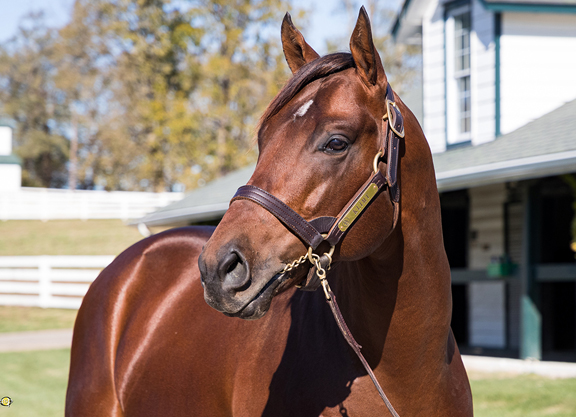
Klimt at Darby Dan | EquiSport
Himself a $435,000 Gulfstream 2-year-old, you can certainly picture him landing one or two pinhook coups: he reiterated his precocity by looking the fastest youngster out west, notably as four-length winner of the GI Del Mar Futurity in 1:21.8 (94 Beyer). His sire can’t have had too many juveniles quite like that and, while Klimt himself did not last at three, he does have the genetic base for his stock to progress: his hard-knocking, graded stakes-winning third dam is a sister to Breeders’ Cup Classic winner Concern (the pair out of another Grade I winner). First things first, however—and, with such volume behind him, he surely needs to put himself in the shake-up for the freshman title.
The other who shares the same damsire is UNIFIED (Candy Ride {Arg}-Union City by Dixie Union). Lane’s End launched him at $10,000, which fee he retains after selling 62 of 83 yearlings offered at $43,390, an average magnified by the $450,000 home-run colt who topped a session at Keeneland September.
Unified has very attractive roots, his third dam being a Storm Bird half-sister to Dehere and the next two by Secretariat and Damascus. Though himself unraced at two, his mother is a sister to a Grade II-winning juvenile and Unified certainly landed running with a 99 Beyer on debut before consecutive Grade III and Grade II wins, clocking 1:47.14 in the Peter Pan. Though ultimately confined to seven starts, he missed the GI Carter H. only by a neck and he’s a lovely physical.
Though down to 68 mares in his third season, he has ample ammunition (opening books of 152 and 102) to resume momentum now. In the same, exemplary barn that has housed his sire and damsire, Unified has every chance of making the grade.
Likewise, his chum CONNECT (Curlin-Bullville Belle by Holy Bull) who started alongside at twice the fee after formally gilding a career of similar span and dash with a Grade I in the Cigar Mile. Having maintained numbers at 112 and 114 after an opening book of 165, he gets a friendly clip to $15,000 after selling 49 yearlings (of 84 into the ring) at $52,975.
Another very natural racehorse, Connect packed six wins and four six-figure Beyers into just eight starts and helped to elevate the GII Pennsylvania Derby to elite status by holding the maturing Gun Runner. While of adequate caliber, his family has a conspicuously accommodating outcross quality.
Competition among sons of Curlin is heightened by a cut from $20,000 to $12,500 for KEEN ICE (Curlin-Medomak by Awesome Again). Some such action, admittedly, was looking pretty urgent. Calumet amassed as many as 176 mares for his opening book, and 55 yearlings sales (of 70 into the ring) achieved a lower average than his fee ($15,069). Pretty disastrous, on the face of it, but to me this more realistic tag brings a truly admirable racehorse right back into play.
I’d especially recommend Keen Ice to anyone who might look to retain a filly, as he doubles down that mighty distaff influence Deputy Minister 3 x 3 and his fourth dam is the Emory Hamilton matriarch Chic Shirine (Mr. Prospector). If overstating his GI Travers S. defeat of American Pharoah risks faint praise, then he parlayed these genes into a resilience and durability—24 starts, including 15 at Grade I level, for earnings of $3.4 million—that any breeder should be eager to replicate.
There are some grassy roots in the family, too, so at his revised fee Keen Ice absolutely deserves a fresh look by flexible end-users. That big first book will give him a legitimate platform over the next couple of years to renew traffic that has meanwhile slackened to 73 and 43 mares.
Another now at a still more compelling fee is LORD NELSON (Pulpit-African Jade by Seeking The Gold). Halved to $10,000 by Spendthrift, he is definitely back on the agenda after making plenty of appeal even when opening at $25,000.
His yearlings sold in a good ratio, 37 of 46 offered, at $84,972. Remember that he was knocked out by laminitis when lined up for his debut book and he has been spared the “mass transit” service since, numbers through his first three years controlled at 127, 131 and 123.
Lord Nelson offers an interesting blend. He has all the commercial speed you could ask for, as winner of three consecutive Grade I sprints including the Bing Crosby in 1:07.65, the fastest six furlongs ever clocked electronically at Del Mar. Though he only achieved his peak form at four, that was partly down to experimentation in stretching his speed and he was actually a seven-length stakes winner at two. But he also has a most interesting pedigree: very fast, plainly, for a grandson of A.P. Indy, he evidently kindles a lot of speed from the 3×3 duplication of Mr. Prospector (as Pulpit’s damsire and as grandsire of his own dam). Yet the bottom line balances that with a classy Argentinian family, with all that means in terms of versatility and the robustness we saw in Lord Nelson’s recuperation.
Though himself a speedball, Lord Nelson’s build also suggests that he may be able to draw out some of the stretch latent in his pedigree. We have become accustomed to premium newcomers at Spendthrift, since this guy first arrived, but I wouldn’t be surprised if he turned out to have as much influence as any.
AMERICAN FREEDOM (Pulpit-Gottcha Last by Pleasant Tap) comes from the final crop of the same sire of sires and, as a $500,000 yearling, must have been just about the prettiest. Launched at $10,000 by Airdrie, he has every chance to build fresh momentum from an opening book of 152 mares (if on the customary slide since, to 96 and 54).
That’s a tribute to his physique though, albeit as many as 82 yearlings into the ring gave purchasers ample choice: 60 sales averaged $27,266. More important, perhaps, is the fact that his owners and Airdrie have fired up his engine with 133 mares from their quality herds. Interestingly, moreover the drums seem to be beating quite loudly among 2-year-old consignors.
Now that he’s down to $6,000, American Freedom might prove a timely gamble. After all, he claimed the scalps of Gun Runner plus all three Classic winners in his crop, and got closest of Arrogate’s pursuers in the GI Travers. And a stakes-winning Pleasant Tap mare can only bring in the good stuff, as she had already shown in producing MGSW and Grade I runner-up Gottcha Gold (Coronado’s Quest).
There’s a lot to like about MIDNIGHT STORM (Pioneerof the Nile-My Tina, by Bertrando), down to $7,500 at TaylorMade from an opening $12,500. He offers a mixture of the traditional assets we need to preserve—he won Grade II races four years running in the course of a 10-for-27 career, banking $1.78 million—with the versatility that should be at an increasing premium as the turf/synthetics program expands. He registered multiple triple-digit Beyers on both dirt and turf, and sealed his Grade I by wiring the Shoemaker Mile field, holding off subsequent Breeders’ Cup winner Tourist (Tiznow) in 1:33.55.
Books of 119, 88 and 69 provide a solid enough base and likewise his sales debut: 36 of 48 yearlings sold at $39,856. It’s a fashionable sire-line—and remember that his lamented sire was also versatile, in terms of surface—but there’s no denying that the family adds a genetic dimension to his overall air of flexibility.
Turf was an option never explored by GORMLEY (Malibu Moon-Race To Urga by Bernstein) but it’s certainly something to keep in mind for his stock. His second dam was Classic-placed in Europe and his fourth is champion turf mare Estrapade, while his own sire was out of a top-class French juvenile.
Not that there appeared to be any particular need to leave the main track with a horse who won Grade Is at both two (ended Klimt’s unbeaten spree in the Frontrunner S.) and three (beat Battle Of Midway (Smart Strike) in the Santa Anita Derby). Unfortunately he soon derailed but Spendthrift herded up the customary numbers for a first book of 180, ample to put him in the conversation for the freshmen’s championship—something to keep in mind, now that he is down to $5,000 from an opening $10,000.
Though there was plenty of choice at the yearling sales, he found customers for an excellent ratio (59 of 73 offered) at $37,544. Subsequent books of 127 and 72 suffice to keep him in the game if he can get one or two early headliners, something he is perfectly entitled to do with the depth of Classic influences through his pedigree. Virtually a bet to nothing at his new fee.
Speaking of turf, reverse shuttler ASTERN (Medaglia d’Oro-Essaouira {Aus} by Exceed And Excel {Aus}) is down again to $7,500 from $10,000, after being cut last year from an opening $15,000 at Darley. Albeit he has somewhat puzzled the local market to this point, with 23 of 38 yearlings sold at $35,617, now he gets the chance to show whether they can actually run.
He’s certainly been priced to engage the attention of breeders lacking the regard of their Australian counterparts for a horse who—trading in speed, as an interesting instance of the way this cosmopolitan sire-line obeys the predilections of each local industry—matched the Group 1 success of his half-sister Alizee (Aus) (Sepoy {Aus}), not to mention of their third and fourth dams.
He’s half a year deeper into his career than his Kentucky rivals, with a handful of runners already in his native land. Down there a lot of people would be pretty offended, on Astern’s behalf, by his relative valuation in Kentucky. But we’re about to find out which hemisphere has him right, and books of 116, 90 and 90 are sufficient to permit a rising tide for any breeder enterprising or audacious enough to take a chance on him now.
A Southern Hemisphere import that was able to parade his wares on American tracks is Calumet’s BAL A BALI (Brz) (Put It Back—In My Side {Brz} by Clackson {Brz}). Horse Of The Year in Brazil, he recovered from laminitis after his migration to win a couple of Grade Is on U.S. grass. He proved much too exotic a proposition for the domestic yearling market, 34 of 39 selling at just $7,302, but he does have early numbers behind him (books of 125 and 74 before falling right off to 22 last spring) and also has dirt strains to draw upon in his outcross pedigree. It’s obviously over to him, but he is now realistically priced at $5,000 (started at $15,000) and would hardly represent the first transfusion of South American blood to invigorate the gene pool here.
In contrast the same farm hosts a couple of young stallions trading primarily on very familiar pedigrees. The third dam of MR. Z (Malibu Moon-Stormy Bear, by Storm Cat), indeed, is a Ribot (GB) half-sister to Mr. Prospector himself (who also figures on the page as damsire of Malibu Moon). His own mother is a half-sister to the prolific Canadian turf champion Chief Bearhart (Chief’s Crown) and, while Mr. Z only won twice, he stood up well to aggressive campaigning to become a millionaire. A handful of his yearlings sold mostly for no money but he has now been halved to $2,500 so maybe his first book of 61, more than he’s managed in the two seasons since, can give him a foothold.
Barnmate WAR CORRESPONDENT (War Front-Tempo West, by Rahy) also has a noble pedigree, as a brother to Declaration of War out of a half-sister to Union Rags, and he won a couple of graded stakes on turf. The half-dozen yearlings he sold, of nine offered, averaged $18,576 and he’s now $5,000 from an opening $7,500, again with small numbers behind him.
Though ultimately rescued more or less from oblivion, for a roll of the dice at stud, WILDCAT RED (D’wildcat-Racene, by Miner’s Mark) was a legitimate dasher in his time, as a dual graded stakes winner who was beaten only a neck by Constitution (Tapit) in the GI Florida Derby. He has only covered small books at Buck Pond Farm, but that won’t necessarily stop him outlasting one or two who started with a higher profile. Of just three yearlings sold, after all, one made $180,000 to become the top colt at the OBS Selected Yearling Sale, some yield on a $7,500 fee. Bravo, Wildcat!
That’s the beauty, when we reach this stage of the game. It’s now up to their runners, and nobody can know what will happen once the gates open.
CHRIS McGRATH’S VALUE PODIUM
Gold: Mastery ($25,000 Claiborne)
Always looked the goods and sales debut did nothing to alter that
Silver: Lord Nelson ($10,000 Spendthrift)
What a generous cut for a very fast horse with stretchy genes
Bronze: Gormley ($5,000 Spendthrift)
Bumper first book could give him freshman momentum

The post Kentucky Value Sires for 2021–First Juveniles, Part II appeared first on TDN | Thoroughbred Daily News | Horse Racing News, Results and Video | Thoroughbred Breeding and Auctions.
Source of original post
