Bet to win.
Kempton 2.35 Hint Of Stars – win bet.
Kempton 5.30 Parknacilla – win bet.
Kempton 6.0 Mi Laddo – win bet.
Bet to win.
Kempton 2.35 Hint Of Stars – win bet.
Kempton 5.30 Parknacilla – win bet.
Kempton 6.0 Mi Laddo – win bet.
Oaklawn's top male sprinter last year can now be called the best nationally, too.
The ultra-popular Whitmore, a seven-time Oaklawn stakes winner co-owned and trained by Ron Moquett of Hot Springs, was named the country's champion male sprinter of 2020 during the 50th annual Eclipse Awards ceremony Thursday night.
Whitmore received 132 first-place votes from members of the three consolidated voting blocs – Equibase, Daily Racing Form and the National Turf Writers and Broadcasters. Vekoma finished second with 83, followed by three other 2020 Oaklawn-raced horses in Volatile (16), Charlatan (four) and C Z Rocket (three).
Three finalists in each division were announced Jan. 16, established through a 10-5-1 point system from earlier voting. Eclipse Award winners were determined solely by first-place votes.
Whitmore compiled a 3-2-0 mark from seven starts last year, punctuating his resume with a dominating victory in the $2 million Breeders' Cup Sprint (G1) Nov. 7 at Keeneland.
The gelding's other two victories came at Oaklawn, his winter home since 2016. He won the $150,000 Hot Springs Stakes in March for a record fourth consecutive year and the $350,000 Count Fleet Sprint Handicap (G3) in April for a record third time.
“I think the reaction that we get from the rest of the people kind of mimics how we feel all the time about him,” Moquett said Friday morning. “It's like everybody's giving him credit, loving him or whatever. But Arkansas people kind of already thought that he was a champion, regardless, and it's kind of like the rest of world got to see what we've been thinking for three years.”
Whitmore is training at Oaklawn in preparation for his scheduled 8-year-old debut in the $200,000 Hot Springs Stakes March 13. Whitmore's major spring objective, Moquett said, is again the $500,000 Count Fleet Sprint Handicap (G3) April 10. Both races are 6 furlongs.
“Still the plan,” Moquett said. “He's going to run a mile and a half at Oaklawn.”
Moquett received one first-place vote for outstanding trainer. But Whitmore, his prized gelding, had more than enough support to grab his first Eclipse Award after finishing eighth, second and third in the previous three runnings of the Breeders' Cup Sprint.
“He's a cool horse,” Moquett said.
This is me tonight after the Eclipse Awards feeding mints to a Champion. #Grateful #Whitmore #WhatAHorse pic.twitter.com/AtBuTKv4b1
— Ron Moquett (@RonMoquett) January 29, 2021
The post Moquett Emotional After Whitmore Named Champion Sprinter Of 2020 appeared first on Horse Racing News | Paulick Report.
How aptly we talk of our walk of life as the Turf. Because raising a horse is just like raising a lawn. Take a microscope out there, if you like, but no human being has actually seen grass grow. Yet one morning toward the end of winter, the birdsong sounds different and you realize you left your coat on the peg without thinking about it. And you look at that lawn and, no argument, it's time to take the mower out of its stable.
That moment remains a long way off, for many, but Saturday all can share a cheering sense that the vital forces of Nature are perceptibly astir in the sophomore class of 2021. Because both coasts, in their southernmost exposure, provide comfortingly familiar staging posts on a journey that we resume in growing hope, through the striving of science, that our world may be slowly settling back on its axis by the first Saturday in May.
Gosh, it certainly seems an age since Tiz the Law (Constitution) and Thousand Words (Pioneerof the Nile) respectively won the GIII Holy Bull S. and GIII Robert B. Lewis S. The unprecedented detours on the Triple Crown trail, in the meantime, have taught us afresh how the cyclical challenges we set the adolescent Thoroughbred, long enshrined in the calendar, assist horsemen from one generation to the next in consistent measurement of the breed.
It's not just individual racehorses that come under examination, after all. Each resembles the blades of grass that together make up the lawn. For many of us, the interest lies in the way their roots are entwined–and what that can teach us for future cultivation.
All families evolve through the same, patient rhythms; through horsemen responding to the prompts of Nature. Sometimes these harmonies yield lush, seamless swathes; but there are also occasions when some sparse or choked tangle of briar will nourish a blossom as sudden and brilliant as it appears unexpected. In both cases, the underlying, seasonal processes are just the same.
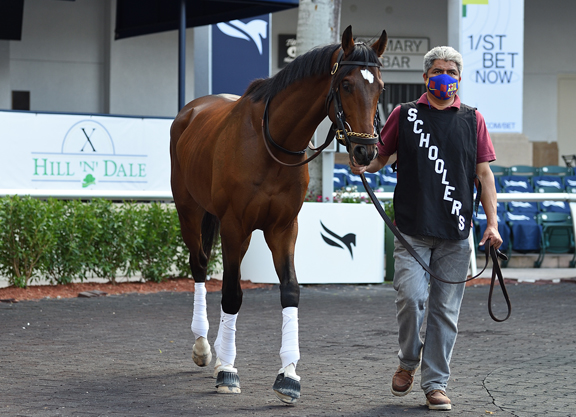
Greatest Honour this week at Gulfstream | Ryan Thompson
Take two horses whose contrasting antecedents bring them similar opportunity in these races. The Courtlandt Farms homebred Greatest Honour (Tapit), who represents the Shug McGaughey barn at Gulfstream, could be named a feasible Classic type when still in the womb. Two of his first four dams are Broodmares of the Year, and the family has duly been seeded by such venerable distaff influences as Street Cry (Ire), Deputy Minister and Blushing Groom (Fr). Hot Rod Charlie (Oxbow), on the other hand, made $17,000 as a short yearling. In the two years since, however, it has become feasible to recognize a born aristocrat in the horse reappearing at Santa Anita.
He owes that transformation, however, to exactly the same diligence, patience and expertise that first created the line tracing from Best in Show now to Greatest Honour. In fact, Hot Rod Charlie is the final bequest of a man who–with the help of those storied farms, Claiborne and Hermitage–was perhaps the most accomplished small breeder of his generation.
Edward A. Cox, Jr. operated what we nowadays call a boutique program. Yet he was co-breeder of Woodman (Mr Prospector); partner in Swale (Seattle Slew); and breeder of Marquetry (Conquistador Cielo) and star European miler Shaadi (Danzig). His Turf career comprised two cycles, with a hiatus between 1998 and 2006. Soon after his comeback he sent Bill Landes, the long-serving Hermitage manager, over to the January Sale to give $250,000 for Glacken's Girl (Smoke Glacken), who had won her only two starts as a juvenile. Cox sent her to Indian Charlie; and the resulting filly, Indian Miss, to veteran Chicago trainer James DeVito. Indian Miss showed ability but also had to be retired after only two starts, because of a chip in her knee. Cox would have culled her for $10,000, but nobody had more than $5,000 so he experimented with matings that wouldn't necessarily have occurred to everybody: Eskenderaya, for instance, in her second year; Oxbow in her fifth.
Her son by Eskendereya made just $20,000 as a yearling. Then, knowing himself doomed by illness, Cox staged his second dispersal in 2018. It was deeply poignant for everyone involved, but he was the kind of gentleman who wanted to leave everything shipshape for his family. At Keeneland that November, 20 head of horse made $3.7 million–including $240,000 from WinStar for Indian Miss (with an Into Mischief cover).
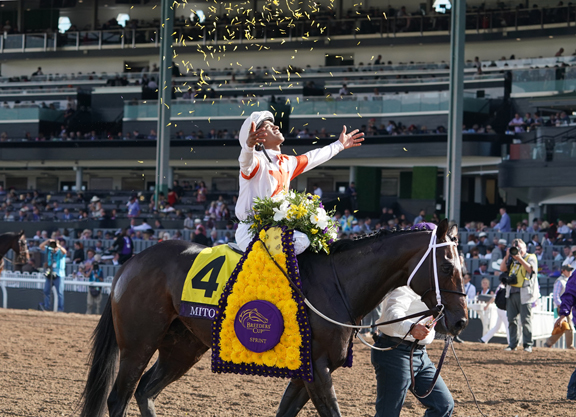
Mitole clinched his championship in the 2019 Breeders' Cup Sprint | Horsephotos
What a great buy that turned out to be. For the colt by Eskendereya was none other than Mitole, who had disappeared after winning a couple of stakes the previous year. His subsequent return and championship campaign saw Indian Miss return to the same sale, this time round, to be cashed in to OXO Equine for $1.9 million.
Her value had been enhanced, moreover, just a couple of days previously by a revelatory performance from her Oxbow 2-year-old. This had been the very last horse sold by Cox. As a weanling, he had been so immature that Landes urged his patron to give him extra time. But time, finite for us all, soon became a scant resource. Around Christmas, though Cox was still sounding pretty good, he called and said: “Landes, get him sold.”
Landes felt the horse was just beginning to turn round when they took him over to Fasig that February, but it took the astute eye of Bob Feld to pick him out of Jim Herbener's consignment. And by the time the rangy, maturing colt was pinhooked through Small Batch Sales in the same ring that October, he was a half-brother to a champion.
In a sane world, Oxbow should have appealed as the icing on the cake: the perfect foil for two dams confined to an aggregate four starts. He's by Awesome Again out of a sister to Tiznow, and showed due toughness and class when sixth, first and second in his Triple Crown series. But that stuff is obviously far too worthy for the commercial guys, and Dennis O'Neill was able to get the colt for $110,000.
A tolerable yield, no doubt, through eight months–but Feld deserved better yet for his acuity. Because he not only found a half-brother to an imminent champion for just $17,000; he also sold on a potential Derby horse.
For this, of course, is Hot Rod Charlie. He took four attempts to break his maiden, but had just been learning the game on turf and/or in sprints. Fitted with blinkers, he then stepped up for the GI Breeders' Cup Juvenile and, though dismissed at 94-1, made his challenge a good deal more smoothly than Essential Quality (Tapit) and was only run down late by the eventual champion.
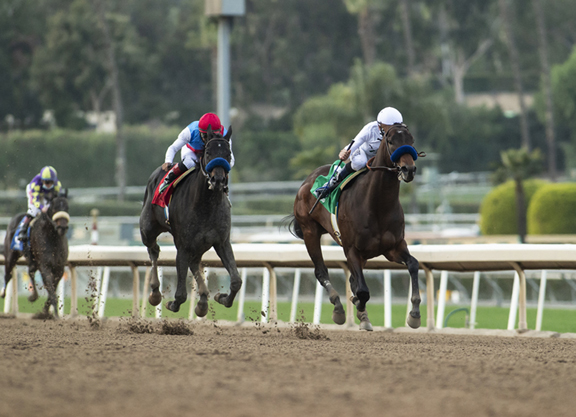
Medina Spirit (red cap) was second to 'TDN Rising Star' Life Is Good in the Sham | Benoit
True, one of his principal opponents in this race had to squint upwards to see even Hot Rod Charlie on their first hammer prices. Medina Spirit (Protonico) made just $1,000 as a short yearling; nor did he seem much more eligible for the Baffert barn, when returned to OBS as a 2-year-old and realizing $35,000 for pinhooker Christy Whitman. Yet his first two starts have proved that even the big-money horses must need this trainer more than he needs big-money horses.
By the same token, his breeder Gail Rice has already shown that you don't need big-money mares or matings to produce a good one, having bred 2020 GI Ashland S. winner Speech (Mr Speaker) out of a $7,500 dam. At the other end of the scale, however, this field also contains 'TDN Rising Star' Roman Centurian (Empire Maker), whose family is full of such familiar Phipps names as second dam Finder's Fee (Storm Cat). He duly cost $550,000 as a yearling and, much like Greatest Honour on the opposite shore, seems equivalent to an ancient and beautifully manicured arboretum, relative to some of these exotic new blooms.
But all these families, to thrive, need to have been tended with the same devotion and flair. And actually Medina Spirit has some pretty noble roots: his third dam is a half-sister to High Yield (Storm Cat) out of a half-sister to Paul Mellon's charming Forest Flower (Green Forest), a 2-year-old champion filly in Britain out of a Classic-placed Nijinsky mare.
As it happens, High Yield made his first sophomore start in this same race, then still known as the Santa Catalina S., finishing second. How surprised his co-owner would have been, to discover that the prize would someday bear his own name. But none of these things happen overnight. Lewis helped to make Baffert; and maybe having High Yield on the page is helping Baffert make Medina Spirit.
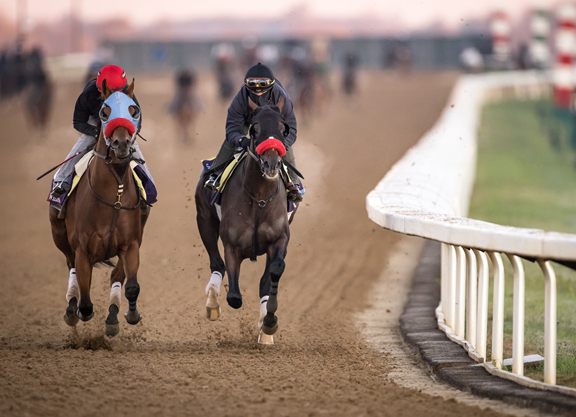
Hot Rod Charlie (inside), as a 2-year-old working with older horse and MGSW Wildman Jack | Breeders' Cup/Eclipse Sportswire
As ever, we seek regeneration both among the horses themselves and also in their owners and breeders. Hot Rod Charlie's enthusiastic ownership group, for instance, includes five recent graduates of the Brown University football team. They will be encouraged that “Chuck” still looked green on hitting the front at the Breeders' Cup, even with all that grounding. On the other hand, it may prove that he will need plenty of help from Oxbow to adapt his speedy family to Classic racing.
Whatever happens, let's celebrate him first and foremost as a last bequest. Landes already feels blessed that Mitole carved so apt a memorial to Cox, but for Hot Rod Charlie to stay on the Derby trail would represent a wonderful codicil. Testament, too, to his own skill–something that warrants stressing, given how it is exceeded only by his modesty and humor.
Familiar attributes, those, in many who have contributed most to the communal, evolving lore of horsemanship; attributes, that is, that accrue naturally when you're daily dealing with a charge as captivating, and exasperating, as the Thoroughbred. Landes always knew that this backward, goofy weanling was going to end up turning himself round. On his late patron's behalf, then, let's borrow the formula by which he would very occasionally, in his understated way, indicate satisfaction: “Landes, you raised a good horse.”
The post This Side Up: One Last Apple from the Cox Orchard appeared first on TDN | Thoroughbred Daily News | Horse Racing News, Results and Video | Thoroughbred Breeding and Auctions.
The New York Racing Association, Inc. announced the schedule for the 2021 Handicapping Challenge series, anchored by the two-day Belmont Stakes Challenge, scheduled for June 4-5.
Register for the online contest is available via NYRA Bets. The leaderboard for all of these contests will be posted throughout the day on America's Day at the Races, the national telecast produced by NYRA in partnership with FOX Sports.
In order to enter and play online, contestants must be registered NYRA Bets account holders. To learn more, visit www.NYRA.com/challenge.
Entrants for the two-day Belmont Stakes Challenge will compete for one seat to the 2022 Belmont Stakes Challenge, four seats to the National Handicapping Championship (NHC) and two seats to the Breeders' Cup Betting Challenge (BCBC).
The 2021 Belmont Stakes Challenge has an entry fee of $10,000, of which $2,500 will go directly to the prize pool, with the remaining $7,500 comprising each participants' bankroll. Eligible tournament races at Belmont Park will start Friday, June 4, and end with the 153rd running of the Belmont S. June 5. Contest players can make win, place, show, exacta, and trifecta wagers.
Online registration for the Belmont Stakes Challenge will open in May.
Over the course of the 2021 season, NYRA will offer six NYRA Bets live-money handicapping challenges featuring a $3,000 buy-in with each event offering cash prizes, a seat in another 2021 $3,000 NYRA Bets contest and two 2022 NHC seats.
The handicapping challenges will kick off Saturday, Mar. 6 with the Gotham Challenge. The GIII Gotham S. provides 50-20-10-5 Kentucky Derby qualifying points to the top four finishers.
The $3,000 NYRA Bets handicapping challenge series:
Saturday, Mar. 6 – Gotham Challenge
Saturday, Apr. 3 – Wood Memorial Challenge
Saturday, July 3 – Stars & Stripes Challenge
Saturday, Aug. 7 – Whitney Challenge
Saturday, Sept. 4 – Woodward Challenge
Saturday, Dec. 4 – Cigar Mile Challenge
Each Saturday throughout the racing season–with the exception of the NYRA Bets challenge series dates and also May 1, May 15, and Nov. 6 –NYRA Bets will offer a $300 live-money handicapping challenge. The NYRA Bets $300 live-money handicapping challenge ($200 live bankroll / $100 prize pool) offers cash prizes to the top seven finishers, while players that land eighth through 10th in the standings will receive an entry in next week's contest ($300 value).
For more information, visit www.nyrabets.com.
The post NYRA Announces ’21 Handicapping Challenge Schedule appeared first on TDN | Thoroughbred Daily News | Horse Racing News, Results and Video | Thoroughbred Breeding and Auctions.
