All-Sources Handle Down for Abbreviated Woodbine Meet

All-sources handle was down more than $50 million at $462,041,545.76 compared to $516,189,419.44 in 2019 for Woodbine’s shortened 2020 Thoroughbred meet, which started late and concluded early due to the COVID-19 pandemic.

The meet ran 96 days with the start being pushed back from Apr. 18 to June 6 and the end date moved up from Dec. 13 to Nov. 22. The abbreviated meet resulted in 35 less race days and 305 less races.

“Like many businesses, the COVID-19 pandemic significantly impacted our business and the entire horse racing industry in Ontario,” said Jim Lawson, CEO, Woodbine Entertainment. “However, I am very proud of how we responded and look forward to working with all of our stakeholders as we continue to manage the ongoing impacts caused by the pandemic.”

In Woodbine’s home market area, wagering on Woodbine Thoroughbred racing was $54,810,867.06, down 41% compared to last year. In 2019, Woodbine Racetrack contributed $28 million to the all-sources handle on Thoroughbred racing. This year, Woodbine Racetrack only contributed $124,000 to the overall handle due to being closed to the public for most of the year.

However, wagering on Woodbine Thoroughbred racing continued to be strong in foreign markets, generating $391,395,974.30 in all-sources handle, which is down less than 3%, despite running 27% fewer race cards. Handle per race was also strong at $509,417.36, up 19.6% year over year. Field size per race was 8.9, up from 8.2 the year prior.

The post All-Sources Handle Down for Abbreviated Woodbine Meet appeared first on TDN | Thoroughbred Daily News | Horse Racing News, Results and Video | Thoroughbred Breeding and Auctions.

Source of original post

This Side Up: Horsemen Worthy of Their Heritage Will Enhance it

What is it, beyond our obvious bond in the Thoroughbred, that most vitally comprises the fabric of the Turf?

It’s a question answerable in too many ways, requiring definition of too many intangibles, to be easily condensed. But I think we’ll get somewhere close if we ponder the retirement this week of Stan Hough, an old-school horseman of a type largely overwhelmed in the era of the super-trainer. And especially because his departure from the stage coincides with the removal of two key features of the scenery: Calder Race Course, where Hough won five consecutive training titles from 1976; and Sagamore, his final patron, now being disbanded as a Thoroughbred farm.

For three such names to recede simultaneously from our sporting theater is surely a prompt to reflect on those elements in our heritage as precious as they are liable to slip through our grasp.

That is not to invite any conflation of the factors determining each of these withdrawals; nor any presumption about their validity. But each will perhaps remind us of a collective stake in the way individual strands are entwined in our sport, and its history.

Hough’s personal legacy has long been secure, having nurtured many important horses and horsemen. The latest of these, of course, is GI Breeders’ Cup Classic third Global Campaign (Curlin)–whose return to WinStar, where he was bred, circumscribes a two-year comeback for a trainer who picked him out, along with Sagamore president Hunter Rankin, as a yearling.

Without deprecating the opportunities available to those apprenticed to the industrial trainers of today, Rankin prizes the disappearing privilege of a mentor who, in turn, directly represents not just the era of Woody Stephens and Allen Jerkens but also a forgotten generation of hardboots. Hough learned the ropes under one William Tompkins at River Downs, whom he describes as “still the best horseman I’ve ever been around.”

“There’s no better description of Stan Hough than ‘old-school’,” Rankin says warmly. “He just is the consummate horseman. He knows his horses really well. He loves his horses. Everybody knows about Stan, and everybody respects the way he went about his business: the way he trained horses, the way he interacted with the horsemen.
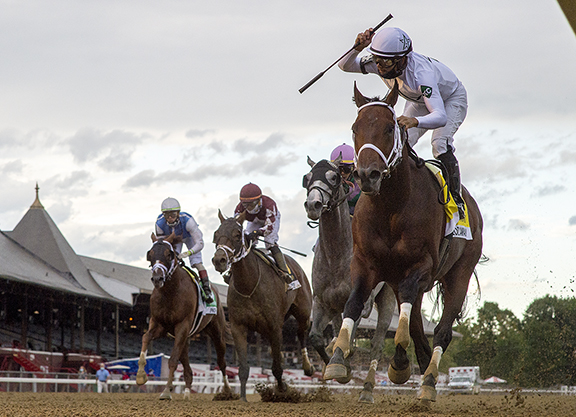
Global Campaign took the Sept. 5 Woodward | Sarah Andrew

“But ‘old school’ doesn’t necessarily mean stuck in his ways. He’s really innovative in the way he trains. He works horses from a lot of different poles. He gallops them different every day. He doesn’t jog a whole lot. He obsesses over what they’re going to do next day–and not just Global Campaign. It’s every horse. I would say, ‘Stan, you don’t need to worry so much about this one, or that one.’ He can’t help it, you know?

“I think that’s the mark of a true horseman. Not that you’re right all the time, but just that you’d do anything to make it work. He’s a master. Doesn’t say a whole lot, doesn’t have any interest in being the center of attention. He has always just loved the game.”

Rankin’s admiration, moreover, is not confined to the horse lore. Hough has seen a lot of life. He was only 16 when he joined Tompkins; and little older, when becoming a husband and father for the first time.

“Trust me, no matter how great a horseman he is, he’s an even better man,” he says. “He’s like a second dad. We are borderline inseparable. My dad is the best, but Stan has just been such a gift to me. I can’t imagine my life without him, really. You won’t find anybody that would say a bad word about him.”

Part of what we are losing, in the retreat of men like this, is the trainer whose “eye” oversees the whole process: not just the conditioning, but the original discovery of potential. If the focus was wrong, when Hough worked the sales or made a claim, he would have to tighten that belt an extra notch. That kind of thing concentrated the mind in a fashion you don’t see so often, now that barns are largely stocked by agents and managers and so on.

While Hough did gain one or two powerful patrons, along the way, he started out claiming horses at places like Hazel Park, Detroit. As Rankin says: “For the most part, he did it on his own; and he did it his own way.” In time, he gathered the seedcorn to buy Proud Appeal (Valid Appeal) at the Hialeah 2-year-old sales in 1980, with a partner, for $37,000. True to that old-school grounding, the following year he trained him up to Kentucky Derby favoritism with five stakes wins in 10 weeks, culminating in the GI Blue Grass S. In the meantime, John Gaines and Robert Entenmann gave seven figures for a stake in the horse. Clients similarly profited from his talent, as when Paul Robsham sold Discreet Cat (Forestry) to Godolphin after he won on debut at Saratoga. Or they just banked the purses, as when Half Iced (Hatchet Man) won the 1982 Japan Cup in the Firestone silks, his 16th sophomore start.
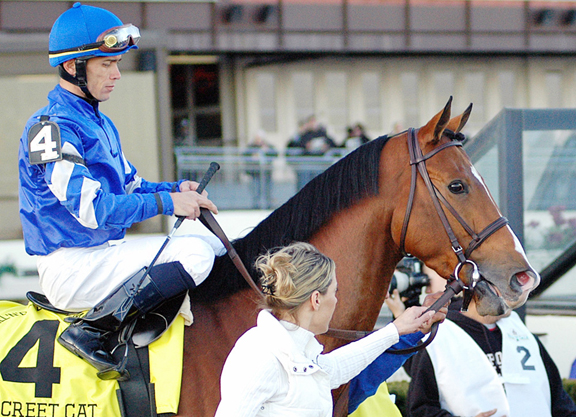
Discreet Cat eventually won the 2006 Cigar Mile | Sarah Andrew

But what gives ultimate symmetry to Hough’s retirement, aged 72 and after 2,212 winners, is that Calder closed its doors the same day. That was where Hough made his name, and you can’t help but feel that its loss should focus our community’s attention on what it is prepared to forfeit, what it wishes to preserve, and how. That is not a simple process.

Everyone would agree that the fate of Sagamore, for instance, is the unique prerogative of its owner. Yes, it’s gratifying that Hough should have secured for Global Campaign the chance to extend a sire line tracing to the “Gray Ghost” himself, Native Dancer. And we’d all be delighted should someone, someday, decide that the Kevin Plank chapter in Sagamore’s Turf history need not be the last. In the meantime, however, everyone accepts that he can do as he wishes with his own property. Presumably the only way to salvage the farm, for Thoroughbreds, would be an offer to purchase sufficient for him to abandon whatever other purposes he may be favoring.

Now it must be said that the same indulgence is seldom extended to the owners of “Gulfstream Park West,” as Calder was unhappily rebranded. They are not in this business as knights in shining armor; not trustees for our community. They are here to get the best possible dividends out of their property for their shareholders. Without a neutral authority to arbitrate a South Florida racing calendar, it’s a perfectly coherent accounting decision to decide that competition with Gulfstream isn’t sufficiently viable for their purposes.
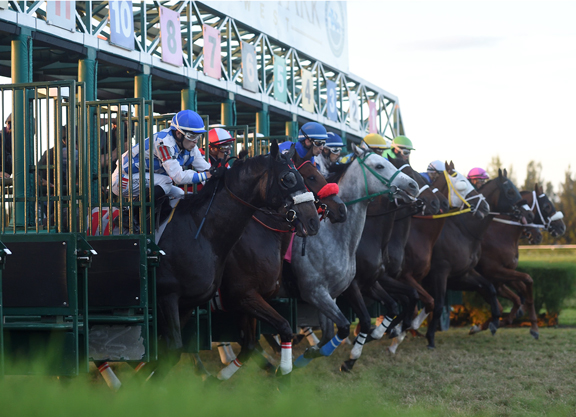
Horses leave the starting gate for the last time at Gulfstream Park West Nov. 28 | Nicole Thomas

Few of us have any idea about how things unravelled over the lease that had brought Gulfstream’s owners into play for Calder’s final years; or, indeed, what the future priorities of that operation may be, for its hugely valuable real estate round the country. In the case of Churchill Downs Inc., however, people know exactly what they are dealing with. And while we may despair over the consequences for Calder or Arlington, then we must at least acknowledge that when they do commit to a track, as a sustainable business proposition, they will do a professional job of making it work. Seeing what they are doing up the road at Turfway, certainly, they seem likely to make Kentucky the sport’s center of gravity even as the opposing coasts are bogged down by diverse problems.

Looking around, and looking ahead, you have to ask how vigorous competition is likely to be among track owners. That’s a concern, whether or not Churchill themselves prove interested in other historic sites that may become available. If they are, well, we all know that stronger competition would be healthier for the consumer. And if they aren’t, then just who is going to step up?

Running a racetrack as a profitable business is not straightforward, especially when so much can hinge on state regulation, slots, etc. E.P. Taylor famously led the consolidation of the sport in Ontario, shutting down the leaky-roof circuit and throwing everything at a state-of-the-art track at Woodbine. That kind of process can be brutal, and there can also be undesirable side-effects. After Calder’s closure, for instance, you seriously fear for the surfaces at Gulfstream, most obviously the turf course.

Nonetheless, Taylor’s vision and leadership showed the fearlessness required for the grasping of nettles like this.

The fact is that ruthless pursuit of profit can only be thwarted by its removal as a consideration. In Britain, The Jockey Club has surrendered its original function as a governing body and evolved into custodian of such historic racetracks as Newmarket and Epsom, where it also owns the communal training facilities. And Ascot, of course, is owned by the Queen herself–not terribly likely, you would say, to sell up for housing any time soon.

That’s not a solution available to Americans, of course, since 1776. But it’s no good wringing your hands over the cynical indifference of commercial operators to tradition, or community, or legacy. If enough people of sufficient wealth are sufficiently concerned, perhaps something might yet be done.
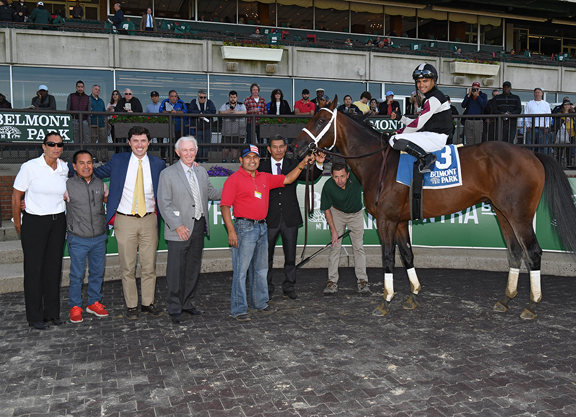
Hough, center, in the 2019 Peter Pan winner’s circle | Coglianese

The Breeders’ Cup, after all, was founded on communal contribution toward the corporate benefit of the industry. It’s not as though all racetracks are doomed to lose money. Otherwise Churchill wouldn’t be in the game. And if the profits of tracks owned and run by stakeholders were routinely ploughed back, then you could aspire to a virtuous circle: better product, better handle, better gates, better television, better purses.

So, as ever, it comes down to the caliber of people. Let’s return to the question asked at the outset, about the fabric of the Turf. Many would suggest that a horseman like Hough is where the answer starts. He guarantees the interests of the horse, whatever it takes. The question is whether the same standards can be met by everyone else involved in getting the show on the road. Because the choice is either to keep blaming other people for neglecting the interests of our sport, or to get together and do a better job ourselves.

The fabric of the business is never more literal than in the bricks and mortar of a racetrack. But those, too, no less than the condition of a horse prepared by Stan Hough, will always reflect the quality of the people responsible.

Remember what Rankin said about Hough. It’s not that you’re right all the time, just “that you’d do anything to make it work.”

The King of Calder has abdicated, and his kingdom has disappeared. But the wider realm can still be defended, and those who can afford a suit of armor should maybe get together and show some knightly qualities of their own.


The post This Side Up: Horsemen Worthy of Their Heritage Will Enhance it appeared first on TDN | Thoroughbred Daily News | Horse Racing News, Results and Video | Thoroughbred Breeding and Auctions.

Source of original post

Astute Looks to Remain Perfect in Starlet

LNJ Foxwoods’ Astute (Speightstown) looks to take her record to three-for-three Saturday in the GI Starlet S. at Los Alamitos. Graduating in her career bow sprinting on turf at Santa Anita Oct. 12, the $425,000 KEESEP purchase romped by 7 1/2 lengths next out on dirt in Del Mar’s Desi Arnaz S. Nov. 14.

Princess Noor (Not This Time) hopes to return to winning ways as she sheds the blinkers here after finishing fifth as the favorite in the GI Breeders’ Cup Juvenile Fillies at Keeneland last out Nov. 6. A debut winner at Del Mar in August, the $1.35-million OBSAPR topper captured both the Sept. 6 GI Del Mar Debutante and Sept. 26 GII Chandelier S. by a combined 14 3/4 lengths.

Her trainer Bob Baffert also saddles Varda (Distorted Humor) and Kalypso (Brody’s Cause). Varda finished second in the Chandelier after a first-out score at Del Mar Aug. 30. Kalypso earned her diploma in the Anoakia S. Oct. 18 after hitting the board in her first two outings.

Completing the quintet is Nasreddine (Nyquist), who graduated at second asking in SoCal Nov. 7.

The post Astute Looks to Remain Perfect in Starlet appeared first on TDN | Thoroughbred Daily News | Horse Racing News, Results and Video | Thoroughbred Breeding and Auctions.

Source of original post

Faust To Finish Year Strong At Arqana

It hasn’t been a bad year for Holger Faust’s HFTB Agency, all things considered. They have been involved in the sale or purchase of three Group 1-winning fillies in 2020, namely Princess Zoe (Ger), Sunny Queen (Ger) and finally, Donjah (Ger), who will be the only Group 1-winning filly in training to be offered at public auction in Europe this year when she goes through the Arqana sales ring on Saturday afternoon.

Faust’s involvement with the G1 Preis von Europa winner, who is catalogued as lot 182, is certainly not a fleeting one. Indeed, the daughter of Teofilo (Ire) was bred by his family’s Gestut Karlshof before he purchased her as a yearling at Baden-Baden for his client Dr. Stefan Oschmann’s Darius Racing.

Donjah is a filly that Faust speaks of fondly, and understandably so, but despite her accolades on the racecourse–an unbeaten 2-year-old season, two group race wins and multiple group race placings – he can’t help thinking that with a little more luck, the best is very much still to come.

“I liked her from the very start, when she was a foal,” says Faust. “She was always special, but I have to say, when you look at her racing career she has been quite unlucky so far. I think that she could be even better than she already is.”

“She was meant to run as a 3-year-old in May as a trial for the German Oaks,” he explains, “but she got lightly injured during a morning canter beforehand, so we needed to put her out for four weeks and start again. She started first time out in the German Oaks and still ran a big race to finish sixth. A riderless horse took her wide outside at the beginning of the straight which hampered her chances. She might have won that race otherwise because she has proven many times that she was by far the best filly from that crop of 3-year-olds.”

Donjah’s 2020 campaign, while hampered by COVID-19 like most others, saw her finally land the Group 1 she deserved in the Preis von Europa at Cologne which was planned to serve as a warm-up for the Breeder’s Cup, as Faust explains.

“This year we focused everything on the Breeder’s Cup and we made the decision at the very last moment whether to run in the Filly & Mare Turf or in the Turf,” he says. “Her preparation was quite good and up until the race we were very excited but, unfortunately she slipped around the second corner and lost her action. You cannot run in one of the biggest races in the world, against the best horses with a faux pas like that. It’s a shame because we think she would have run a good race otherwise.”

Perhaps luck has not always been on her side but there is no getting away from the fact that Donjah is a hugely consistent Group 1-winning filly, who at four years old is still relatively lightly raced. When it comes to her next options, Faust says he believes that the world is her oyster.

“I think she is good enough to run all over the world,” he says. “She could handle the races in the U.S. over a long trip and try the Breeders’ Cup again with a bit more luck. She would also possibly suit Japan. She’s by Teofilo, so if Australians are looking for a potential Cup horse and a good broodmare afterwards she could go down there too.”

Such is the regard for the Darius Racing colourbearer that Faust warns that they would be happy to hold onto her if she doesn’t reach her true value on Saturday.

“The thing is she is not sold yet,” he says. “It depends what happens in the ring. If we don’t get a fair price on her then we will keep her racing next season.”

Faust first met German businessman Dr. Stefan Oschmann in 2012. The following year he began buying yearlings for him and by 2014 Darius Racing was formed. The relatively young operation became Germany’s champion owner in 2016 after winning the German Derby with Isfahan (Ger) and has since ranked consistently among the top five leading German owners. A first foray into breeding by Darius Racing, under the guise of Anahita Stables, produced 2020 Group 1 winner Sunny Queen.

It is safe to say that the relationship between Faust and Dr. Oschmann has been a fruitful one and another interesting lot representing Darius Racing at the Arqana Breeding Stock Sale is the listed-winning daughter of Holy Roman Emperor (Ire), Apadanah (Ger) (lot 132). Plagued by problems in the starting stalls, she is another that Faust says he believes has the potential to be far better than she looks on paper.

“She’s got so much class but she lost her races a couple of times at the start,” Faust says. “When she won her listed race at Dortmund she lost five to 10 lengths at the start. When you look at her performance in the German St Leger she loses 25 lengths at the start and was beaten by five lengths, so you can imagine how much ability she does have. If she was a good starter, I think she is a horse that could run in every Grand Prix race all over Europe.”

“To be honest, she is a very interesting lot from either a racing or a breeding perspective,” continues Faust. “She’s by Holy Roman Emperor and there are a lot of things happening in her family. She has Alson (Ger), Step By Step (Ger) and a Melbourne Cup winner, Almandin (Ger), in the family as well. Apadanah’s Sea The Stars (Ire) half-sister sold for 400,000 guineas as a foal at Tattersalls last year and the mother is a young Alderflug (Ger) mare so there is still plenty to happen too.”

The Faust family’s Gestut Karlshof is also represented by two standout lots to be offered at the Arqana Breeding Stock Sale on Saturday, under the Ecurie Des Monceaux banner. Catalogued as lot 192 is the Classic-placed daughter of Night Of Thunder (Ire) No Limit Credit (Ger), who reminds Faust of another Gestut Karlshof-bred, the dual Grade I winner A Raving Beauty (Ger) (Mastercraftsman {Ire}).

“No Limit Credit is a fantastic racehorse,” he says. “She was the second richest 2-year-old filly of all time in Germany. Despite doing a lot at two her form didn’t decline as a 3-year-old when she was Classic-placed and won a group race. Her lifetime best form was in the Lydia Tesio in her last start where she got stuck on the inside so the jockey had to go the long way round and she was flying at the end. She proved then that she can stay.”

“We thought all along that she could stay,” continues Faust, “but we prepared her for the German Oaks which she ran a poor race in. It turns out she had an infection afterwards, but as it was her first disappointing race we thought she should go back to the mile. We ran her at a mile and the jockey said she needed further but we did the opposite and ran her over seven furlongs on heavy ground where she was an easy winner just because of her class.

“I have a lot of respect for her and I think she is a lot like A Raving Beauty because of her toughness. A Raving Beauty became a star in America as a 5-year-old and I think she can do that next year as a 4-year-old. I definitely see No Limit Credit running in the U.S. because she can do 1700 metres or 2000 metres, smaller tracks, short straights, performs on all ground, everything suits her and I think she could have a great career in the States.”

On the subject of A Raving Beauty, Gestut Karlshof are also offering the dam of the multiple Grade I winner and performer, Anabasis (Ger) (High Chaparral {Ire}) (lot 164), who at 12 years old is already well proven as a broodmare with plenty more potentially still to come.

“There are two reasons for selling her on,” explains Faust. “First of all, we are packed with the family at the stud. We have a sister of hers and daughters, including A Racing Beauty (Ger), full sister to A Raving Beauty who was listed placed this year and remains in training. Secondly, we noticed that for German breeders, it’s hard to get a really good result in the sales ring for the yearlings and the racing prospects and broodmares have been sold for better money in recent times. Maybe because we don’t have the same yearling preparations here or maybe because German breeding is a little more backwards than Irish, English or French. That’s why we said, ‘ok, if we get a fair price on her then we will sell her,’ but obviously she has a reserve price so we shall see what happens.”

Indeed, there will be plenty to keep an eye on for Faust on Saturday as he follows four very exciting lots through the Arqana sales ring and he’ll be hoping that what has already been a good year for HFTB Agency can finish on a high note.

The post Faust To Finish Year Strong At Arqana appeared first on TDN | Thoroughbred Daily News | Horse Racing News, Results and Video | Thoroughbred Breeding and Auctions.

Source of original post

Verified by MonsterInsights