This Year’s Sporting Art Auction Offers Racing Legends, Beautiful Landscapes, And A Bit Of Humor

In a year when nothing is quite normal, it's nice to have a few things you can count on. For the Keeneland auction pavilion, the switch from horses to art is as reliable as the changing of the seasons. For the eighth year, broodmares and weanlings made their annual November parade through the auction ring while paintings and sculpture decorated the pavilion's halls, awaiting their turn to change hands in the Sporting Art Auction.

While in previous years, the Sporting Art Auction sees paintings and sculpture auctioned from the iconic Keeneland ring, this year's sale will be conducted virtually. Those who were at Keeneland for the November Sale may also have noticed fewer works of art lighting their passage between the café and the back walking ring, as organizer Cross Gate Gallery sought to display this year's catalogue in smaller groups to discourage crowding from viewers.

Much like the sale that precedes it, the catalogue for the Sporting Art Auction varies a bit year by year.

“We want everyone to be able to find something that we like, so we do have 19th Century British, and we extend all the way up,” said Bill Evans Meng, gallery director for Cross Gate Gallery in Lexington, Ky. “There are a lot of contemporary painters. I'm 37 and everyone my age is buying the new things. [The catalog] is maybe is a little more contemporary this year but sometimes you have to go with what you can find.”

Meng said he aims to have a healthy mix of time periods, styles, and subjects each year. While most feature horses either in racing or foxhunting contexts, there are often a few pastoral scenes as well as a few of hunting dogs, farm creatures, or fowl.

A few works were commissioned to depict specific horses. A trio of portraits from well-known equine painter Richard Stone Reeves depict Law Society, Coup De Feu and Mr. Right, while a signed collection of 12 prints from Franklin B. Voss (no relation to the author) is a fond look back at the top runners of the 1920s and 1930s, including Man o' War, Gallant Fox, Seabiscuit, and Discovery.

For Meng, works designed to immortalize a particular subject sometimes come along with the most interesting stories.

“The ones that are specific, they have a story and people like that,” said Meng. “I feel like all three of the Reeves this year, they had real connections to the connections. The one of the Coup de Feu was a father and son story – the father owned it and got his son started racing. Law Society was a big horse for Vincent O'Brien and of course shows his incredible training facility. The third Reeves, Mr. Right, came from the trainer and I got to talk to him a lot and he really liked the horse. When you do these specific ones, there's always a story and I think people connect to that.

“Of course a lot of our clients are horsemen and they're into bloodlines. They might know this was their horse's great-great-grandsire and that means something to them.”

In a somewhat unusual twist, this year's auction also features a human portrait from German/American artist Nicola Marschall of Daniel Swigert. Swigert and his Elmendorf Farm are two of the oldest names in the Kentucky Thoroughbred business, tracing back from the 1870s.

(We wrote about Elmendorf and Swigert in our Kentucky Farm Time Capsule series. Read that profile piece here.)

“When he was young he tried to build up what became Buffalo Trace Distillery and then he went on to become a great horsemen,” he said. “I knew about him, but I didn't know enough about him to appreciate it when I saw the painting the first time [10 or 12 years ago.]”

Lot 120, Early Morning Exercise, Green Lane as painted by Peter Howell

Other pieces are looser or more interpretative, allowing an owner or fan to see their own favorite horse in the lights and shadows. Painter Peter Howell's depictions of morning training at Keeneland and Newmarket are particularly good examples of this.

Then there are pieces likely to garner attention on name recognition alone. The catalog contains a number of sketches from the well-known Sir Alfred Munnings, as well as brightly-colored scenes from popular Henry Lawrence Faulkner and a landscape from Andrew Wyeth.

(Read more about Sir Alfred Munnings in this 2017 feature.)

There are also pieces with a sense of humor. Andrew Pater's 'The Empty Bowl' features a hound next to his empty dish wearing the dry, humorless expression all pet owners have experienced when they've dared to come home late. 'Antagonizing the Barn Cat' from George Armfield shows a faceoff between an irritated tabby and a trio of terriers poised to hop and play. Then there's Philip Eustace Stretton's 'Study of A Ginger Cat' displaying an enormous orange feline upon a regal crimson cushion.

“I've chuckled myself walking by it,” said Meng. “We don't get a lot of cat paintings, but we do have some clients that sort of got on a cat kick, so there you go. He's sort of looking majestic.

“They kind of would paint these animal genre scenes like that, where you'd see them acting out. Animals are going to be animals. I think they're something people can relate to, something lighthearted. Those do well, because people like to laugh.”
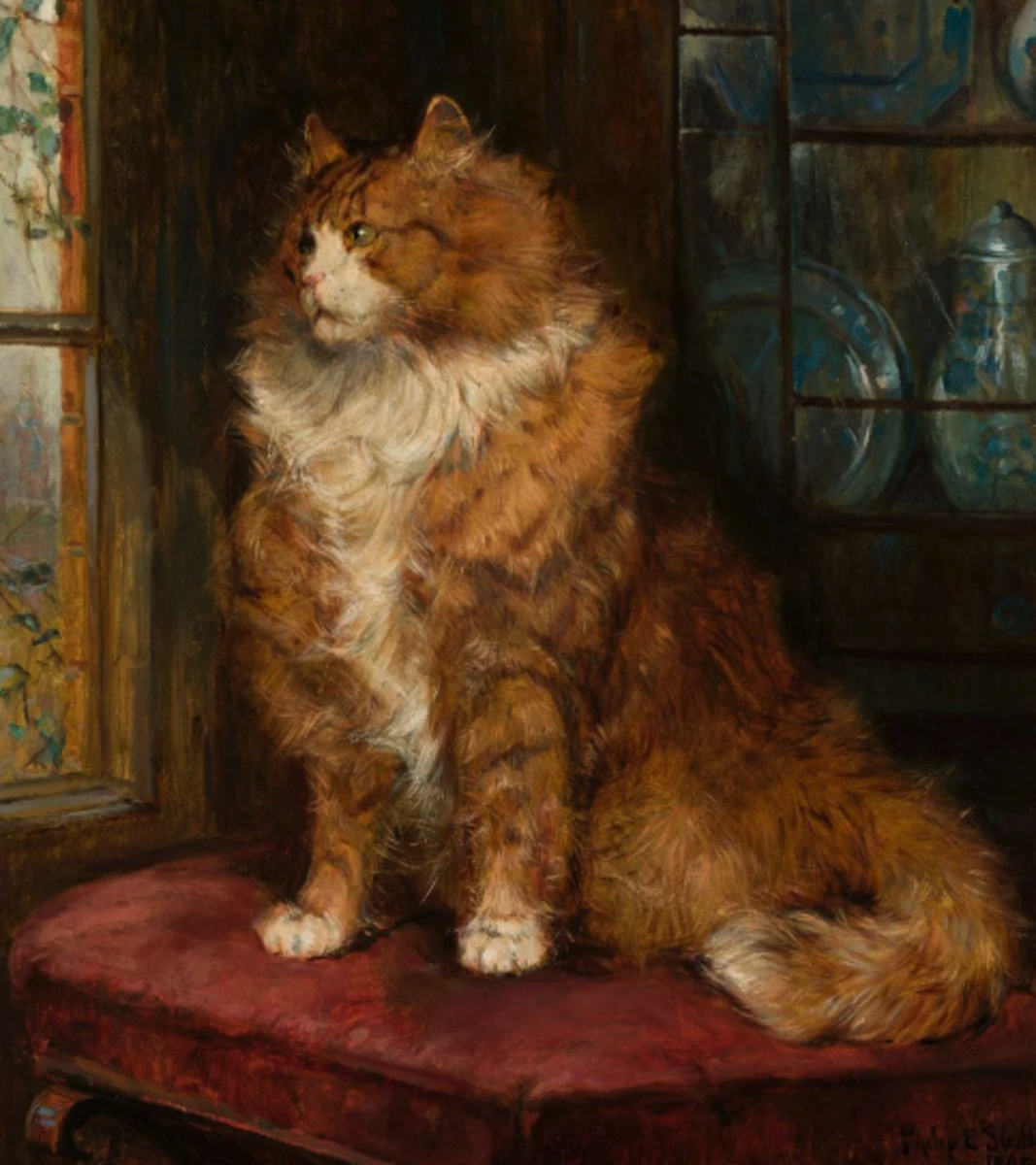
Lot 73, Study Of A Ginger Cat, 1908 by Philip Eustace Stretton

Art collectors, like breeders with an impressive base of broodmares, do not necessarily have a time clock on their investments. Some pieces may come to auction when an owner disperses their collection or as part of an estate sale. Other owners may look at the market and their particular piece's merits and try to read the tea leaves, deciding if this is the time to benefit from an increase in value. Meng tells people that their decision should ultimately come down to their relationship with a piece – and for some, that means they may decide to rebuff his overtures to selling.

“That's why we generally have 180 lots instead of 5,000 like at the Keeneland sale,” said Meng. “I tell people, you're the one who has to love it. You're the one who has to look at it every day. And if you love it, you shouldn't let it go.”

See this year's Sporting Art Auction catalog online here.

The post This Year’s Sporting Art Auction Offers Racing Legends, Beautiful Landscapes, And A Bit Of Humor appeared first on Horse Racing News | Paulick Report.


Source of original post

Zayat Stables Equine Liquidation Approaches Finish Line After Keeneland November Sale

One of the overarching storylines throughout this year's detour-laden auction calendar has been the liquidation of the once-mighty Zayat Stables operation to settle debts from a defaulted eight-figure loan and an ensuing bankruptcy.

Beginning with the Fasig-Tipton Kentucky Winter Mixed Sale in February, the equine holdings of Ahmed Zayat have been steadily pieced off through the auction ring, private sales, the claim box, and giveaways. According to a court document filed in early November by Elizabeth Woodward, the receiver responsible for handling the liquidation, there were still 10 horses publicly on the books for the stable. After the recently-completed Keeneland November Breeding Stock Sale, where all 10 were cataloged, only two remain, and they will likely be sold privately by Thanksgiving.

This, of course, is not a clear-cut indicator that all of the liquidation resources have been exhausted. The document implies that Zayat Stables still holds some stallion interests, and other holdings might still be in the process of being determined. Regardless, it is clear that the sun is almost over the horizon on the operation that bred and raced Triple Crown winner American Pharoah, won Eclipse Awards as outstanding owner and breeder, and was recognized by the Turf Publicists of America with the Big Sport of Turfdom Award and by the National Turf Writers and Broadcasters Association with the Mr. Fitz Award for “typifying the spirit of racing.”

The November sale saw nine of the 10 remaining Zayat horses go through the ring, with eight selling for a total of $491,000.

Starting with the two that didn't sell, Amandrea is owned in a 45 percent minority with partner Myracehorse.com, and she was scratched from the sale. The next filing from the receiver will indicate if a private deal was brokered or pending for Zayat's share before the sale. A weanling Kitten's Joy filly finished under her reserve with a final bid of $80,000, but liquidation horses that did not meet their reserve at previous auctions this year have typically been sold privately or re-entered in another auction.

The remaining eight followed the pattern set by their predecessors, hammering well below their lofty assessed values set by Zayat's representatives in mid-December 2019. That assessment came about when the owner submitted a liquidation plan to creditor MGG Investments to pay off a $23-million loan and stave off a lawsuit. MGG ultimately filed suit in late January.

The group cataloged in the November sale (minus the weanling, who wasn't born at the time of the valuation) was valued at a combined $5.9 million in December 2019, meaning they ultimately brought about 8 percent of what they were projected to when they went through the ring nearly a year later.

The six horses sold at this year's Fasig-Tipton July Horses of Racing Age Sale brought 9.62 percent of their December assessed value, while the six horses sold in February brought about 19 percent of their assessed worth.

It's well established that assessing value to a Thoroughbred is not a concrete science, and Thoroughbred value can be so fluid that the 2019 projection is practically obsolete at this point. The receiver's November report also makes sure to note how COVID-19 has affected the marketplace for public and private trade.

What makes it worth pointing out at this juncture is the assessment's use as a milepost – first, to show just how fluid those valuations can be, and second, to display how short of the mark the Zayat dispersal will come to paying off its creditors.

One of the primary methods of assigning valuation is based on income projection – what a horse could potentially earn in his or her lifetime at that point in the road. This would explain the widest discrepancy in the Keeneland November group, Gozilla, who sold for $60,000 after being valued at $2.25 million a year earlier.

In December, Gozilla was a 2-year-old looking down the Triple Crown trail with a third in the Grade 1 Hopeful Stakes and a fourth in the G1 Champagne Stakes. The Flatter colt had a a full buffet of spring graded stakes races to bolster his resume, and a strong performance in the Triple Crown races themselves could have made him a legitimate stallion prospect, easily worth seven or eight figures. The opportunity to reach that level, paired with the past performance to imply he was capable of doing it, justified a higher valuation, even if it was one staring at his ceiling.

To put that valuation in perspective, Max Player was appraised at a “fair market value” of $1.75 million after winning the G3 Withers Stakes in early February. The Kentucky Derby qualifying points the son of Honor Code earned in that race were arguably worth more than the graded stakes win itself. The fact that he was firmly on the path to the Triple Crown, and proved he was capable of defeating other horses with the same intentions, increased his earning potential.

Now, in November, Gozilla's Triple Crown opportunity has been exhausted, along with a potentially lucrative Breeders' Cup try. He has raced just once in 2020, finishing eighth in a Keeneland allowance in July.

Gozilla remains intact, and horses have recovered from greater downturns in form to become high-level runners and stallions, but his window is much smaller to achieve it, and the public auction market is as risk averse as it's ever been. It's highly unlikely he'd have ever commanded a price anywhere close to the Zayat assessment, but his open market value is also a fair assessment of his earnings potential at this point in his career.

A similar trajectory can be seen in Alex Joon, a 3-year-old Flatter colt who shortly before had broken his maiden at Churchill Downs when assigned a $1-million valuation last year. He has since run twice, most recently finishing second in a Churchill allowance, before selling for $120,000 at the November sale.

Alex Joon's allowance runner-up effort came on Oct. 29, shortly before the November sale, and recent form can be appealing for a racing prospect. This was also the case for the most expensive Zayat offering, Bob and Jackie, who sold for $190,000.

The 4-year-old Twirling Candy colt has been one of the highlights among the Zayat runners in 2020. He kicked off his campaign with a victory in the Wickerr Stakes at Del Mar, then he finished fourth in the G2 Del Mar Handicap later in the meet. He entered the November sale off a G2 City of Hope Mile Stakes at Santa Anita on Oct. 3, giving potential buyers recent proof that he can compete at a graded stakes level.

Bob and Jackie was a two-time stakes winner at the time of the December valuation, which placed him at $750,000. Using the same methodology for his higher-priced stablemates, his Triple Crown chances had passed at that point and he'd only run once in 2019 by mid-December. However, his recent stakes success and the fact that he plausibly still had a few prime racing years left in him to make a stallion resume boosted his value above the rank and file. As it turns out, he would become one of the most valuable Zayat horses to change hands at auction during the liquidation.

One last horse to examine from the November group is the Eskendereya mare Fateer, the dam of Bob and Jackie who was offered at this year's Fasig-Tipton Kentucky Winter Mixed Sale in February but finished under her reserve at $95,000. She was offered in-foal to top sire Kitten's Joy during the sale, and the ensuing filly was an $80,000 RNA at the November sale.

Nine months later, Fateer went through the ring again, not pregnant for the 2021 foaling season, and she sold for $57,000 – a steep drop from her $450,000 valuation in December.

Like many bankruptcies, the assets of the Zayat Stables dispersal will likely put only pennies on the dollar toward paying back the outstanding debt.

Thoroughbreds are a volatile commodity, and the fortunes of a public or private sale can swing wildly over one or two big performances by a runner or their foals, as well as the overall health of the marketplace. The valuations placed on the Zayat horses in December were unrealistic – they always were – but an unspectacular year from the stable in the middle of a pandemic also created a wider gap between projection and reality.

One of the most celebrated stables of the past decade went out quietly on the racetrack, which led to it going out quietly in the auction ring.

The post Zayat Stables Equine Liquidation Approaches Finish Line After Keeneland November Sale appeared first on Horse Racing News | Paulick Report.

Source of original post

No Winning Tickets In Stronach 5; $91,481 Carries Over To Nov. 27

There will be a carryover in the Nov. 27 Stronach 5 of $91,481.74 after there were no winning tickets in Friday's popular wager.

The Stronach 5, featuring an industry-low 12-percent takeout and races from Laurel Park and Gulfstream Park West, featured several longshot winners during Friday's sequence, beginning with the opening leg when Gracetown won Laurel's seventh race and returned $35.60. The hits kept coming with Isadorable Aida ($17) winning Gulfstream's seventh race and second leg of the sequence and Hall Pass ($19.20) winning Laurel's eighth race and third leg of the sequence.

The last two legs of the wager were won by Ms. Haiti ($9) and Notsosubtle ($11).

Friday's races and sequence

  • Leg One – Laurel Park 7th Race: $35.60
  • Leg Two –Gulfstream West 7th Race: Isadorable Aida $17
  • Leg Three –Laurel Park 8th Race: Hall Pass $19.20
  • Leg Four –Laurel Park 9th Race: Ms. Haiti $9
  • Leg Five –Gulfstream West 9th Race: Notsosubtle $11

Fans can watch and wager on the action at 1/ST.COM/BET as well as stream all the action in English and Spanish at LaurelPark.com, SantaAnita.com, GulfstreamPark.com, and GoldenGateFields.com.

The Stronach 5 In the Money podcast, hosted by Jonathan Kinchen and Peter Thomas Fornatale, will be posted by 2 p.m. Thursday at InTheMoneyPodcast.com and will be available on iTunes and other major podcast distributors. 

The minimum wager on the multi-race, multi-track Stronach 5 is $1. If there are no tickets with five winners, the entire pool will be carried over to the next Friday.

If a change in racing surface is made after the wagering closes, each selection on any ticket will be considered a winning selection. If a betting interest is scratched, that selection will be substituted with the favorite in the win pool when wagering closes.

The Maryland Jockey Club serves as host of the Stronach 5.

The post No Winning Tickets In Stronach 5; $91,481 Carries Over To Nov. 27 appeared first on Horse Racing News | Paulick Report.

Source of original post

Immediate Future of Racing at Woodbine Unclear Following Lockdown Declaration

During a Friday afternoon briefing, Doug Ford, the Premier of Ontario, Canada, announced a mandatory 28-day lockdown in the city of Toronto and the suburb of Peel, beginning at 12:01 a.m. Monday, Nov. 23. It was not immediately clear how the decision would impact racing operations at Woodbine Racetrack, though the Toronto Star reported that while training can continue, racing will cease.

“With the numbers rising rapidly in certain regions, we have to make the tough, but necessary decisions now to protect our hospitals, long-term care and retirement homes, and every person in this province,” said Premier Ford. “We cannot afford a province-wide lockdown, so we are taking preventative action today by moving Toronto and Peel into Lockdown level restrictions and other regions into higher levels of restrictions. We need to take decisive action to stop the spread of this deadly virus.”

Late Friday, Jamie Dykstra, Director of Communications and Content for Woodbine Entertainment, issued a statement that read: “Since the beginning of our province’s fight against the COVID-19 pandemic earlier this year, our commitment to public safety has not wavered. We are extremely supportive of the Government’s efforts to reduce the spread of COVID-19 throughout our community.

“Furthermore, we are very proud of our safety record at Woodbine Racetrack and Woodbine Mohawk Park in this regard. To that end, we are currently working to understand the implications this recent news will have on Thoroughbred racing at Woodbine Racetrack and the thousands of people it supports throughout the province.

“We will provide further updates at the appropriate time.”

The racing season at Woodbine was delayed from its usual mid-April start to June 6 owing to the COVID-19 pandemic. As recently as Nov. 19, track officials announced that they were managing a COVID positive in an active jockey, but that live racing would be able to proceed. Woodbine was scheduled to conclude its 2020 season Sunday, Dec. 13.

The post Immediate Future of Racing at Woodbine Unclear Following Lockdown Declaration appeared first on TDN | Thoroughbred Daily News | Horse Racing News, Results and Video | Thoroughbred Breeding and Auctions.

Source of original post

Verified by MonsterInsights