NYRA Releases Aqueduct Winter/Spring Schedules With Extended Purse Bumps

The New York Racing Association announced Thursday the 2020-21 winter and spring meets at Aqueduct Racetrack. In addition, NYRA announced that the purse increases now in effect across a number of categories at the Belmont Park fall meet will be extended to the fall, winter and spring meets at Aqueduct.

Purses for open claiming and maiden claiming races at NYRA are the highest in the country. The open $25,000 claiming category will see a $4,000 increase to $50,000, while the $40,000 maiden-claiming condition will now offer a purse of $43,000.

“NYRA is pleased to be able extend these significant purse increases to our upcoming Aqueduct meets as part of NYRA’s commitment to year-round racing,” said Martin Panza, NYRA Senior Vice President of Racing Operations. “Aqueduct plays a vital role within the overall ecosystem of New York racing, and we look forward to our return to the Big A.”

The 2020-21 Aqueduct meet will feature 42 stakes races worth $4.57 million in purses. It begins Thursday, Dec. 10 and runs through Sunday, Mar. 28. Live racing will generally be conducted Thursday through Sunday until the end of February with a holiday break set for Dec. 24-27 and the addition of special Monday cards Jan. 18 for Martin Luther King, Jr. Day and Feb. 15 for Presidents’ Day. Live racing in March will be offered Friday through Sunday through the conclusion of the winter meet Mar. 28.

The 11-day 2021 Big A spring meet will run Thursday, Apr. 1 through Sunday, Apr. 18 with live racing returning to a Thursday to Sunday schedule. The 2020 spring meet will include 13 stakes worth $2.7 million in purses, highlighted by the 96th running of the $750,000 GII Wood Memorial S. Saturday, Apr. 3. The race will offer 100-40-20-10 GI Kentucky Derby qualifying points to the top-four finishers. The day will also feature the return to Aqueduct of the GI Carter H. after the race was run at Belmont due to the pandemic this year, and the GIII Gazelle S., which will offer 100-40-20-10 GI Kentucky Oaks qualifying points for 3-year-old fillies.

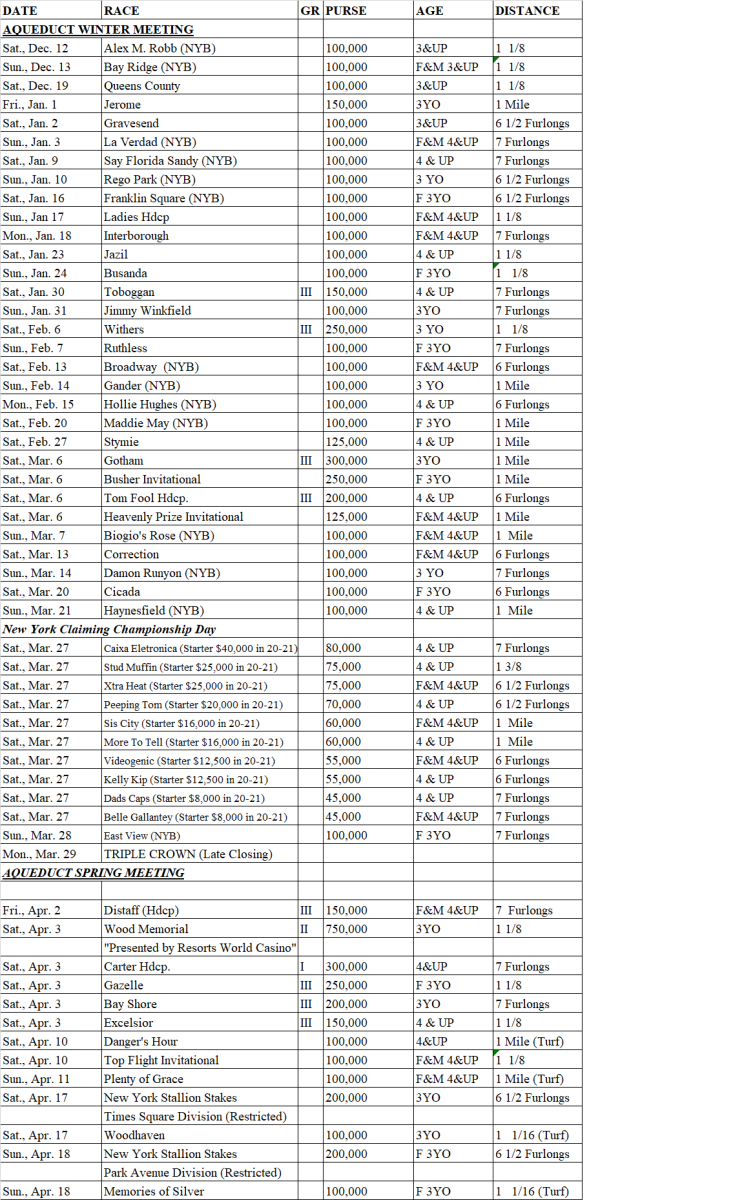
To view the entire stakes schedule for the winter and spring meets, click here.

The post NYRA Releases Aqueduct Winter/Spring Schedules With Extended Purse Bumps appeared first on TDN | Thoroughbred Daily News | Horse Racing News, Results and Video | Thoroughbred Breeding and Auctions.

Source of original post

NYRA Releases 2020-2021 Aqueduct Winter, Spring Meet Stakes Schedules

The New York Racing Association, Inc. (NYRA) today announced the race dates and stakes schedule for the 2020-21 winter and spring meets at Aqueduct Racetrack.

In addition, NYRA announces that the purse increases now in effect across a number of categories at the Belmont Park fall meet will be extended to the fall, winter and spring meets at Aqueduct.

Purses for open claiming and maiden claiming races at NYRA are the highest in the country, providing opportunities for horsemen at all levels. The open $25,000 claiming category will see a $4,000 increase to $50,000, while the $40,000 maiden-claiming condition will now offer a purse of $43,000.

“NYRA is pleased to be able extend these significant purse increases to our upcoming Aqueduct meets as part of NYRA's commitment to year-round racing,” said Martin Panza, NYRA Senior Vice President of Racing Operations. “Aqueduct plays a vital role within the overall ecosystem of New York racing, and we look forward to our return to the Big A.”

New York Thoroughbred Horsemen's Association (NYTHA) President Joe Appelbaum expressed his support for the upcoming Aqueduct schedule and attendant purse increases.

“Over the last several months, the NYTHA Board and management team has been working with NYRA to ensure year-round racing has a solid foundation, both in terms of racing opportunities and the purses that fuel our thoroughbred economy”, said Appelbaum. “This plan is a big step in that direction. Aqueduct is going to be a great spot for horsemen to race.”

With 42 stakes races on offer worth $4.57 million in purses, the 56-day winter meet begins Thursday, Dec. 10, and runs through Sunday, March 28. Live racing will generally be conducted Thursday through Sunday until the end of February with a holiday break set for Dec. 24 – 27 and the addition of special Monday cards on Jan. 18 for Martin Luther King, Jr. Day and Feb. 15 for Presidents' Day.

Live racing in March will be offered Friday through Sunday through the conclusion of the winter meet on March 28.

The December winter meet calendar will feature a trio of $100,000 stakes races at nine furlongs on the main track, including the Alex M. Robb on December 12 for New York-breds 3-years-old and up; the Bay Ridge on December 13 for New York-bred fillies and mares 3-years-old and up; and the Queens County on December 19 for 3-years-old and up.

January racing will open on New Year's Day with the one-mile $150,000 Jerome, the first of three Kentucky Derby prep races at the Big A winter meet. The Jerome will offer 10-4-2-1 qualifying points to the top-four finishers. The Martin Luther King, Jr. Day holiday card, marking the birthday of the late civil rights leader, is slated for Monday, Jan. 18 and features the $100,000 Interborough for fillies and mares 4-years-old and up. There will be no live racing on Thursday, Jan. 14 to accommodate the special holiday card.

The nine-furlong $100,000 Busanda for sophomore fillies on Jan. 24 will provide 10-4-2-1 Kentucky Oaks qualifying points to the top four finishers. The winter meet graded stakes calendar will open with the Grade 3, $150,000 Toboggan, a seven-furlong sprint for older horses on Jan. 30.

New York's road to the Kentucky Derby continues at the Big A winter meet with the nine-furlong Grade 3, $250,000 Withers on Feb. 6, offering 10-4-2-1 Kentucky Derby qualifying points to the top four finishers. The Monday, Feb. 15 President's Day Card will be highlighted by the $100,000 Hollie Hughes, a six-furlong sprint for New York-breds 4-years-old and up. There will be no live racing on Thursday, Feb. 11 to accommodate the Presidents' Day card.

A total of 12 racing cards are set for March, featuring eight stakes, including two graded events. The centerpiece of the March racing calendar is the one-mile Grade 3, $300,000 Gotham on March 6, which provides 50-20-10-5 Kentucky Derby qualifying points to the top four finishers. The Gotham day card includes the Grade 3, $200,000 Tom Fool Handicap for 4-year-olds and up going six furlongs; the $250,000 Busher Invitational for 3-year-old fillies offering 50-20-10-5 Kentucky Oaks qualifying points to the top-four finishers; and the $125,000 Stymie for 4-year-olds and up.

On its final weekend, the 56-day winter meet will showcase a 10-stakes card on New York Claiming Championship Day, Saturday, March 27 and the $100,000 East View on Sunday, March 28.

Throughout the 2020-21 Aqueduct winter meet, the trainer of any horse who finishes fourth through last in a race will receive a $300 credit towards an insurance escrow account in the trainer's name with the horseman's bookkeeper. The horse must be an official starter and finish the race. This money can only be used to make New York Jockey Injury Compensation Fund [NYJICF] payments. These funds cannot be withdrawn by trainers. Monies not used by the end of 2021 will refund to the purse account.

The 11-day 2021 Big A spring meet will run Thursday, April 1 through Sunday, April 18 with live racing returning to a Thursday to Sunday schedule. The 2020 spring meet will include 13 stakes worth $2.7 million in purses highlighted by the 96th running of the Grade 2, $750,000 Wood Memorial presented by Resorts World Casino on Saturday, April 3.

Opening Weekend of the spring meet will offer six graded races in total beginning on Friday, April 2 with the Grade 3, $150,000 Distaff at seven furlongs for older fillies and mares.

Wood Memorial day on Saturday, April 3 features the first Grade 1 of 2021 on the NYRA circuit in the $300,000 Carter Handicap, a seven-furlong sprint for older horses. The stakes-laden day is headlined by the Grade 2 Wood Memorial presented by Resorts World Casino, which offers 100-40-20-10 Kentucky Derby qualifying points to the top-four finishers.

Bolstering the lucrative Wood Memorial day card are a trio of Grade 3 races, including the $250,000 Gazelle at nine furlongs for sophomore fillies offering 100-40-20-10 Kentucky Oaks qualifying points to the top-four finishers; the $200,000 Bay Shore, a seven-furlong sprint for sophomores; and the $150,000 Excelsior at nine furlongs for older horses.

Closing weekend of the Big A spring meet offers the $200,000 NYSSS Times Square at 6 ½-furlongs for sophomore state-breds and the $100,000 Woodhaven for sophomore turf routers on April 18. The 11-day spring meet will conclude on Sunday, April 19 with the $200,000 NYSSS Park Avenue at 6 ½-furlongs for sophomore filly New York-breds and the $100,000 Memories of Silver for sophomore filly turf routers.

As previously announced, the 18-day Aqueduct Racetrack fall meet, offering 29 stakes, including 11 graded events worth $3.41 million in purses, will begin off on Friday, November 6 and run through Sunday, Dec. 6.

The Aqueduct fall meet is highlighted by the 32nd renewal of the Grade 1, $250,000 Cigar Mile for 3-year-olds and up on Saturday, Dec. 5.

For additional information, visit NYRA.com.
The post NYRA Releases 2020-2021 Aqueduct Winter, Spring Meet Stakes Schedules appeared first on Horse Racing News | Paulick Report.

Source of original post

Equibase Analysis: Reagan’s Edge Leads Strong Field In Raven Run

The Grade 2, $200,000 Lexus Raven Run Stakes at Keeneland is usually a showcase of some of the top filly sprinters in North America, and this year's edition is no exception. Four of the 10 entered are graded stakes winners, with another four having finished in-the-money in graded stakes so far in their careers.

In terms of career earnings, Finite leads the group with over $650,000 in the bank, most of it earned winning the Grade 2 Rachel Alexandra Stakes in February. Venetian Harbor won the Grade 2 Las Virgenes Stakes in February and enters this race off a fine second behind Gamine in the Grade 1 Test Stakes. Tonalist's Shape brings a six-for-nine record with her including a win in the Grade 2 Davona Dale Stakes in February and she had significant traffic trouble in the Grade 3 Charles Town Oaks in her most recent race.

Four Graces won the Grade 3 Beaumont Stakes at this distance at Keeneland in July and was most recently second in the Grade 2 Eight Belles Stakes. Never Forget finished third in the Eight Belles and hopes to improve, as does Grade 2 Prioress Stakes fourth place finisher Secondary Market. Fair Maiden just missed in the Grade 1 Natalma Stakes 13 months ago and won following 10 months off in September so could get back to stakes quality form.

Grand Cru Classe won the Weber City Miss Stakes last month and is racing in a graded stakes for the first time. Reagan's Edge hasn't won a stakes race yet but finished second in the Grade 2 Prioress Stakes in her most recent start. Secret Keeper also finished second last time out, in the Grade 3 Torrey Pines Stakes, and these two appear to be strong contenders in a very deep field.

Reagan's Edge has finished second in two straight stakes races to Frank's Rockette, arguably the top 3-year-old filly sprinter in North America. Frank's Rockette would be the prohibitive favorite here and since she's not running in this race, Reagan's Edge is going to be tough to beat. She's earned 105 and 103 Equibase Speed Figures in her last two races, the lowest of which is higher than any other horse's last two figures. We call this a “Double Advantage” and that's another reason Reagan's Edge gets top billing as a win contender, because it means other horses in the field have to improve significantly to run faster to beat this filly.

Secret Keeper won the first two starts of her career with 90 then 96 figures. In her third start she improved to a 98 figure when second in the Torrey Pines Stakes to Harvest Moon, who then improved seven points to win the Grade 1 Zenyatta Stakes. If Secret Keeper continues her pattern and moves up like Harvest Moon did, she's going to run as fast as a 105 figure, which is as good as Reagan's Edge earned in the best of her last two starts. As such, Secret Keeper must be considered as logical to win this year's Lexus Raven Run Stakes as Reagan's Edge.

Four Graces won the similar Grade 3 Beaumont Stakes at this seven furlong trip at the July Keeneland meeting, earning a 99 figure, then improved again to career-best 102 figure effort when second in the Eight Belles Stakes last month. Excluding the one race in which she tried to run farther than this seven furlong distance, Four Graces has won four races and finished second in the other so deserves a lot of respect in this year's Raven Run Stakes.

The rest of the field, with their best Equibase Speed Figures, is Fair Maiden (100), Finite (101), Grand Cru Classe (92), Never Forget (98), Secondary Market (99), Tonalist's Shape (95) and Venetian Harbor (106).

Win Contenders:

Reagan's Edge
Secret Keeper
Four Graces

Lexus Raven Run Stakes – Grade 2
Race 9 at Keeneland
Saturday, October 17 – Post Time 5:30 PM E.T.
Seven Furlongs
Fillies, Three Years Old
Purse: $200,000

The post Equibase Analysis: Reagan’s Edge Leads Strong Field In Raven Run appeared first on Horse Racing News | Paulick Report.

Source of original post

A Conversation About Accuracy: 30,000 Falsehoods Annually

by Thoroughbred Idea Foundation

While Aunt Pearl’s performance in the [GII] J.P. Morgan Chase Jessamine S. on Oct. 7, 2020, was an impressive gate-to-wire score in a sizzling time, smashing the stakes record by more than two seconds, the pesky un-timed portion of nearly every American race played a role in the eye-popping clocking.

“Run-up” is the distance from where the gate is placed and the timing of the race begins–that is, the point at which the horses reach the published distance of the race. The Jessamine, and nearly every other race in North America, is not run over the distance listed in the program or past performances. So, when reporting the race was “1 1/16 miles”–that is really only the portion of the race which is timed, not the full distance run.

The actual distance the race covers, naturally, is the point from where the gate is placed to the finish, but depending on how far the gate is from the published distance of the race will dictate how much of ground at the start is covered before the horses reach the point which is 1 1/16 miles from the finish.

In the case of the Jessamine, the initial Equibase chart of the race reported 216 feet. Keeneland later informed Equibase that distance is closer to 100 feet, and the chart was amended.

The Daily Racing Form‘s Marty McGee covered the issue in the days after the race:

“[Bob] Elliston said additional gaps for entry to the turf course have been added this fall ‘in an attempt to try to preserve the surface by not placing the starting gate at the same position on the turf course at [often-run] distances. The gate can rough up the course through that kind of repetition.’

“For the Jessamine, the gate was ‘placed the farthest back of all the gap options,’ Elliston said. ‘Obviously, this is the kind of thing handicappers have a right to know about beforehand, so we’re making that information available on a regular basis.'”

At the suggestion of the Thoroughbred Idea Foundation (TIF), Elliston confirmed that Keeneland would begin updating the daily run-up information on the track’s website, which can be found here on the “track conditions” page.

“We thank Keeneland for their attentiveness to the situation and getting the updated information to the public,” said Patrick Cummings, Executive Director of TIF.

“There needs to be an industry-wide discussion about accuracy in our sport. Every time entries are drawn for a new race, and they are published, our industry is misled into believing a race is being run over the distance that is listed. That is false–our sport reports about 30,000 falsehoods a year just in terms of the accurate distance of races run. We report the distance timed, not the distance run, and in so doing, disrespect everyone in the sport, but most especially the horseplayers and the horsemen.”

From the break of the gate to the finish in the 2020 Jessamine, Aunt Pearl ran for about 1:46. Last year in the same race, Sweet Melania ran for about 1:45. Images [found on] YouTube of each race show the gate in different positions relative to the distance poles on the various courses.

Craig Milkowski of TimeformUS confirmed from video timing software that the 2020 Jessamine field ran for about 5.31 seconds before timing began. He added that, based on this method of timing one-mile dirt races at Santa Anita, which have a reported 160 feet of run-up, routine run-up times are around 4.95 seconds. At Del Mar over the same distance, run-up is reported at 200 feet and the time is about 5.75 seconds of un-timed racing before the clock begins and horses reach the point one mile from the finish.

TIF published a report several weeks ago which highlighted gross inaccuracies in distances run at Saratoga, Gulfstream Park and Kentucky Downs. There have been few changes.

On the last day of racing at Gulfstream prior to their seasonal shift to Gulfstream West, Mo of the West won Race 9 carded at one mile on turf. The published final time was 1:36.44, but the horses actually ran for about 1:44.

“Aunt Pearl looks a very nice filly,” Cummings said, “but the raw information our sport presents to customers suggests she was potentially 12-14 lengths faster than any previous winner of the Jessamine.

“Even if Aunt Pearl is to be a future superstar, the next Zenyatta, it is almost impossible to believe she is that much faster than all previous winners of the race. What is not doubted is that she covered a longer course in the 2020 Jessamine, which seems to have had the longest run-up of any previous edition, and thus made the times faster given she got up to a higher speed once the clock started.

“This is just another reason that the sport’s speed and pace figuremakers are valuable for racing, they serve as an incredibly valuable check-and-balance to the raw data the sport presents. Take nothing away from the horse, but the times can be very misleading to the public given that tracks are not putting the gate in the same place and races are not effectively run over the same distance, particularly on turf, from year-to-year. In a sport where the difference between a big win and total loss can be incredibly small, accuracy matters so much.”

The post A Conversation About Accuracy: 30,000 Falsehoods Annually appeared first on TDN | Thoroughbred Daily News | Horse Racing News, Results and Video | Thoroughbred Breeding and Auctions.

Source of original post

Verified by MonsterInsights