A newborn foal in need of a nurse mare is never a desired scenario. Regardless of the reason, to avoid hand-raising an orphan, a nurse mare is necessary. The nurse mare industry is controversial because it produces orphan foals when the mare is taken away from her own foal.
Learn more about nurse mares and their foals from this 2013 Paulick Report feature.
There is another answer, and that is inducing lactation in a mare. While this is a technical procedure that needs specific treatment, veterinarian oversight and the right mare, it can give one foal a chance at life while not leaving another orphan foal behind.
Overview of the Procedure
First, the right mare has to be chosen. According to Dr. Patrick McCue, DVM, PhD, Dipl. ACT, professor specializing in equine reproduction at Colorado State University (CSU), the potential nurse mare must have been pregnant, developed a mammary gland, given birth and lactated at some point in her life. Very importantly, she also has to have a good personality and have been a good mother.
McCue notes that induced mares do not produce colostrum. If the newborn foal did not receive enough from his natural mother, colostrum needs to come from a different source. That is vital for the health of the foal, so McCue always checks the IgG level (the amount of immunoglobulin type G, an antibody) of the orphan and supplements with colostrum or plasma if necessary.
Lactation is regulated by prolactin made by the anterior pituitary, but prolactin itself is not available as a commercial treatment in horses. However, prolactin secretion can be modulated by administration of a dopamine antagonist such as domperidone. Domperidone blocks the receptors that dopamine binds to, allowing prolactin levels increase, and the mare comes into milk.
Research shows pretreating mares with estrogen prior to domperidone therapy resulted in higher prolactin levels. After four to six days of domperidone therapy, there is usually enough mammary gland development to start hand milking, which promotes even more milk production.
Once the mare has enough milk, the new foal can be introduced. This is usually three to five days after hand milking starts, or seven to 10 days after the beginning of domperidone therapy. While all this is happening, the foal needs to be fed with milk replacer. McCue advised to limit foal handling so that the foal doesn't bond with people and will eventually bond with the nurse mare.
Introducing the mare and foal is definitely a tricky time. McCue uses a prostaglandin protocol to establish the maternal bond in the mare. The mare will usually develop an intense interest in the foal. He recommends having the foal hungry so it will instinctively search for the mammary gland. Once the foal latches on, they step back and watch the behaviors to make sure all is well. He does note that despite all the efforts, occasionally the process does not work.
Filling a Need
Bronwyn Watts of ColdSpring Nurse Mares has spent her life devoted to horses. Born and raised on a working horse farm in the Blue Ridge Mountains of Virginia, she was a professional groom in the three-day event world for 15 years.
After hearing about the controversial nurse mare industry, she was motivated to do something about it.
“It struck a nerve with me,” she said. “How can it be that we do not have a more ethical way of providing such a vital service to the equine breeding industry?”
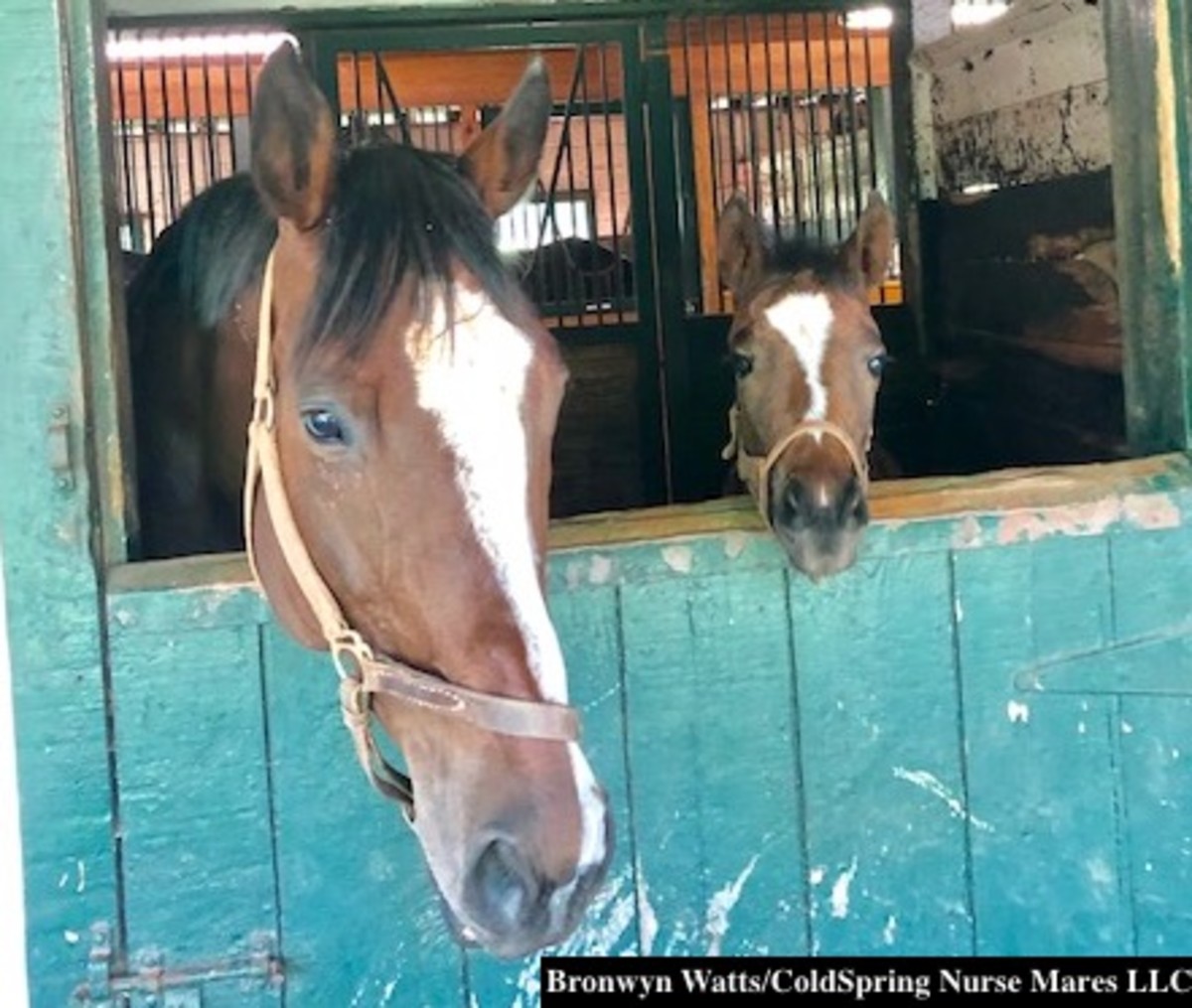
A mare and foal matched through ColdSpring
After that, she began researching hormone induced lactation, determined to start her own hormone induced nurse mare program. Two years ago, ColdSpring Nurse Mares, now based in Ocala, Fla. and Lexington, Ky., was founded. While many people associate nurse mares with the Thoroughbred breeding industry, Watts emphasizes that they serve all breeds.
The farm does all the work, which takes much of the pressure off the foal owner.
“Our mares are ready to go starting the middle of January,” Watts said. “We deliver the mare to the foal, and we handle the pairing process to ensure it is done in a professional, controlled and safe manner, resulting in a 100% success rate.”
In their first two years, they have successfully paired 52 mares to orphan foals all over the southeast and mid-Atlantic regions.
Pros and Cons
There are no real physical, clinical or pathological drawbacks for the nurse mares. They are happy being a mom, and a mare can still be bred even while nursing. There are no adverse issues with the mammary gland and no real downside to therapy.
“ColdSpring Nurse Mares provides an innovative and vital service to the equine community while also bringing awareness and action to the problem of equine over population,” said Watts. “Our program allows us to save three lives by not producing throw away foals, giving the ultimate nutrition and proper socialization skills to an orphan foal, and repurposing older broodmares who often find themselves in less than desirable situations once they no longer can conceive.”
One Farm's Story
Western Venture Farms in Waukesha, Wisc., is a large boarding facility with mostly pleasure riders. Several years ago, barn owner Tammie Roeber accepted a starving Arabian mare with a severe sinus infection along with her one month old foal. After lots of time and care, and two sinus surgeries, the mare, named Haleena, and foal recovered and were doing well.
One boarder brought in a pregnant Quarter Horse mare who was severely lame from untreated laminitis, navicular syndrome, and infected frogs. They were able to manage the mare through her pregnancy, but after she foaled a filly, she foundered and retained a portion of placenta. Unfortunately, she couldn't be properly treated without endangering the foal.
Roeber and the mare's owner needed to try something, so they thought of inducing lactation in Haleena. They talked with their vets about it and decided to give it a try.
It took four to five days for Haleena to start producing milk. Once the pair were introduced, they kept a very close eye on the mare and foal for two days to be sure everything was going well.

A ColdSpring nurse mare on the job
Fortunately, the process worked.
“The filly is wonderful,” said Leslie Sutherland, who works part-time at Western Venture. “It required a network to get it all done. You have to want to try, do the work, be diligent and have lots of good help.”
In the End
A new foal without a mother is a serious situation. The preference would be to find a mare who recently lost her foal if she is still lactating. If one is not available, inducing lactation is a viable option, and both ways are better than trying to raise a foal without a mother.
Stephanie J. Ruff, M.S., has been a freelance writer specializing in the horse industry for over 20 years, and was the recipient of the Sheikha Fatima bint Mubarak Ladies Darley Award for Outstanding Female Journalist in 2017. She blogs about her riding and writing life at www.theridingwriter.wordpress.com and lives in Florida with two horses, two dogs and two cats.
The post Induced Lactation in Mares: A Viable Option, Free Of Nurse Mare Foals appeared first on Horse Racing News | Paulick Report.
Source of original post
