This Year’s Sporting Art Auction Offers Racing Legends, Beautiful Landscapes, And A Bit Of Humor

In a year when nothing is quite normal, it's nice to have a few things you can count on. For the Keeneland auction pavilion, the switch from horses to art is as reliable as the changing of the seasons. For the eighth year, broodmares and weanlings made their annual November parade through the auction ring while paintings and sculpture decorated the pavilion's halls, awaiting their turn to change hands in the Sporting Art Auction.

While in previous years, the Sporting Art Auction sees paintings and sculpture auctioned from the iconic Keeneland ring, this year's sale will be conducted virtually. Those who were at Keeneland for the November Sale may also have noticed fewer works of art lighting their passage between the café and the back walking ring, as organizer Cross Gate Gallery sought to display this year's catalogue in smaller groups to discourage crowding from viewers.

Much like the sale that precedes it, the catalogue for the Sporting Art Auction varies a bit year by year.

“We want everyone to be able to find something that we like, so we do have 19th Century British, and we extend all the way up,” said Bill Evans Meng, gallery director for Cross Gate Gallery in Lexington, Ky. “There are a lot of contemporary painters. I'm 37 and everyone my age is buying the new things. [The catalog] is maybe is a little more contemporary this year but sometimes you have to go with what you can find.”

Meng said he aims to have a healthy mix of time periods, styles, and subjects each year. While most feature horses either in racing or foxhunting contexts, there are often a few pastoral scenes as well as a few of hunting dogs, farm creatures, or fowl.

A few works were commissioned to depict specific horses. A trio of portraits from well-known equine painter Richard Stone Reeves depict Law Society, Coup De Feu and Mr. Right, while a signed collection of 12 prints from Franklin B. Voss (no relation to the author) is a fond look back at the top runners of the 1920s and 1930s, including Man o' War, Gallant Fox, Seabiscuit, and Discovery.

For Meng, works designed to immortalize a particular subject sometimes come along with the most interesting stories.

“The ones that are specific, they have a story and people like that,” said Meng. “I feel like all three of the Reeves this year, they had real connections to the connections. The one of the Coup de Feu was a father and son story – the father owned it and got his son started racing. Law Society was a big horse for Vincent O'Brien and of course shows his incredible training facility. The third Reeves, Mr. Right, came from the trainer and I got to talk to him a lot and he really liked the horse. When you do these specific ones, there's always a story and I think people connect to that.

“Of course a lot of our clients are horsemen and they're into bloodlines. They might know this was their horse's great-great-grandsire and that means something to them.”

In a somewhat unusual twist, this year's auction also features a human portrait from German/American artist Nicola Marschall of Daniel Swigert. Swigert and his Elmendorf Farm are two of the oldest names in the Kentucky Thoroughbred business, tracing back from the 1870s.

(We wrote about Elmendorf and Swigert in our Kentucky Farm Time Capsule series. Read that profile piece here.)

“When he was young he tried to build up what became Buffalo Trace Distillery and then he went on to become a great horsemen,” he said. “I knew about him, but I didn't know enough about him to appreciate it when I saw the painting the first time [10 or 12 years ago.]”

Lot 120, Early Morning Exercise, Green Lane as painted by Peter Howell

Other pieces are looser or more interpretative, allowing an owner or fan to see their own favorite horse in the lights and shadows. Painter Peter Howell's depictions of morning training at Keeneland and Newmarket are particularly good examples of this.

Then there are pieces likely to garner attention on name recognition alone. The catalog contains a number of sketches from the well-known Sir Alfred Munnings, as well as brightly-colored scenes from popular Henry Lawrence Faulkner and a landscape from Andrew Wyeth.

(Read more about Sir Alfred Munnings in this 2017 feature.)

There are also pieces with a sense of humor. Andrew Pater's 'The Empty Bowl' features a hound next to his empty dish wearing the dry, humorless expression all pet owners have experienced when they've dared to come home late. 'Antagonizing the Barn Cat' from George Armfield shows a faceoff between an irritated tabby and a trio of terriers poised to hop and play. Then there's Philip Eustace Stretton's 'Study of A Ginger Cat' displaying an enormous orange feline upon a regal crimson cushion.

“I've chuckled myself walking by it,” said Meng. “We don't get a lot of cat paintings, but we do have some clients that sort of got on a cat kick, so there you go. He's sort of looking majestic.

“They kind of would paint these animal genre scenes like that, where you'd see them acting out. Animals are going to be animals. I think they're something people can relate to, something lighthearted. Those do well, because people like to laugh.”
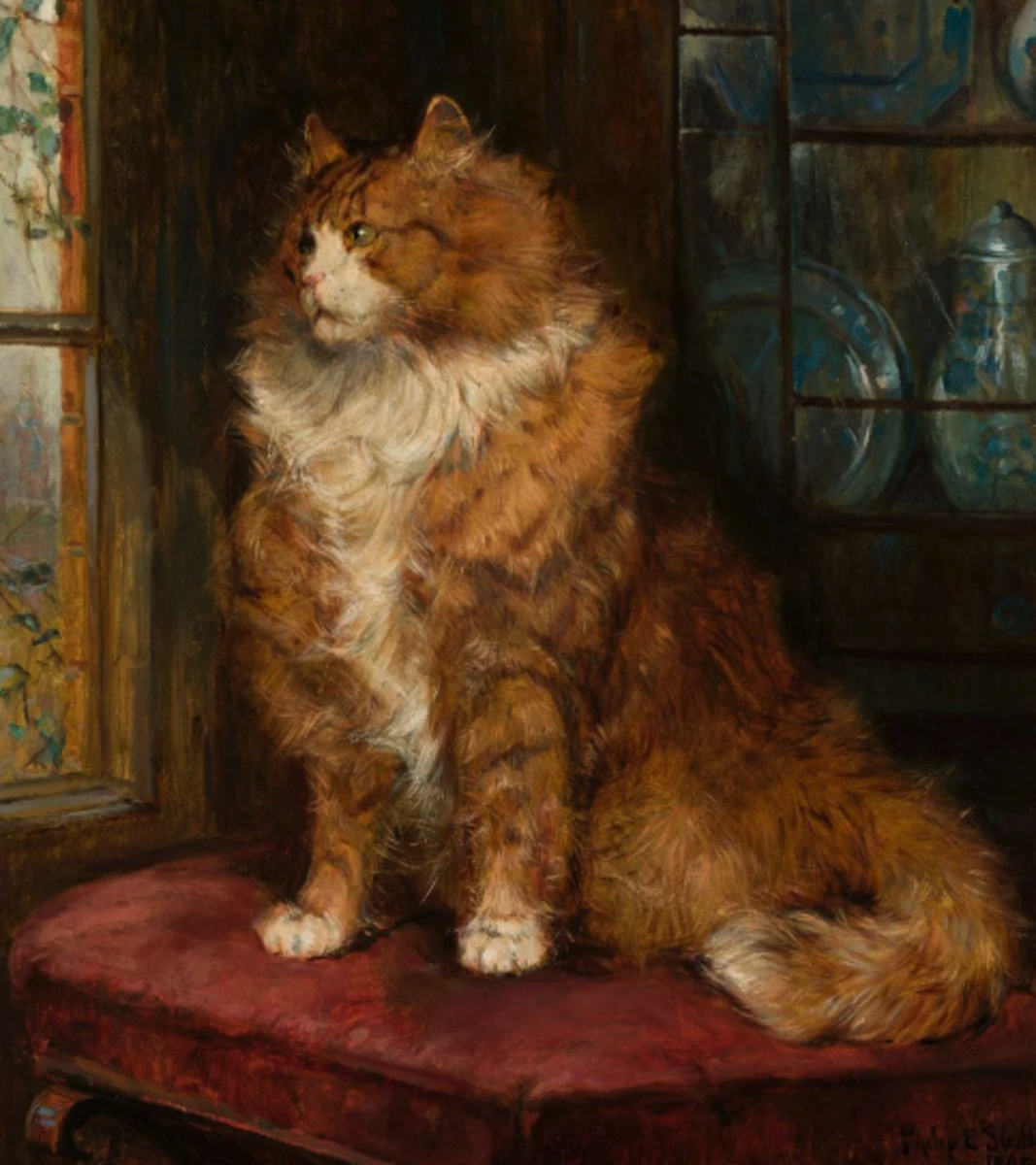
Lot 73, Study Of A Ginger Cat, 1908 by Philip Eustace Stretton

Art collectors, like breeders with an impressive base of broodmares, do not necessarily have a time clock on their investments. Some pieces may come to auction when an owner disperses their collection or as part of an estate sale. Other owners may look at the market and their particular piece's merits and try to read the tea leaves, deciding if this is the time to benefit from an increase in value. Meng tells people that their decision should ultimately come down to their relationship with a piece – and for some, that means they may decide to rebuff his overtures to selling.

“That's why we generally have 180 lots instead of 5,000 like at the Keeneland sale,” said Meng. “I tell people, you're the one who has to love it. You're the one who has to look at it every day. And if you love it, you shouldn't let it go.”

See this year's Sporting Art Auction catalog online here.

The post This Year’s Sporting Art Auction Offers Racing Legends, Beautiful Landscapes, And A Bit Of Humor appeared first on Horse Racing News | Paulick Report.

Source of original post

Paul Williams Named Chief Executive Officer Of 1/ST Technology

1/ST announced today the appointment of Paul Williams to Chief Executive Officer, 1/ST Technology and to Chief Technology Officer, 1/ST. Williams joined The Stronach Group in 2018 as the company's first Chief Technology Officer, focused on building and delivering the digital and technology road map to maximize the company's world-class platforms and to expand the opportunities for innovation across The Stronach Group's racing and gaming verticals.

As Chief Executive Officer, 1/ST Technology, Williams will work directly with 1/ST Racing and 1/ST Content to amplify the company's innovative racing and content programs. He will lead the consolidation of 1/ST's digital businesses to drive revenue for some of horse racing's largest and most recognized racing and gaming brands including, AmTote, Xpressbet, 1/ST Bet, XB Select, XB Net, PariMAX and Betmix.

In addition, Williams will continue his responsibilities as Chief Technology Officer, 1/ST to build on the industry-leading internal and external IT infrastructure that is currently in place at 1/ST. He will focus on strengthening and improving the digital systems that support company-wide platforms to increase cyber defense capabilities, digital efficiencies and innovative customer interfaces.

“Paul's added appointment to Chief Executive Officer, 1/ST Technology, represents the ongoing evolution of 1/ST as Thoroughbred horse racing's premier operator,” said Belinda Stronach, Chairman and President, 1/ST. “I have tremendous confidence in the 1/ST team and their collective commitment to evolving our racing and gaming platforms with continued forward-thinking that will drive our company's growth for the future.”

“As we look to the future of Thoroughbred horse racing and to gaming in general, the opportunities for expansion and innovation are endless,” said Williams. “By structuring the 1/ST Technology, 1/ST Racing and 1/ST Content businesses as congruent brands, we will be able to offer our customers world-class racing and gaming products that reflect the new era in our sport.”

Since joining The Stronach Group, Williams has improved the Xpressbet legacy platform and has successfully engaged a new generation of customers with the development and roll out of the 1/ST Bet app, an innovative mobile platform that has changed the wagering experience for everyone from the first-timer to the experienced horse player.

Williams has a passion for building immersive technologies supported by world-class infrastructure and has led several large-scale global technology teams throughout his career. He formerly served as Chief Information Officer of IBEXGlobal and Chief Information Officer at Cantor Gaming and as Global Director of Trading Infrastructure at Cantor Fitzgerald, LLC.

For more information on 1/ST and 1/ST BET please visit www.1st.com and www.1stbet.com or @1ST_Racing and @1stbet.

The post Paul Williams Named Chief Executive Officer Of 1/ST Technology appeared first on Horse Racing News | Paulick Report.

Source of original post

Churchill Downs Partners With LEE Initiative For Jefferson County Public Schools Family Meal Program

The LEE Initiative, in partnership with Churchill Downs, announced its newest relief effort in response to the COVID-19 pandemic and the hardships it has caused for families: a meal program.

Family Meal is a collaborative effort between The LEE Initiative, Churchill Downs, Jefferson County Public Schools (JCPS), Louisville Metro, Audi and Humana, and will feed families who have children enrolled in JCPS.

“Reports are indicating that roughly 8 million Americans are slipping into poverty due to this crisis,” said chef Edward Lee, co-founder and director of programming for The LEE Initiative. “We hope the entire city will join us in proving that Louisville can be a truly compassionate city and that we can create innovative solutions to the hunger issues that have become so rampant. This program is more than just feeding families; it is helping families avoid facing poverty.”

The LEE Initiative will hire 50 cooks who have been out of work due to the pandemic. These cooks will use the Churchill Downs Racetrack kitchen to prepare 8,000 boxed meals a week, with each box feeding a family of four.

“We love working with The LEE Initiative to take the stigma out of getting a free meal and making sure families have a high-quality chef-prepared meal,” said Churchill Downs Racetrack executive chef David Danielson. “We are very pleased with the success of the program so far. It has reignited our team, and we work to show the virtue of leadership with hospitality. While there is still much hard work to do and many problems to solve, nothing is possible without a seat at the table for all. Feeding people is in our hearts, and during this difficult time, it is uplifting to know we can help those in our community who are in need.”

All meals will come frozen with instructions to reheat in the oven or microwave. JCPS will handle distribution and make meals available on Tuesdays and Thursdays at their meal site pick locations. Further pickup details will be available through JCPS.

For more information on the relief efforts, visit leeinitiative.org.

The post Churchill Downs Partners With LEE Initiative For Jefferson County Public Schools Family Meal Program appeared first on Horse Racing News | Paulick Report.

Source of original post

Rice Emails Suggest Entry Information Did Not Necessarily Convert To Additional Wins

On the sixth day of a hearing examining her receipt of information from the New York Racing Association (NYRA) racing office, trainer Linda Rice said the emails provided to her by entry clerk Jose Morales had minimal impact on her decisions about which races to enter or the results of those races.

Rice continued her testimony started Wednesday before a hearing officer as part of the the proceedings, which will determine whether her actions were “inconsistent with and detrimental to the bests interests of racing generally” or were “improper acts and practices relating to racing” according to state rules. An investigation by the New York State Gaming Commission uncovered evidence that between 2011 and 2015, Rice received faxes and emails from former entry clerks Jose Morales and Matt Salvato, giving her the names and past performance records of horses prior to draw time. Senior racing office management has said the names of trainers and horses in a given race are not to be released until after a race is drawn (with stakes races being the exception).

On Thursday, Rice described the circumstances around her first getting this type of information from Morales. As the horse shortage in New York began to worsen, Rice remembered that racing office personnel became more aggressive about “hustling” races, or trying to convince trainers to enter their horses. She recalled being in the racing office several times when a clerk would print out current entries with horse names and past performance records and let her look at the sheet. She also said she witnessed this happening with other trainers.

Rice said she often asked NYRA stakes coordinator Andrew Byrnes to provide her lists of stakes nominations along with an idea of which horses were probables for a stakes race, which is not considered confidential information. She recalled one morning when Morales called to say he had faxed her this information on a stakes race she'd requested, along with entry and past performance information for a race she hadn't asked about, which he was tasked with hustling.

“I thought for a second, 'That's odd,'” she said. “But I'd already had him slide the races across the desk in the racing office and seen other racing clerks do it so I didn't think much of it.”

Rice is accused of receiving this information on an ongoing basis, both for races Morales was hustling and for races she requested to see. Morales initially faxed the information to Rice's office but switched to using email when the fax machine was out of order one morning. Fax transmission records are no longer kept from the period of time in question, so the commission's evidence focuses on copies of emails accessed by investigators.

Rice revealed that of 74 or 75 emails with race information, she entered horses in 23 of the races included in those emails. She won three of those races. Rice said there were around 80 races on the NYRA circuit she entered during the same period of time for which she did not receive any information from Morales. For the period of time covered by the emails, Rice said she won 16 percent of her races, a bit lower than her usual 20 percent.

There were many factors that determined whether or not Rice would enter a horse in one of the races for which Morales provided entry information. She said she typically points horses at races two or three weeks ahead of time and is not inclined to change the horse's program just because the office is hustling a race. She also bases some of those decisions on whether or not a preferred rider is available, in addition to the usual factors like a horse's performance in workouts, physical condition, etc.

Rice also addressed testimony from earlier in the hearing that she had a tendency to enter a race and then later swap out one horse for another. This wasn't due to any insider info from Morales, Rice said, but more likely because turf races would attract so many entries that the racing office would give preference to horses who had not yet run at the meet. If she learned a race was oversubscribed and her entry had already run at the meet, she might swap another horse in that was more likely to make the final cut.

Andrew Turro, Rice's attorney, completed questioning the trainer at the conclusion of Thursday's hearing. Thursday had originally been scheduled as the final day for the hearing, but commission counsel has not yet had a chance to cross examine her, or to present any rebuttal evidence. An additional two days have been blocked out to conclude the hearing Dec. 9 and 10. No timeframe has been provided as to when the hearing officer may make a decision in the case.

Read previous coverage of the Rice hearing here.

The post Rice Emails Suggest Entry Information Did Not Necessarily Convert To Additional Wins appeared first on Horse Racing News | Paulick Report.

Source of original post

Verified by MonsterInsights