This Side Up: Third Coast Supplies Extra Dimension

The world we share with these amazing animals may be an ever-changing one, but its mysteries abide. We consider ourselves ever more knowledgeable, ever more certain, riding the slipstream of science. Yet how much do we truly know, when Afternoon Deelites holds out for all those years and then waits just six days before following his owner to whatever shore may (or may not) lie beyond the horizon of life?

The same journey was made this week by the trainer of Alydar. John Veitch laid the ground for the greatest Triple Crown campaign of any horse that never won a Triple Crown race by giving him 10 starts as a juvenile. Curiously, however, trainers of the succeeding generation appear to have decided either that they have found a better way; or at least that the materials provided, since breeding became an almost exclusively commercial enterprise, are no longer equal to the same kind of treatment.

Trainers today map out the road to the Derby with two priorities: minimize gas consumption, and avoid traffic. That way, they feel, their charges can reach Churchill with a relatively full tank and pristine engine. But the fact is that you always feel able to drive a car more aggressively once it has taken a few bumps and scratches. And you also learn far more about its capacity and response if you have repeatedly had to accelerate or brake to get out of trouble, as compared with cruising along an open road and every six weeks overtaking a laboring truck while barely changing gear.

In the prevailing environment, then, we must give credit to the people at Fair Grounds for redressing the shortfall in conditioning by extending the distance of all three legs of their trials program. If horses can no longer get the kind of mental and physical foundation they once derived from sheer volume of racing, then at least they can have a little more aggregate. With a field of 14, moreover, the GII Risen Star S. is meanwhile guaranteed to steepen the learning curve.


(To listen to this article as a podcast, click the arrow above.)

Saturday will be only the fourth time the race has been run over this extra 1/16th, yet its last two winners have both gone on to finish second in the Derby. One, of course, was actually promoted to first place; while much the same was done for the other by voters at the recent Eclipse Awards.

To be fair, the Risen Star was already on a roll, having lately produced a GI Preakness winner, the phenomenal Gun Runner and the promising stallion Girvin. Between here and Oaklawn, then, you won't find many handicappers nowadays still reducing the quest for the Derby winner to the two dimensions of East and West Coasts. Paradoxically, however, I feel that a still better way to regenerate the Triple Crown trail lurks right at the other end of the spectrum.

Alydar started his Classic campaign over seven furlongs; so too, as it happens, did Afternoon Deelites. With Diana Firestone also among the week's obituaries, we might mention Honest Pleasure and Genuine Risk, who both resumed in sprints as well. That had long been standard procedure, for the old school, as a way of sharpening a horse without penetrating to a vulnerable margin of fitness.

I've often remarked on the dilution of the Derby since the willful exclusion of sprinters under the starting points system. Okay, so they finally managed a meltdown last year and so set up a historic aberration in every way. But otherwise the race has lately been dominated by those setting or sharing a pace shorn of raw sprint competition. And I do think that the Derby's status as the definitive test of the American Thoroughbred, identifying the kind of genes we should want to replicate, is suffering as a result.

Between trainers' dread of running horses at all, and the imperative to bank points when they actually do, we're ending up with the worst of both worlds. Remember that it was as recently as 2015 that Nyquist and Exaggerator cranked each other up over seven in the GII San Vicente S., in 1:20.7, and that didn't work out too badly on Derby day.

I really do think that loading a few points into the San Vicente and the GIII Swale S. would be a smart move by Churchill. Because it doesn't feel as though the model nowadays favored by trainers is working on too many levels. It certainly doesn't work for fans, who get a woefully condensed narrative and reduced engagement; it arguably doesn't help the horses, sent straight into the red zone when they can't be fully fit; and I'm not sure it's working for the Derby, either as a spectacle or as a signpost to genes that can carry meaningful speed.

In the meantime, aptitudes of more obvious pertinence to the Derby scenario will at least be examined in this crowd scene for the Risen Star. And wait, look at this: there's actually a horse in the field with eight starts to his name already. Determinedly (Cairo Prince) is followed here by the pair of Tapits he held off in an allowance last month, a performance rather too faintly praised because everyone had written a different script in advance. Actually this horse's own part keeps being rewritten, having started out on turf and apparently flirted with a return to sprinting. But maybe he can keep some of these flashier types honest, and help to measure the kind of talent Victory Formation (Tapwrit) will need to maintain his unbeaten record from a post out near Baton Rouge.

From a European perspective, it's always surprising that people should be so specific, almost dogmatic, about the optimality of dirt horses operating within so narrow a range. The way people talk, you would think that the poor creatures will drop clean off the edge of the world if venturing that crucial 1/16th too far.

That's why I like to see them given the chance to work on their all-around game, and develop different strengths. Because, if the oldest of Old Friends can be so susceptible even in the span of his years, then what limits might we be putting on the things they do in their prime?

The post This Side Up: Third Coast Supplies Extra Dimension appeared first on TDN | Thoroughbred Daily News | Horse Racing News, Results and Video | Thoroughbred Breeding and Auctions.

Source of original post

Tom Amoss Joins the TDN Writers’ Room Podcast

Trainer Tom Amoss has never been shy about sharing his feelings about his filly Hoosier Philly (Into Mischief), saying she's the best horse he has ever trained. With Hoosier Philly ready to make her 3-year-old debut in Saturday's GII Rachel Alexandra S. at the Fair Grounds, the TDN team called upon Amoss to join them for this week's TDN Writers' Room podcast presented by Keeneland to get his latest thoughts on a filly who could be a superstar. Amoss was this week's Green Group Guest of the Week.

It didn't take him long to figure out that Hoosier Philly was going places.

“When she was getting ready to run at the beginning of September, we worked her quite a bit with other horses,” he said. “What she was doing in the mornings in her workouts and her strong moves against competition was unlike anything that we had seen in our barn. I'm not going to tell that I've had all these champions, but we've had a lot of good horses. We've had enough of them through the years since 1987 when I started that I knew this one was just different. Hoosier Philly was different than anything I've had before.”

When last seen, Hoosier Philly was romping to a five-length win in the GII Golden Rod S. at Churchill Downs on Nov. 26. She returned to the worktab on Jan. 28 at the Fair Grounds, posting the first of three straight bullet works. Amoss knows the expectations will be huge come Saturday, but he feels that Hoosier Philly will be ready.

“The expectations have now become so high with her,” he said. “It's almost as if anything less than a win is going to be a huge disappointment, not only to the barn and the ownership but to the general racing public. Hoosier Philly has gone through her preps just as she should. If there's any hesitancy in my voice at all, it's only because she hasn't run since the end of November and this is her first start off the bench. I just want her to show me that she's the same horse she was at two, if not a more mature, better version of that. In the mornings, that's what she's telling us. So, hopefully, we'll see that on Saturday.”

Hoosier Philly has been nominated to the Triple Crown and Amoss has said he will consider a start in the GI Kentucky Derby. (Hoosier Philly closed at 11-1 in the latest round of Derby Future Wager betting). For now, though, Amoss said he's not looking past the Rachel Alexandra.

“She's going to run in this race on Saturday, the Rachel Alexandra,” Amoss said. “What she does after that race is so dependent on how she performs and how she comes out of the race. We'll have a long discussion with the owners so far as what we're going to point to next. But that would be the case with any horse. Getting ahead of yourself and beginning to do this or that is silly. When you think about those odds, the 11-1 in the Future Wager, if we were to go to the Derby I think she might be 11-1 at post time. So why would you want to bet on something like that now? All the talk about the Derby is just a lot of noise. I'm looking forward to Saturday and in her coming back as a healthy horse after the race and, hopefully, a successful one.”

Elsewhere on the podcast, which is also sponsored by Coolmore, Lane's End, the Pennsylvania Horse Breeders Association,  XBTV and West Point Thoroughbreds, Randy Moss, Zoe Cadman and Bill Finley took a look back at the stunning upset by Dreaming of Snow (Jess's Dream) in the Suncoast S. at Tampa Bay Downs and the wins by Litigate (Blame) and Hit Show (Candy Ride {Arg}) in their Derby preps. Looking ahead, the team previewed the Rachel Alexandra S. and the GII Risen Star S. Moss, Cadman and Finley also shared their memories of three notable figures who passed away during the week, Burt Bacharach, Diana Firestone and John Veitch.

Click here to listen to the audio version.

The post Tom Amoss Joins the TDN Writers’ Room Podcast appeared first on TDN | Thoroughbred Daily News | Horse Racing News, Results and Video | Thoroughbred Breeding and Auctions.

Source of original post

The Happy Blend Behind Litigate

In an era when it appears that no horse can run twice under the same moon, once again we're going to have plenty of relatively unexposed animals converging on the GI Kentucky Derby. That requires us to fall back on some secondary evidence, in pedigree and upbringing, to estimate what latent resources may be summoned to deal with the startling novelty of a 20-horse stampede.

That's why the handicapping jury should heed the defense attorney for Litigate (Blame), despite a pedestrian 77 Beyer in the GIII Sam F. Davis S. last Saturday. Because everything about this horse tells me that the more he gets tested, the more exemplary he can become.

Before we get to his pedigree, which is copper-bottomed for the job, we need to emphasize that Litigate benefitted from as good a grounding as any Thoroughbred in the crop. All who know and admire John Mayer of Nursery Place are aware of his resolutely self-effacing nature. So let's just put it front and center that this colt was prepared for his vocation at a farm where absolutely no corners are cut, by one of the most respected horsemen in the Bluegrass.

It was typically astute to unearth Litigate's dam, Salsa Diavola (Mineshaft), for just $12,500 down the field in her second (and final) start in maiden claimer at Woodbine in 2016. Her family is saturated with the quality you would expect when Numbered Account (Buckpasser) surfaces as fourth dam; while mating her with Blame, whose third dam is none other than Special (Forli {Arg}), makes Litigate a top-to-bottom aristocrat. He always had a physique to match, too, judging from the $370,000 paid by Centennial Farms as a Keeneland September yearling.
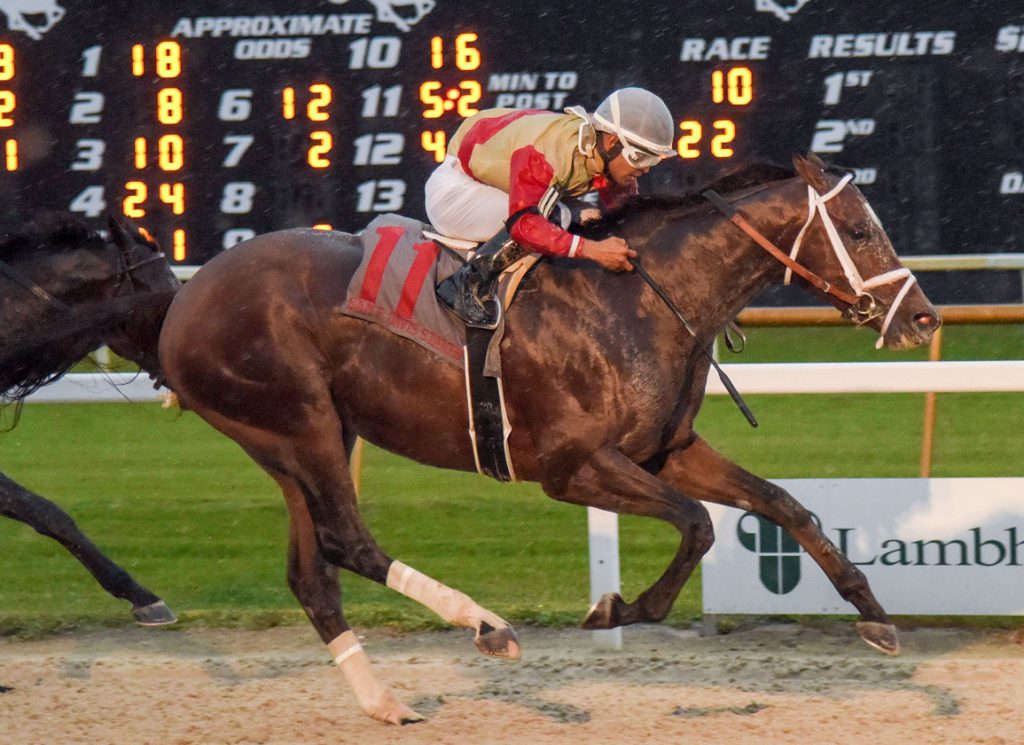
Litigate wins the Sam Davis | SV Photography

Fortunately, Mayer's unyielding modesty will not prevent a due testimonial to his work–and that of his sons Griffin and Walker–from Happy Broadbent, vice-president of Brisnet. He has had a ringside seat to the rise of Litigate, both as Mayer's brother-in-law and as a partner in Salsa Diavola.

“John Mayer is the hardest-working guy I know,” Broadbent says. “Now that the foaling season has started, he won't come off that farm until June, literally until the last mare has foaled. If that means mucking out a 12-stall barn by himself, he'll be doing it to this day. I'm fortunate enough, one, to be his brother-in-law; but also to see first-hand the way he raises these horses. He always does what's best for the horse.”

After a lifetime in the business, Broadbent sets three horsemen apart. All happen to share the same first name; and two of them, to Broadbent's immense gratification, are partners in Salsa Diavola (among several other mares) at Nursery Place.

“The three people top of my list, as far as hardboot horsemen, are my brother-in-law John Mayer, my other partner John Donaldson, and John Williams,” Broadbent explains. “I was fortunate enough to work for him [at Spendthrift] back in 1980, when the first crop of Seattle Slew was going through as yearlings. And with the other two, believe it or not, I have now been partners for 30 years: we bought our first mare in 1993, and we've bought and sold and traded horses together ever since.

“John Donaldson moved here [to Kentucky] from Arizona in '79. He told me recently that the best thing that ever happened to him in this business was walking through the door of my dad's office and getting hired to do bloodstock research. That's how he got started on his career, and how I got started with him too–because I always recognized his great eye for a horse, his knowledge of conformation and pedigree. He does a lot of consulting for Stonestreet, he's heavily involved in the matings of all those mares. So along with all the information that comes through Brisnet, the three of us have all been able to add something different.”

Between them they certainly spotted a bargain in Salsa Diavola, a half-sister to dual graded stakes-winning sprinter Pacific Ocean (Ghostzapper) and the stakes-placed dam of Blamed, a dual Grade III winner by Litigate's sire. Their dam is an Unbridled half-sister to Mutakddim (Seeking The Gold), a prolific stallion in Argentina, out of a Seattle Slew half-sister to the Mr. Prospector siblings Rhythm, a champion juvenile, and Not For Love, the lesser racehorse but superior sire of the pair. The next dam is Grade I winner Dance Number (Northern Dancer), a half-sister to Private Account (Damascus) out of the elite runner/producer Numbered Account.

“At the time we bought Salsa Diavola out of Canada, we felt that Mineshaft was going to be a good broodmare sire,” Broadbent recalls. “And with the deep, blue-hen family she had, we thought we'd take a shot with her. When we claim a filly, or buy one privately, typically we'd look to sell them on. But at the time we'd started to keep a few mares ourselves and this one, with her background and looks, was one we decided to be patient with.”

Admittedly they tested the water with her, offering her with a maiden cover by Ghostzapper at the Keeneland November Sale of 2017, but fortunately she failed to meet her reserve at $130,000.

“And this colt, Litigate, when he went through the ring was just an outstanding individual,” Broadbent recalls. “We've been watching him since; weren't quite sure at first, but then all of a sudden he started firing bullet works. We knew he was in great hands, with Centennial and Todd Pletcher, so we were hoping that something like this was going to happen. Because it's the kind of pedigree we liked to see in the olden days, blue blood all the way. And it just screams distance. He should run all day long.”

Which is just what excited many of us about Litigate: the fact that he was able to win a sprint maiden on debut at Aqueduct in November, despite a pedigree tailor made for the first Saturday in May (not to mention Belmont in early June). He did, admittedly, get outgunned by a flashy talent next time out, but Pletcher relied on him from eight nominations to extend his race record when introduced to a second turn at Tampa Bay. Sure enough, Litigate was able to break clear of a wide draw before dropping inside, then sweeping round rivals while still green in delaying a switch of leads. He will need to keep learning new tricks against more potent competition, but he certainly has the pedigree to keep building.

Salsa Diavola's first four dams are by Unbridled, Seattle Slew, Northern Dancer and Buckpasser; and Seattle Slew recurs along her top line, of course, behind Mineshaft's sire A.P. Indy. But it's the sheer, undiluted quality of the families entwined by the mating with Blame that already makes you hope that Litigate can progress sufficiently to earn a chance at stud. Salsa Diavola's own maternal line we have already sketched out (and it's intriguing that the genes have worked even better in the stallion shed than on the track, in the case of Mutakddim and Not For Love). Her sire's granddam is Up The Flagpole (Hoist The Flag). Blame, as mentioned, goes back through Special to Thong (Nantallah) and the associated dynasty; and his sire Arch is a grandson of Courtly Dee's daughter Althea (Alydar). Find me the weak link in that chain.

Broadbent says that no decision has yet been made on Salsa Diavola's next date, but the team are certainly pleased that they sent her back to Blame after his first cover proved so productive.

“John [Mayer] told me Saturday night that the mare's starting to bag up now and probably about 10 days away from foaling a full-brother or sister to Litigate, so fingers crossed,” he says. “John has always loved Blame, since day one, and we've had some luck with his babies before. He was a hard-knocking racehorse, and an underrated stallion in my opinion.”

No dissent to that view here, the Claiborne stallion having featured as high as the top step of our “Value Podium” among established sires. Even before the rise of Litigate he had already made a game-changing step forward with this sophomore crop, in the role of a highly precocious broodmare sire. Both Forte (Violence) and Loggins (Ghostzapper), who ran the champion so close in the fall, are respectively first foals of daughters of Blame.

So this esteem from breeders who can think for themselves is unsurprising. Only the previous weekend, we had seen how Nursery Place can prosper against the tide. Hot Spell (Salt Lake) was already 11 when added to the broodmare band for $85,000 at Keeneland January in 2015. She'd shown stakes talent in a brief career, but little as a producer and was being culled with a cheap cover. Nursery Place sent her to the upwardly mobile Quality Road, then still standing at $35,000, and the resulting colt made $900,000 as a Keeneland September yearling to a partnership of Bob Baffert's patrons. They called him Hopkins and, while he has made them wait, he's putting it all together now and ran out a decisive winner of the GIII Palos Verdes S.

“So that's two weekends in a row the program has produced a graded stakes winner,” Broadbent says. “Hopkins was an absolute beast when we sold him. We never imagined he might bring what he did, but they've handled him the right way. I give credit to Bob, and to Tom Ryan, for being so patient. He's shown along the way in the mornings that he was going be a nice horse and they have given him the time he needed to do that.”

Actually Broadbent himself is on a particular roll. Because if you go back another weekend, there he was in Palm Beach among the First Row partners collecting an Eclipse Award for their mare Goodnight Olive (Ghostzapper).

“Her winning at the Breeders' Cup was a huge pinnacle for me,” he explains. “I always tell people my blood's not red, but Keeneland green: my mother's grandfather was Hal Price Headley, [co-]founder of Keeneland; and my grandfather Louis Lee Haggin II was president there for many years. So to win a Breeders' Cup race in front of a home crowd, with mom and whole family all there, was very special.”

Broadbent's 87-year-old father-in-law Bill Robbins (along with brothers-in-law Will and Earl Robbins) has also shared the ride with First Row Partners–who had similarly hit the jackpot as co-owners of dual graded stakes winner Nay Lady Nay (Ire) (No Nay Never). She was sold to Juddmonte for $1.7 million at Fasig-Tipton in November 2021, having cost $210,000 as an OBS March juvenile.

“She was the only No Nay Never from his first crop to be sold over here as a 2-year-old,” Broadbent remembers. “I was saying we must be crazy, buying a horse by some no-name sire out of a no-name mare! Next thing you know, he's the hottest young sire in Europe and her full-brother Arizona was winning at Royal Ascot.”

But Broadbent, whose late father Dick founded Bloodstock Research Information Services, knows that such dividends are typically won only by playing the long game.

“My dad revolutionized the horse industry with computerized pedigrees,” he reflects. “It's amazing to think back to what he was doing back in the '70s and '80s, and everything the internet evolved into since. I was fortunate to work for him 23 years, and I'm still with Brisnet after 37 years, doing what I love every day, working in same building, with so many great people.

“When I was young, Dad had me going round every summer learning every aspect of this business, from yearlings to broodmares to stallions to foaling. It's been my passion all the way through, the one thing I really know is to surround myself with good people–which is just what this horse has been all about.

“We've got probably the best group of yearlings we've had in a long time. Salsa Diavola has a Twirling Candy filly that's one of the best on the farm, we think she's going to be a star come September at Keeneland. So let's hope Litigate stays healthy and carries on from here.”

On Monday morning Broadbent telephoned Don Little Jr. of Centennial to offer gratitude and congratulations. He also mentioned how Little's sister Andy, lost to cancer a few years ago, had been at school in Virginia with Broadbent's wife Pattie.

“I told him of that connection, and all the fun the girls had together through college,” Broadbent says. “And Don said, 'Well, we've got an angel looking over the gate, going forward.'

“There's no bigger thrill than to have a horse on the Derby trail. We were fortunate enough, back in 2006, to have a horse we bred, Steppenwolfer (Aptitude), run third. That was just an unbelievable ride he gave us, one of the thrills of my life. The difference in the number of texts and messages you get, between Hopkins and Litigate, is night and day. It just shows you how the Derby captures the imagination. And I know the people around him couldn't be more excited about this horse as he stretches out.”

The post The Happy Blend Behind Litigate appeared first on TDN | Thoroughbred Daily News | Horse Racing News, Results and Video | Thoroughbred Breeding and Auctions.

Source of original post

Grading the TDN Rising Stars: Class of 2019

While no singular superstar emerged from this class numbering just 60, the top-to-bottom quality separates this class from its counterparts.

MGISW Guarana (Ghostzapper) was the only 'TDN Rising Star' to win multiple Grade I events in 2019. She posted three consecutive victories that year, going straight from her maiden-breaking score at Keeneland to the GI Acorn S., where she defeated GI Kentucky Oaks winner Serengeti Empress (Alternation) and future Eclipse champion Ce Ce (Elusive Quality), and then to Saratoga's GI Coaching Club American Oaks. Second only to GISW Street Band (Istan) in her final start of the year, the GI Cotillion S., Guarana returned in 2020 to score once more at the highest level, retiring a winner back where she started in Keeneland's GI Madison S.

With a final record of 6-5-1-0 and earnings of $1,078,268, Guarana wasn't done making headlines just yet, going on to bring a final bid of $4.4 million from Hill 'n' Dale's John Sikura at the Fasig-Tipton Night of the Stars Sale in November 2021. She produced a colt by leading general sire Into Mischief in 2022 and was bred to a fellow Hill 'n' Dale great in Charlatan for 2023.

A further eight 'Rising Stars' from 2019 would find success at the Grade I level including elevated GI Kentucky Derby winner and current Darby Dan stallion Country House (Lookin At Lucky), GI American Pharoah S. winner Eight Rings (Empire Maker), WinStar stallion Global Campaign (Curlin), himself the half-brother to 2022 leading first-crop sire Bolt d'Oro (Medaglia d'Oro), and Valid Point (Scat Daddy). A quartet of fillies, many of whom brought big sales numbers upon their retirement, joined this group: Hard Not To Love (Hard Spun), who sold to Gainesway and Whisper Hill Farm for $3.2 million while pregnant to Curlin, Sharing (Speightstown), Wicked Whisper (Liam's Map), who brought $2,9 million from Whisper Hill Farm also in foal to Curlin, and Wesley Ward's millionaire Kimari (Munnings) who sold at the same Fasig-Tipton Night of the Stars Sale for $2.7 million to Coolmore's M.V. Magnier.

Another eight horses achieved graded-stakes success highlighted by GI Breeders' Cup Juvenile Fillies runner up Donna Veloce (Uncle Mo), who sold in foal to Tiz the Law for $1.9 million at the 2022 Fasig-Tipton Night of the Stars Sale, and Frank's Rockette who finished 2022 strong with a win in the GIII Sugar Swirl S. at Gulfstream Dec. 31. GII Risen Star S. winner Mr. Monomoy (Palace Malice), a half-brother to dual Eclipse champion Monomoy Girl (Tapizar), and GIII Iroquois S. victor Dennis' Moment (Tiznow) both found their best form as 2-year-olds in 2019 while Magic Star (Scat Daddy) entered the graded-stakes ranks with a win in the 2020 GIII Marshua's River S.

Amongst those who competed at the stakes level, Canadian champion 3-year-old Desert Ride (ON) (Candy Ride {Arg}) took wins in two of the three legs of the Canadian Triple Tiara, the Woodbine Oaks and the Wonder Where S. Others include the ill-fated dual-stakes winning filly Taraz (Into Mischief), GI Santa Anita Oaks runner up Flor de La Mar (Tiznow) and MGISP Shoplifted (Into Mischief).

Other names to note include a pair of foals by Constitution in MGISP Gouverneur Morris, a factor in the 2019 Road to the Kentucky Derby, and MGISP Golden Principal, who did her best racing as a 3 and 4-year-old.

In total, 9/60 (15%) 'TDN Rising Stars' of 2019 would achieve success at the Grade I level. 8/60 (14%) won graded-stakes races, 18/60 (30%) were stakes winners, 10/60 (16%) placed at the graded-stakes level, 3/60 (5%) placed at the stakes level, and only 12/60 (20%) did not reach black-type status.

The post Grading the TDN Rising Stars: Class of 2019 appeared first on TDN | Thoroughbred Daily News | Horse Racing News, Results and Video | Thoroughbred Breeding and Auctions.

Source of original post

Verified by MonsterInsights